
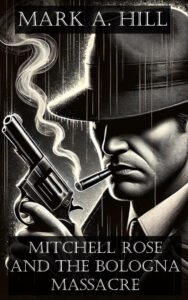
Thriller author Mark A. Hill chats with me about his new organized crime novel, Mitchell Rose and the Bologna Massacre.
During his virtual book tour, Mark will be giving away a $15 Amazon or Barnes and Noble (winner’s choice) gift card to a lucky randomly drawn participant. To be entered for a chance to win, use the form below. To increase your chances of winning, feel free to visit his other tour stops and enter there, too!
Bio:
Mark is a novelist, poet, translator and English teacher. He has lived in Cagliari, Italy for 33 years.
His poetry has been published in The UK Poetry Library’s Top Writers of 2012 and the Live Canon 2013 Prize Anthology. In 2016, one of his poems was commissioned, published and performed at The Victoria and Albert Museum, London, for the anniversary of hakespeare’s death. In 2024, he was published by Pierian press, Dreichmag, Cerasus press and Southlight 36 edition. In 2025, he has been published in the Penumbra Journal of Literature, Rituals, Art at California State University Stanislaus, Book of Matches and And Other Poems.
He is the winner of the Azerate poetry prize and his debut poetry collection, “Death and the Insatiable” was published in September 2025. https://hiddenhandbooks.com/azerate-poetry-prize His first novel “Mitchell Rose and The Bologna Massacre” was published by Wallace Publishing in July 2025.
Welcome, Mark. Please tell us about your debut release.
This is a crime story that explores the last fifty years of cross-fertilisation between the Italian criminal underworld, its secret services, politics and the judicial system.
Milanese judge Remo Rhimare calls Mitchell Rose to Milan and asks him to look into the Bologna bombing of 1980. You might expect him to turn the job down, but he doesn’t.
Rhimare hands Rose the double mission of finding those behind the bombing and reining in his errant daughter. As the story unfolds the two missions become one, culminating in a dreadful dramatic climax
What inspired you to write this book?
In 2019, I was teaching a group of judges and ex-judges in Bologna. It was one of those state sponsored courses that certain Italian institutions organise for certain privileged social groups and during those lessons, we started to talk about the Bologna massacre of 1980. That year, there was a terrorist bombing of Bologna Centrale railway station, which killed 85 people and injured over 200. It was Italy’s most serious terrorist attack. Several members of the neo-fascist terrorist organization Nuclei Armati Rivoluzionari (NAR, Armed Revolutionary Nuclei) were subsequently sentenced for the bombing. It is unlikely to ever come to light who the real perpetrators were.
I did some reading around the subject and decided that the whole incident was so compelling and there were so many conspiracy theories that reverberated around it, that there was probably enough material for a novel.
So, with a little dose of reality and a whole lot of imagination, I set about writing. I created the classic private investigator character, the villain, Carlos the Jackal, the corrupt Italian politician couldn’t go amiss. Who’s not going to identify with that? A little bit of love interest and off I went.
I disciplined myself to recount a straightforward narrative in chronological order, with a basic structure, using simple ideas and style. It is an attempt to narrate events in a more disciplined way and to eradicate any complex descriptive passages in a more high-flown poetic style. When I edited and it sounded like I was showing off, I just eliminated the offending paragraph and rewrote it as I actually perceived it, like saw it happening step by step.
Excerpt from Mitchell Rose and the Bologna Massacre:
When I came around, I found myself bound and gagged. I was closed tight in the boot of a car and I was travelling at high speed. I tried to move my arms and get my hands free but it was no good, I had no room for manoeuvre. I was conscious for about one hour before we came to a stop. I had time to think, but I had reached no conclusions as to what was happening. I was bundled out of the car and onto the ground before an expanse of water. I could smell the deep tendrilled dampness rise up to my nostrils. I had no idea where I was or who the people before me were. There were three of them dressed in hunting gear; green and brown camouflage slacks and jackets, toting semi-automatic weapons. I reflected on my giving up firearms many years ago and how it had been a very honest, yet somewhat misguided course of action. Still, what would I have done with a pistol now I was bound and gagged and facing three men with automatic weapons? It was unlikely that a small handgun would have made the situation any better; it might well have made it worse. That’s the thing with weapons and situations, you never find out if the weapon is going to make things worse until the situation happens, until it catches you fist first in the face.
They dragged me down to the water’s edge and wedged me on my back at twenty degrees to the ground in the mud. My face was covered with a flannel and water was poured slowly over me. I began to gag and vomit rose through my oesophagus to my throat. I felt like I was going to die. Maybe, I was going to die. I tried not to betray my emotions; I tried to float away from the situation. Everything had to become a series of physiological perceptions; I couldn’t let my feelings enter the present. Any control of the situation that I had, had to be released to my captors, so I remained inert like the pressure gauge on a car. You could tell by my face what was happening, but there was no way I could express my will back upon them. I couldn’t invert the volition.
In my line of work, fear is the most important emotion to control. If you asked the average Joe if he wanted to do what I do, he might instinctively answer in the affirmative. He’d like the romance, the glamour, the girls. After a good dose of fear, though, he would change his mind. I tell myself that the fear is necessary. Without fear, everyone would want to do what I do. Without fear, I would catapult myself into a thousand dangerous or potentially lethal situations. You may think that you would like to live a fearless life, but you know deep down that this is pure fantasy.
Fear, like anger, is a basic emotion, one that all creatures possess; a dog is afraid, a spider is afraid, you are afraid. To be alive is to be loved, but it also means being vulnerable. Fear, like anger, is an engagement with outside forces, not just a self-contained emotion. It is about something that may finish us off. Of course, fears can be mistaken or exaggerated, but this was not the case this evening. Most of our fears are reasonable and necessary, they enable us to stay alive.
They took the cloth off my face and pushed me down to the water’s edge; they placed my head under the water. Because of my lifelong love of the swimming pool and my ample lung capacity, I was able to resist this treatment. My head was underwater for several seconds and I thought maybe I would survive, but then the procedure was carried out once more and I was less sure. I was then kicked repeatedly and left to lie on the muddy bank. I still had no way of making out who these people were or where I was. I was waiting for a warning, a revelation; waiting to be given some justification for the punishment that was being meted out. Any sort of communication would not go amiss, as I was looking for some sort of respite from the fierce physical punishment.
A car radio was turned on and Italian pop music seeped across the mud toward me. I made a note to try to remember the tune as if this might help me to recall the evening’s events at some later date. There was love in the song and a division, and an end, and then something about springtime and re-birthing.
Then they picked me up and we were off again. Their methods were repeated for a third time; first I was gagged, then placed under the water, then kicked. I reflected on the random nature of the third kicking and willed myself to believe that they were losing interest. I was lifted up and thrown back into the boot of the car. I lost consciousness and, the next thing I knew, I woke up in my hotel room.
What exciting project are you working on next?
I’m working on the follow-up to this novel. It’s called Mitchell Rose and the London bombings. It’s nearly finished, but now, I am busy promoting this book and my collected poems.
When did you first consider yourself a writer?
I guess there are several steps. The first time I was published in a poetry collection was an important moment. Then the first time I received the confirmation that this novel would be published. There was the first time I did a radio interview and the first time I was asked to read my own words in public. In that sense, it’s a kind of continual process. I’m more convinced every day.
Do you write full-time? If so, what’s your workday like? If not, what do you do other than write and how do you find time to write?
I normally write in the mornings and at weekends. I work as an English teacher, interpreter and translator in the afternoons and evenings. As someone once said, writers should all have real jobs. Otherwise, they just tend to get into trouble.

What would you say is your interesting writing quirk?
Perhaps the fact that I prefer drafting to reviewing. Finishing the first draft is always a worrying moment because you risk thinking that the hard work is done. Personally, I find it much more difficult to rewrite rather than to write. I have to be harsh on myself and willing to bin whole chunks if they’re not up to standard.
As a child, what did you want to be when you grew up?
Writer, soccer player, pop star (honest answer).
Anything additional you want to share with the readers?
When I finished the novel, I went back to Raymond Chandler as I was a little worried as to whether I had actually copied his style. I think there is definitely something of his in this novel, but perhaps I’m aping more the era than the writer. If you think back to all those 50s and 60s detective films that we were brought up with in the 70s and 80s, the private investigator is stylized, cryptic, pushing a door open with a gun in his hand, nudging forward. To some extent, it’s a childhood image that stayed with me and got reproduced here. As I said, I picked through the Chandler novels, afraid that I was going to discover that I had lifted whole sections, but luckily that wasn’t the case. I dug out a couple of phrases that I had used in real life and thought they were my own, but thankfully that was the sum total of my plagiarism.
In this novel, I am trying to produce something more troubled, slightly more existential than a classic crime novel. The way the main character is driven on by a will to find the truth, do what’s right, reach some sort of conclusion which I guess is how I believe I think we should all be spending our lives. Then, it’s clear that there is a certain comic element to Mitchell Rose. He would want to be the last great action hero, an iconic symbol of freedom, but he doesn’t quite make it. He’d likely misspell freedom or mispronounce it.
Links:
Website | Facebook | Instagram | LinkedIn | Twitter/X | Amazon UK | Amazon US | Amazon De | Amazon It
Good morning and thank you to Lisa for hosting me today. I’ll be available most of the day to field any questions or comments that come my way…Don’t be shy…
Why did you decide this image for the book?
Hi Nicolo, I described what I had in my head to my editor and I sent a series of photos of old 1950s/60s magazines and pamphlets. They did the rest. I must say that I really appreciate the work they did.
It reflects what Mitchell Rose would like to be, sophisticated, suave, dangerous. As the story plays out, he comes to terms with reality…
There was any fact in particular that caught your attention during your research on the case?
Gef, I’m not sure how I should answer that. There were many things that came to light that I can’t really speak about. Then, as I studied Moreno’s “la Strage di Bologna” I couldn’t believe how many different detailed strands of “depistaggio” there were. There are theories involving the secret services of several countries and political influences from left and right. I hope that you have read the book and I think on reading it you get a sense of all the diverse influences that are at play. The main character, Mitchell Rose tries to understand what is happening, who is resoonsible, but in the end… NO SPOILER
Thank you so much for hosting today.
May I add my thanks, Lisa. Thank you very much…
Who came first? The writer or the investigator?
Bea, I’m guessing that’s short for Beatrice. What a wonderful name! The writer and the investigator are clearly two different people. Mitchell Rose strives to make his way forward (like me). Mitchell Rose is brave and throws himself into a series of unpredictable situations (like me). Mitchell Rose has great success with the ladies (not really my id.).
At the moment, I’m trying to get into Mitchell’s head and see what is going on because lots of people keep me asking about him. For now, he is my priority and for the next few months, he must take centre stage…
Mitchell Rose is a liquor-loving bloke with an eye for the ladies. Besides yourself, obviously, was there anyone else you based the character on?
And, did you ever wonder if you were delving too deep into the Massacre, going places that certain factions may prefer to leave hidden in the past?
Tony,
The character was originally a mixture of James Bond, Mattieu De La Rue from “Age of Reason” and Alan Partridge. On publishing, people have told me that there is no Alan Partridge anywhere to be seen. I think what I meant originally was that the way he wants things to play out very rarely comes to fruition.; he has ideas above his station and an inflated idea of how he might intervene to bend reality to his will.
I know that other writers have got into trouble when writing about what happened in Bologna. There was a ghost written novel that was traced to a secret services agent, which managed to pass seven days on the shelves. It was subsequently returned and copies were burnt. I have only been arrested and questioned by Italian secret services on one occasion, and I’m afraid I can’t tell you what happened…That will have to wait until I am famous…
Hi Mark, did you have any expectations about the book’s sales when it was published? And what do you think made it so successful?
Antonio, I really didn’t know what to expect when it was published, but I was overwhelmed by the comments I received in the reviews on Amazon. Then I saw that it was selling relatively well in Italy and that it had pockets of popularity in Singapore, Denmark and Hong Kong. I can see that when I read from the book live, that the audience are very receptive and appreciative. In my opinion, that it success. I don’t expect to be retiring from my other six jobs any time soon.
To answer why it has been so well received is difficult. It follows a trusted formula, but the character is seeking some kind of knowledge that is beyond him, trying to answer complex problems with simple solutions. Maybe that’s something we can all relate to, an everyman who doesn’t quite get there…SPOILER ALERT
Which is your favourite question here on the blog?
Cesa, Is that like the Roman Emporor, who inspired a million books, a million songs and works of art? I appreciate all the questions that I have been asked, but perhaps this one the most as it gives me a chance to thank all those people who have contributed to today’s blog. Lisa who has hosted us has been particularly kind and I’d like to say a BIG thank you to her and all of you.