
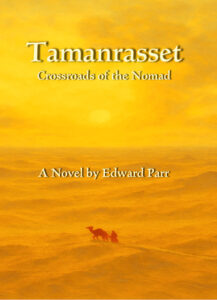
Historical novelist Edward Parr chats with me about his latest novel, Tamanrasset: Crossroads of the Nomad.
During his virtual tour, Edward will be awarding a $25 Amazon or Barnes and Noble (winner’s choice) gift card to a lucky randomly drawn participant. To be entered for your chance to win, use the form below. To increase your chances of winning, feel free to visit his other tour stops and enter there, too!
Bio:
Edward (“Ted”) Parr studied playwriting at New York University in the 1980’s, worked with artists Robert Wilson, Anne Bogart, and the Bread and Puppet Theater, and staged his own plays Off-Off-Broadway, including Trask, Mythographia, Jason and Medea, Rising and an original translation of Oedipus Rex before pursuing a lengthy career in the law and public service. He published his Kingdoms Fall trilogy of World War One espionage adventure novels which were collectively awarded Best First Novel and Best Historical Fiction Novel by Literary Classics in 2016. He has always had a strong interest in expanding narrative forms, and in his novel writing, he explores older genres of fiction (like the pulp fiction French Foreign Legion adventures or early espionage fiction) as inspiration to examine historical periods of transformation. His main writing inspirations are Charles Dickens, George Eliot, Bernard Cornwell, Georges Surdez, and Patrick O’Brien.
Welcome, Ted. Please tell us about your latest release.
My newest novel, Tamanrasset: Crossroads of the Nomad, is my attempt to tell a story that reflects the amazing place and time of many classic pulp fiction stories – the Sahara desert of Africa at the dawn of the 20th century – but with the benefit of what we know now about what would happen there, treating all the characters and their beliefs with respect, and based on the actual events that occurred there at that time. In the novel, the lives of four protagonists become entwined: A mature Foreign Legionnaire who has made his home in the harsh life of France’s desert fortresses; a young Arab son of the Sharif that leads the tribes in the western Sahara who are fighting to protect their families; an ambitious American archeologist in charge of the excavations at Carthage; and a young Swedish widow in Fez who adopts Islam in order to earn a place there. Each of them suffers a crisis which isolates them from their community, and it is only through the chance intersection of their lives that they become bound together and influence a world that stands on the brink of vanishing. It’s a novel about loss and alienation and the fragile, transitory bonds that tie people together.
Excerpt from Tamanrasset: Crossroads of the Nomad:
The Basilica of Douïmès was quite a lovely site (and fairly peaceful considering the dozen native workmen who were lazily taking measurements and digging pilot holes at Ren’s direction) yet it was not a place for great discoveries. Ren thought about the Byzantine necropolis behind the basilica which seemed such a promising site; unfortunately, Père Delattre had reserved it for his own excavations. Ren wondered how much it would cost to drain the flooded marsh in the Salammbô district nearby where the Temple of Tanit was rumored to be located. As he walked about and reviewed the work of the diggers, Ren became increasingly irritated. Ordinarily, he thought, the Tunisian diggers preferred to do anything but work–they showed a greater interest than the professors in the minutest fragment of pottery and would stand around listening in awe to an academic discussion of a thing they’d never heard of before. Their picks moved with a balletic slowness of motion intended to keep even the most delicate relic safe from harm. Ren had to remind himself again that he was lucky to have earned this position: He had no surviving family, his father had been no one of importance, he had been raised on money left for him in trust. He was lucky to have ended up in England after being orphaned, lucky to have worked with Petrie in Egypt, and lucky to be in Carthage. Nevertheless, he chafed at Delattre’s pedantry and the slow pace of the work.
© 2025 by Edward Parr and Edwardian Press (New Orleans, Louisiana)
Do you ever wish you were someone else? Who?
When I’m writing, I frequently imagine I am someone else. Since I write primarily from one character’s Point of View at a time, I need, in the same way that the theater guru Konstantin Stanislavski would have suggested were I performing each part in a play, to imagine what I would feel and say and do if I were that character in that situation. However, while I love to dream up incredible situations and imagine being inside them, that’s a far cry from wishing I was really someone else. On the other hand, I don’t think I’d enjoy writing as much as I do if I did not sometimes find refuge in the imagined lives of others. Maybe that is common to all authors – I don’t know.
What did you do on your last birthday?
Fortunately, I live in New Orleans which is a fabulous city for celebrating a birthday. Although I rarely visit Bourbon Street in the French Quarter anymore, there are a million great restaurants and a lot of wonderful music all across the city. On my last birthday I shared dinner with family and a few friends at a great old standby, Ralph’s on the Park, and enjoyed some cold drinks and hot jazz at the Bayou Bar.
What part of the writing process do you dread?
Typographical errors are like cockroaches, constantly creeping into my text, and every time I revise the words I seem to create more of them. Neither proofreaders nor software catch them all. I hate proofreading and you’ve got to do it, but at some point you just have to accept you’ve done what you can.

Do you ever suffer from writer’s block? If so, what do you do about it?
I think writer’s block is a common problem but with a lot of different causes. For me, when I approach a new project, I always have this impulse to make it be about everything, about all of life, and I have a hard time sometimes figuring out what I am specifically going to write about. This can make it impossible to even get started. In practice, I always remind myself to go back and figure out what interested me in the project in the first place – what drew me to that place or time or person or story and why it means something to me. Since I write historical fiction, I also like to consider the events that really occurred and made an impression upon me, because I know those need to be in the story somewhere.
Links:
Website | LinkedIn | Goodreads | Amazon Author | Reddit | Instagram | Facebook | Amazon | Barnes and Noble
Thank you so much for featuring TAMANRASSET and Edward Parr today.
It is a real pleasure to appear on your blog today. I would be happy to answer any questions or talk about my novels if anyone cares to post here, I’ll check back regularly. Thank you!!
This sounds like a great read.
Glad to be co-hosting with you!