
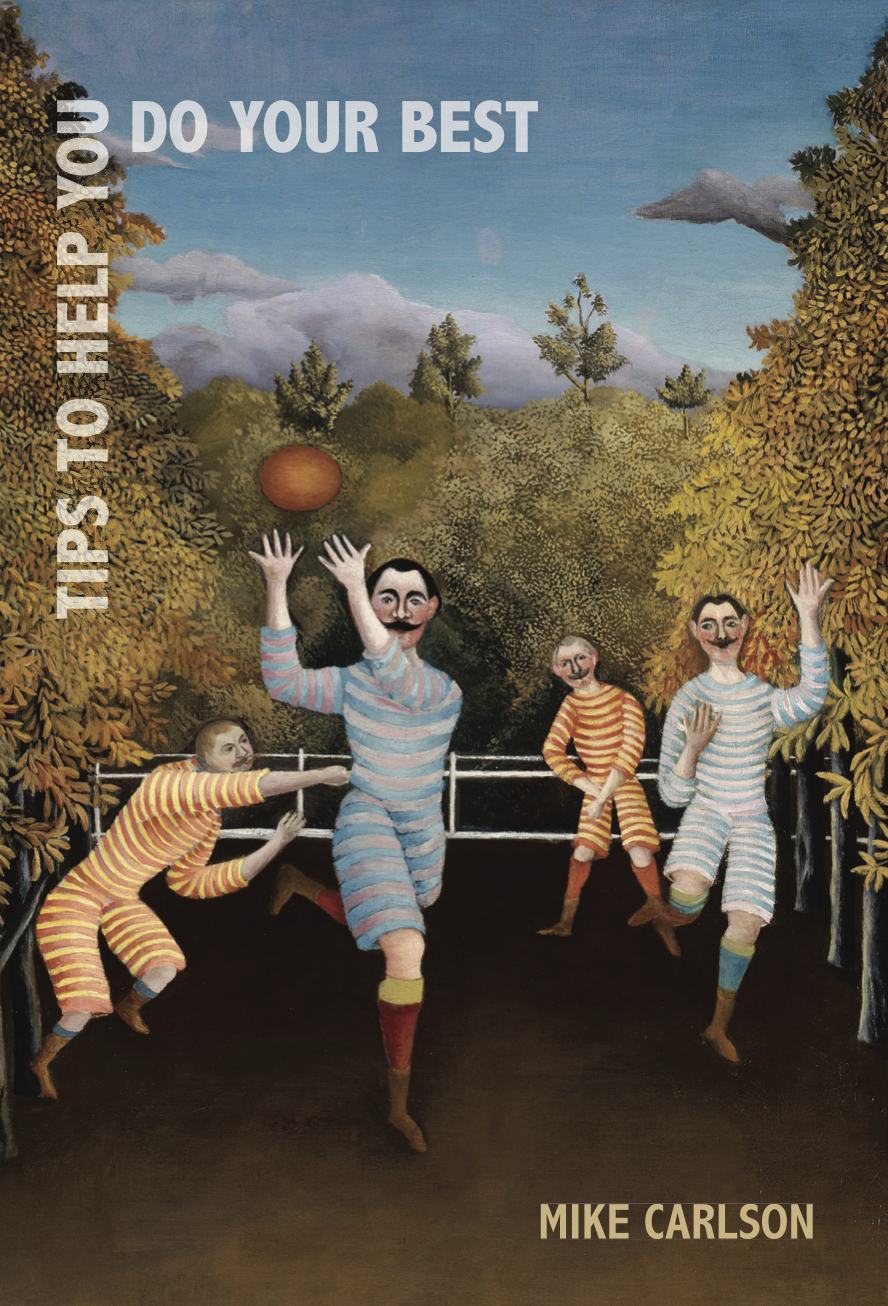
Poet Mike Carlson is chatting with me about his new collection of poems, Tips to Help You Do Your Best.
Bio:
Mike Carlson is the author of Tips to Help You Do Your Best, published by Tupelo Press. His first collection of poems, Cement Guitar, was awarded the Juniper Prize. His poems have appeared in Antioch Review, Gulf Coast, New Letters, Seneca Review, The Southern Review and elsewhere. He is a teacher at P.S. 107 in Brooklyn.
What do you enjoy most about writing poems?
I love being at that place in a poem where I have said something I feel is meaningful and the way forward is still a mystery. I love having a feeling of responsibility toward that possibility.
Can you give us a little insight into a few of your poems – perhaps a couple of your favorites?
One morning last spring I opened my computer to find that my daughter had left open a design website with an AI image search function. She had been asking the computer to create a series of outrageous cakes. I had never done anything with AI, but I started to wonder what would happen if I typed in one of my poems. I hesitated over doing this for long time. I felt like it might have grave consequences for my imagination and for my life as a writer, but eventually I did it. I copied and pasted the first poem in my new book, the title poem, “Tips to Help You Do Your Best.” When I saw the result, I was relieved. It was basically just a landscape that matched some of the images from my poem, stones lining a rocky hillside, oak trees extending in all directions, a box of raisins on the ground, but I was happy with the overall mood and how the algorithm interpreted the setting. I was like, “This computer really gets me.” I was like, “I’m done with human readers. From now on, I only write for whatever digital sentience will arise and deliver us from the limitations of human reason.” (Sorry! I couldn’t stop.) In any case, this experience did actually reaffirm that the work I do crafting concrete images has consequences. If AI can generate a clunky picture of a landscape from my poem, then I can be confident that I can transfer a way more subtle and nuanced image to an actual reader. I think this is one of the cool things about the way poems work and why I sometimes think of myself as “landscape poet.” I’m fascinated by poems that ground themselves in a physical situation and use those surroundings to generate meaning. I will never get over Marianne Moore’s “The Steeplejack” and Elizabeth Bishop’s “The Bight.”
What form are you inspired to write in the most? Why?
I am always looking for new forms and structures, new constraints that will allow me to say something I wouldn’t have said if I hadn’t adopted them. A lot of the poems in my first book used a traditional form or syllabic line as a way of achieving that end, but in writing this book I expanded my idea of form. For example, my poem “Zen Apology, Beginner’s Apology” takes the form of an ideal apology as described in a short article in the New York Times, which asserted that an apology should have four particular ingredients. My poem “Connoisseurship for Aficionados” takes its tone, and some common syntax, from a bunch of Artist Statements written by different painters. I love when I encounter something outside the realm of poetry that suggests possibilities for the structure or the framework of a poem.
What type of project are you working on next?
Right now I am working on a third book of poems. I am a bit superstitious about describing what I am doing specifically, but I will say my poems are getting longer.
When did you first consider yourself a writer / poet?
In 9th grade, perhaps hypnotized by the opening theme music of the television show “Thirtysomething,” I watched an episode that included a dream sequence involving Emily Dickinson reciting “I’m nobody! Who are you?” I couldn’t get that poem out of my head. Around the same time, I had a student teacher in my English class. She gave us each a postcard with a painting on it and told us to write a poem about it. I got a Monet painting of a man and a woman among what I think were birch trees. In my poem, I imagined an unspoken relationship between the two. When I got it back, the student teacher had written on it, “You have talent.” That really landed with me.
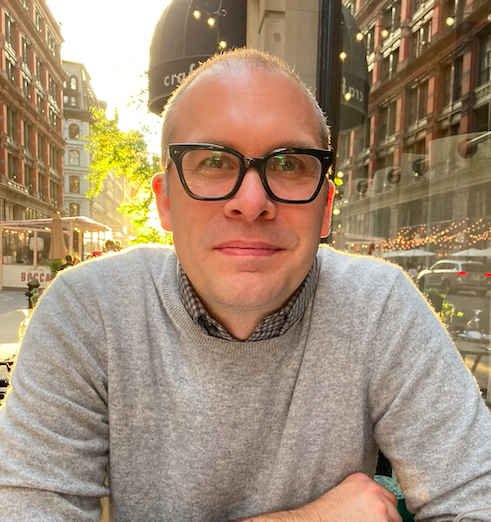
How do you research markets for your work, perhaps as some advice for not-yet-published poets?
I keep a big list of journals that I’ve read and liked or that I’ve seen listed in the acknowledgements of books of poets I admire. And when it comes to submitting I try not to think too much about it and to just send to as many places as possible. I try to make the process as machine-like as I can.
What would you say is your interesting writing quirk?
I have a bag of words and sometimes when I get stuck in a poem I pull out a word from my bag of words and use that word in my next sentence. It doesn’t always work, but it reminds me that poetry is not essay writing and often depends on some element of conjuring or chance. My “bag of words” is actually an envelope, but on it I have written “Word Bag” in bubble letters with a marker. There is an asterisk after “Bag” and in the bottom right corner of the envelope, I have printed in black pen: *Not a bag.
As a child, what did you want to be when you grew up?
As a kid I was constantly going through phases, but I think I always wanted to be a comedian. Maybe this is why I’m a teacher. I like having an audience and I like doing things that make my students laugh.
Anything additional you want to share with the readers?
Lately, I’ve been fascinated with Terrance Hayes’ poem, “A House Is Not A Home” from his book Lighthead. I don’t have anything to say about it except maybe that it is one of the ten best poems of this century. I think it is inexhaustible, which is a quality I look for in poems and in all good writing. If you haven’t read it, check it out.
I really appreciated the chance to talk about my book and reflect on my writing process. Thanks Lisa!