
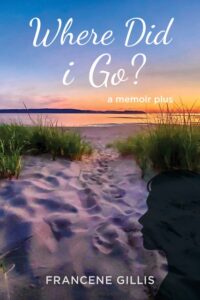
Writer Francene Gillis joins me today to chat about her memoir, Where Did i Go?
Bio:
Francene is a dedicated, passionate writer living in Cape Breton, Nova Scotia. Along with being an author, she writes for the Inverness Oran, where she has done a weekly column for 33 plus years. She was a teacher (Dalbrae Academy) and educator for 35 years. Living in the serene, rural village of Port Hood, triumph, tragedy, and advocacy shape her fiction and nonfiction writing. She majored in English at St. Francis Xavier University in Nova Scotia, obtained her BA, B.Ed., and M.Ed.
An activist against injustice, unfairness, and hatred of any kind, and for silent voices to be heard she writes educational, informative, human interest pieces. A council member of the Writers’ Federation of Nova Scotia, she pulls from life experience as well as lessons learned from her late mentor, and esteemed author, Alistair Macleod, in her fiction, non-fiction, and decades of writing her weekly column.
Proactive in education and literacy work, highlights include: running her own business, 1994-1997; authoring/self-publishing A Rose In November (1994); working as maritime consultant for the Canadian Congress Learning Opportunities for Women (CCLOW); consultant on several Nova Scotia Department of Education committees and advisory boards; editing and reviewing for Pearson Canada; and writing and reviewing for Canada’s National History Magazine. She has won an Atlantic newspaper, journalism investigative award; and an excellence in teaching award (2015) from Canada’s History. She won 3rd place in The Grain short story contest 2018; a creative nonfiction finalist nod from The Quarterly 2020; and was a finalist for Nova Writes 2018 and 2020, for her short stories.
Francene and husband, Sandy, have two cherished grown daughters, three precious grandsons, and an adorable granddaughter. She is beyond thrilled and thankful to be able to write and to be publishing Where Did i Go? a Memoir Plus through OC Publishing, releasing on June 22, 2025.
Please tell us about your current release.
Where Did i Go? was born through writing therapy suggested by my occupational therapist, Jeniffer Hilling, a year after a serious slip and fall injury. My writing was a strength, and she felt it would help me to get my feelings and frustrations out. It was also a place to keep track of websites I researched in an effort to find answers because I wanted to get back to my classroom and needed to be well enough to teach. The more I learned, the less I knew, and I realized we do not know, what we do not know. Concussions and head injuries often caused more symptoms that 15 – 25% of people have difficulty overcoming. I turned out to be in that group and was diagnosed with PCS (post-concussion syndrome) and whiplash, which branched into vestibular issues, visual issues, and cognitive problems, as well as an inability to deal with multiple senses known as flooding. When I realized the value of my information and experience, a lightbulb went on and I thought if I can help people new to head injuries and/or their families, then my plight would at least have some purpose. It is a combination of narrative, expert and evidence-based research, humour, and over one hundred visuals designed in eye therapy, which provide information in an easier format, most welcome when reading dense text is difficult when first injured. To add balance to my main story I felt I needed to include a few other stories and so there are seven stories done through interviews to complement mine. The purpose of the book is to show that even through life’s unexpected storms we can triumph with support, care, awareness, and education. I hope it proves inspirational to those in emotional, mental, or physical pain, struggling or suffering from a loss of self, their identity, or another’s.
What inspired you to write this book?
My frustration of not knowing where to go to get help when I was injured from a fall on black ice on February 1, 2016, while walking into the school where I was teaching. Four months after my fall I sent out a distress call to my sisters because I desperately wanted to get back to teaching, and yet I could not manage my symptoms or daily functions when alone in a quiet house. I was a mess. I had lost my teaching passion, felt useless, and of no help to anybody. I struggled with old ghosts including an extremely low self-esteem, feelings of unworthiness, and tremendous frustration because I could not do what I could before my fall. Comparing became a bitter enemy as did time for I had no control over my brain and when I could go back to teaching in a classroom. My symptoms led to disability and that was a mountainous volcano to accept which took years.
Excerpt from Where Did i Go?:
Let me tell you a secret. The refreshing breeze from my open, bedroom window sings to my spirit, whispering secrets and possibilities offered with getting up for the day. Thank God for nature, but my sanctuary pulls me back, a dichotomy to overcome. Will I get up or not? Isolation is a cold, dark place to be. Why am I here? Why is it so difficult to drag my widening ass out from under the cozy, comfortable covers? Why? Why? Why? Damn that three-letter inquisition; it haunts my existence ever since …
It is too quiet, silence screaming accusations. The boat I am on refuses to stop dipping, dropping, drowning me in rough waves, an ocean swell stirred up from a simple knock on the head—falling on, no, slipping on insidious, black ice, my world and identity flying into the abyss as my head bounced, pounded. What next? I remember a female hollering, “Are you okay?” Am I? Fluffy white, lost cumulus clouds, float; the snow-crusted, concrete ground is cold. I shiver. What should be my paradise is skewed by loneliness, lack of understanding, stuttering, wonky eyes, dizziness, headaches. I am going to vomit. How do I get through the haze? The breeze feels sultry after the cold. It lifts my spirits. No one understands, emotions like a yoyo. “You’re not the same.” Damn! What is that supposed to mean? The condescending tone suggests it is undesirable. Wrapped, strangled in an invisible blanket, it squeezes the breath out of me. If only I had the strength to get up. A fall. Where did i go? Lost in a foreign world of concussion and PTSD, I slip back to my childhood, which shaped me into an empath, gave me the courage and thirst to reach out but not without tremendous suffering. My philosophy, shaped during my teenage years—life’s experiences hold lessons. However, I am angry at myself for falling, not in the mood for lectures or learning. I do not realize how much my trauma affects me until my fall brings it all back.
It is a painful journey to travel within, but the most awakening trip we will ever take. Otherwise, we become distant, depressed, bitter, or angry, damaging our ability to trust, be vulnerable, true to ourselves and our aspirations. When the universe disrupted my path, it forced me to stand in stormy seas, and scurry into black holes. Bitter north winds threatened my very survival, childhood trauma resurfacing, my mind travelling back.
What exciting project are you working on next?
I am presently working on a creative, nonfiction historical book chronicling the story of four brothers called into the Second World War, and their lives as boys, soldiers, and men before, during, and after the war, as well as that of their family back home and their mother who lived to see three centuries, born in 1898. It focuses on family and how difficult it was for their mother, all mothers, and is called, Momma Cried. It is told through the sons in first person narratives and winds through their upbringing in rural Cape Breton, NS, signing up, and fighting in Italy, France, Belgium, and Holland at different times and unknown to each other. Born in the States, Joe the oldest signed up with the American army. Danny was assigned to the Cape Breton Highlanders, Richard to the West Nova Scotia Regiment, and the youngest, Pat to the Cape Breton Highlanders a few years after Danny, and not in the same unit, but on the Frontlines during the worst of the fighting. The parents also narrate stories of home and of the harsh fighting in the Atlantic. Unlike most war books, after each son narrates their war experiences, we get to see what happens to them as men, if they all return, and experience the battles fought on and off the battlefield as they age. It is more than a war book, its stories are universal, timely, heartfelt, and raw, and its themes go beyond the Second World War and into daily living, local history, and prominent world events. To help, over one hundred old black and white photographs are included.
When did you first consider yourself a writer?
As a teenager I played with writing poetry and short stories. After my baby brother drowned, I wrote him a poem, and in grade 12 I entered a short story contest and won. I also wrote tributes to individuals in my community. Even then I was all about building others up. In the early 1990’s I approached an editor about writing a weekly column for his newspaper, but he said no. With nothing to lose, I sent a column, then another and another that they were welcome to publish if they wanted. Then the call came offering me page 2 to write about anything I wanted, and I started my human interest column.
Do you write full-time? If so, what’s your workday like? If not, what do you do other than write and how do you find time to write?
I am lucky in that I am now retired. I write when I physically, mentally and emotionally feel up to it, so my days are sporadic. Mornings are best. Sometimes I write in the quiet for long periods of time, with built-in breaks as I have to pace myself or I pay for doing too much. On other days I am toast. It’s hard to say. My husband is very supportive of my writing and helps a lot around the house, which he started doing out of necessity after my fall. I strive for four to six hours in increments, sometimes can only do less, and at others I can do more sometimes into the evening when the desire hits. I think as writers we are always writing in our head and when the ideas come, we have to get them down on paper. When not writing, I am editing, revising, or researching or sitting out in my sanctuary, the corner of my back deck overlooking the Atlantic Ocean. I still go for therapies, but not nearly as often, and I enjoy nature, walks, and spending time visiting and trying to create a new network of friends.
What would you say is your interesting writing quirk?
Hmmm … writing quirk—When I get an idea, I get lost in my writing and don’t want to come back to reality. I will write for hours and days as the characters jump off the page and make themselves known to me. A lot of the time I have no idea how a section will end or who will show up, so I go by the seat of my pants. I find if I plan or plot too much, I stifle my creativity and cannot hear the voices of those who want in. Sometimes I just want to be silly while at others I work to bring a message home. Since my injury I have trouble remembering spellings of names, or what I said or didn’t say so I often have to reread sections, and sometimes when I do, I literally ask myself, did I write that? in a Steve Urkel voice, and then surprise myself! That has to be a writing quirk!
As a child, what did you want to be when you grew up?
Everything! A doctor, lawyer, teacher, writer, first in my family to go to university, a professional who others look up to.
Anything additional you want to share with the readers?
I want to express my gratitude to those who take a risk on me, and I sincerely hope they feel that reading any or all my books is worthwhile. I tried to address various angles in all my publications, and to place myself in the reader’s shoes, and answer any questions or concerns. I wanted the reader to feel something, a line or section that speaks or resonates with them, or someone they love in an impactful manner that stays with them and helps in some way. If I accomplish that, the pain and trauma that went with my injury will somehow be lessened, and the excruciating loss of my job a bit more palatable.
Thanks for helping us spread the word about Francene’s memoir launching this weekend! It’s very timely as June is Brain Injury Awareness month. We so appreciate your support in joining the tour!