
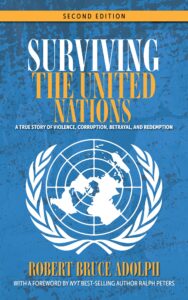
Writer Robert Bruce Adolph chats with me today about his international relations non-fiction book, Surviving the United Nations: A true story of violence, corruption, betrayal, and redemption.
During his virtual book tour, Robert will be awarding a $25 Amazon or Barnes and Noble (winner’s choice) gift card to a lucky randomly drawn participant. To be entered for a chance to win, use the form below. To increase your chances of winning, feel free to visit his other tour stops and enter there, too!
Bio:
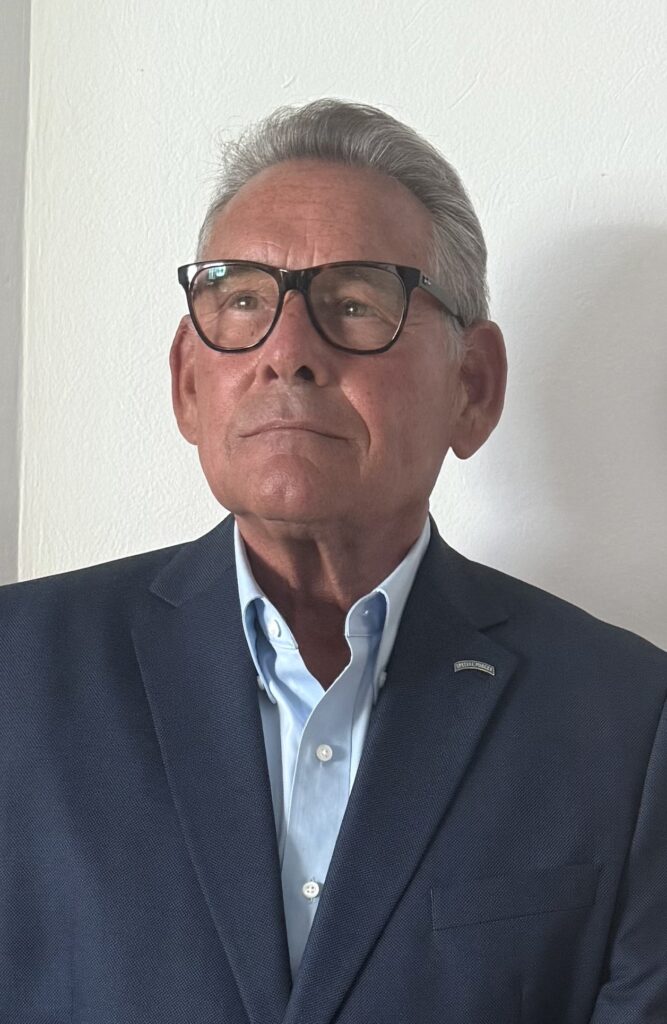
Robert Bruce Adolph is a retired UN Chief Security Advisor & US Army Special Forces Lieutenant Colonel. He holds master’s degrees in both International Affairs (Middle East Studies) from American University’s School of International Service and National Security Studies and Strategy from the US Army’s Command and General Staff College.
Adolph served nearly 26-years in multiple Special Forces, Counterterrorism, Psychological Operations, Civil Affairs, Foreign Area Officer, and Military Intelligence command and staff assignments in the US and overseas. He also volunteered to serve on UN peacekeeping missions in Egypt, Israel, Cambodia, Iraq and Kuwait.
After he retired from active military service in 1997, he began a second career as a senior UN Security Advisor. Among his positions he served as the Chief of the Middle East and North Africa in the UN Department of Safety and Security.
Welcome, Robert. Please tell us about your current release.
It’s just the true story of a US Army Special Forces soldier who became a warrior for peace. In my humanitarian and peacekeeping missions for the United Nations I dealt with child-soldiers, blood diamonds, a double hostage-taking, an invasion by brutal guerrillas, an emergency aerial evacuation, a desperate hostage recovery mission, tribal gun fights, refugee camp violence, suicide bombings, and institutional corruption. My UN career brought me face to face with the best and worst of humanity and I share it all here. This is a second edition, updated with photos.
What inspired you to write this book?
I needed to set the record straight.
Excerpt from Surviving the United Nations:
I was an American soldier for well over two decades.
Following my retirement from active military service, I was at a loss for something worthwhile to do. In retirement, I missed the meaning and purpose the military had given my life. The same is no doubt true for many old soldiers. For nearly two years I tried writing, teaching, and military contracting. None of these gave me the same feeling I had experienced in uniform. Something was missing. Although not conscious of it at that time, I ultimately sought out a second profession that provided me what I needed most.
This unlikely record of events concerns my initial period of service with the UN. It is unlikely because, looking back on my fledgling years with the organization, I find it difficult to believe it all happened, and yet it certainly did. There are simply too many credible and usually sober eyewitnesses to confirm the facts. This sometimes-tragic history involves multiple rape victims, child soldiers, blood diamonds, kidnappings, invasions, emergency evacuations, refugee camp violence, gun fights, jihadist suicide bombings, the abuse of power, institutional corruption, political expediency, and betrayal.
I never imagined that my choice of the UN might nearly result in my own death or the death of someone I loved. I was wrong.
It was 21 August 1999. I had been serving in Sarajevo for nearly a year as a defense policy advisor to the fledgling government of Bosnia-Herzegovina. My year-long contract was generated by the US State Department and performed by Military Professional Resources Incorporated, a private military contractor. Essentially, we were attempting to assist the three formerly warring factions build a national and—we hoped— unifying army in the wake of a terrible war. I drafted the Defense Planning Guidance and Army Plan. These are both keystone national military policy documents.
The previous work year had been long and tedious, producing unquestionably questionable results. The Roman Catholic Croats, Orthodox Christian Serbs of Republika Serbska (a Serbian enclave within Bosnia) and Bosnian Muslims had demonstrated little trust in one another or the future of the international community’s cobbled together nation of Bosnia Herzegovina. Their mistrust of one another was real and justified. Much blood had been spilled. Essentially, the country seemed to be headed nowhere.
The war in the former Yugoslavia was punctuated with war crimes. An especially heinous act was perpetrated by the Serbs when they massacred over 7,000 Muslim men and boys in 1995 at a place now infamous, Srebrenica. More than 20,000 residents of the town and environs were also “ethnically cleansed,” meaning they were either killed or forcibly driven from their homes.
What exciting project are you working on next?
A book written for fledgling writers.
When did you first consider yourself a writer?
After the publication of my first article.
Do you write full-time? If so, what’s your workday like? If not, what do you do other than write and how do you find time to write?
As I am retired, writing is very much now my passion. Every day is different.
What would you say is your interesting writing quirk?
Wine sometimes compliments the process.
As a child, what did you want to be when you grew up?
I wanted to be a hero.
Anything additional you want to share with the readers?
Writing will make you better.
Thank you for featuring today’s book.
Thank you for the opportunity to plug my book.
Do you have a favorite space to do your writing?
I write when I can and where I can. The place is far less important than the activity.
Sounds like an interesting story.
It looks like a good read.
The book sounds very interesting. Thanks!