
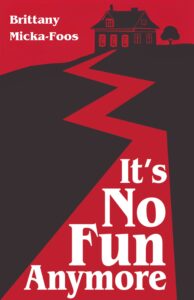
Short story writer Brittany Micka-Foos is chatting with me about her new collection of shorts, It’s No Fun Anymore.
Bio:
Brittany Micka-Foos is the author of the short story collection It’s No Fun Anymore (Apprentice House Press, 2025) and the prose poetry chapbook a litany of words as fragile as window glass (Bottlecap Press, 2024). Her short stories, poetry, plays, and essays have been published in Ninth Letter, Witness Magazine, Literary Mama, Epiphany, and elsewhere. A former victim’s rights lawyer, Brittany now lives in Bellingham, WA, with her family.
Welcome, Brittany. What do you enjoy most about writing short stories?
I’ve always wanted to write a novel, but, especially since the birth of my daughter, I’ve found it challenging to commit to such a large, time-consuming project. Short stories are magic for parents like me, who might otherwise become overwhelmed by the prospect of birthing an entire novel. Short stories are finite and manageable—they can be written (and finished!) in discrete chunks of time, around naptimes, playdates, and all the odds and ends of family life. Writing short stories has helped me stay motivated and better manage the logistical and mental load of both writing and parenting.
Can you give us a little insight into a few of your short stories – perhaps some of your favorites?
It’s No Fun Anymore is a short story collection of dark literary fiction told through a feminist lens. There’s a story about a multi-level marketing shampoo pyramid sales scheme, one about being a parent at an anime convention … there are tradwives and Insta-mothers and a little bit of pregnancy body horror thrown in for good measure. What these stories have in common is that they all explore the difficulties and dangers inherent in a capitalist society and how those systems affect women and mothers.
What genre are you inspired to write in the most? Why?
I like to call my genre “domestic horror” or maybe “suburban horror.” I’ve also heard it called “uncanny fiction,” which is interesting. It’s not so much a specific genre as it is a reflection of the uncomfortable, inhospitable spaces that women inhabit in everyday life. I think a lot about safety as a psychological concept. What does it mean to feel safe, and how do the institutions around us contribute to and even profit off our fear and vulnerabilities? We don’t like to admit that safety can be elusive, especially for women, people of color, individuals with mental illnesses or disabilities, and other marginalized groups. And it’s contextual, it’s nuanced, it’s not always this big terrible event, but sometimes it can be a collection of small, embedded things that just chip away at you. It can be woven into the framework of life. Which, to me, is even more sinister.
What exciting story are you working on next?
I don’t have any big projects currently in progress, which is unusual for me, and a little unnerving. But it’s also exciting in its possibilities. I’ve always wanted to write a novel…
When did you first consider yourself a writer?
After the birth of my daughter. Though I was always writing as a teenager and young adult, I really struggled to take myself seriously as a writer. Writing was a secret that I kept to myself. I never considered pursuing an MFA or joining a writing workshop—that would have required a level of confidence I did not possess. But after the birth of my daughter, I felt like I had been through something, and I wanted to understand that experience better. So in these little pockets of time, I started writing—mostly poetry and short stories—as a way to cope and to create meaning. In those early days especially, I thought a lot about what it is okay to talk about and what we don’t talk about as new mothers. I wanted to push back against the sanitized narrative of motherhood and childbirth that I had been sold and had internalized. Having that motivation helped me overcome some of my confidence issues and come into my identity as a writer. I was part of a conversation that was larger than just me.

How do you research markets for your work, perhaps as some advice for writers?
I’ve heard a lot of horror stories about the market (or lack thereof) for short story collections, and while it may be true that writers can have a harder time placing such collections, in my experience, the outlook is not as bleak as I was led to believe. I think much of it depends on your expectations. I don’t know too many writers who are getting rich off of short stories, but there are avenues to get these kinds of books out in the world and into the hands of readers. There are so many wonderful small presses that accept, or even focus on, writing that is outside the mainstream (novellas, hybrid work, collections, etc.). I would encourage authors to consider whether a small or university press might be a good fit for your book and do their research. Different presses have different vibes and personalities. Publishing is not a one-size-fits-all endeavor.
What would you say is your interesting writing quirk?
I’m a huge Taylor Swift fan, and her music sometimes obliquely makes its way into my short stories. This surprises people because my stories are so dark. For example, one of the stories in It’s No Fun Anymore, called “The New Jenny,” was inspired by her criminally underrated song “Happiness,” from the album Evermore. “Happiness” is about the end of a relationship, and she keeps saying, “You haven’t met the new me yet.” That was such an evocative line for me. In the song, it operates as a bittersweet, hopeful idea of personal growth, but I thought it would be interesting to turn it into a sort of warning or a threat. As in: Come see what I’m capable of. You haven’t met the new me yet. And a whole story was born from that.
As a child, what did you want to be when you grew up?
A ventriloquist. I was a weird kid.
Thanks for the interview, Lisa! Really happy to be featured on the blog. I’ll be popping back in later to respond to any comments or questions that come up.