
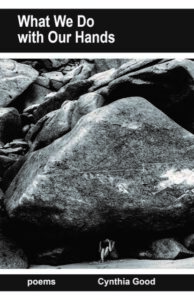
 Today’s special guest is author, activist, and poet Cynthia Good and we’re chatting about her new chapbook, What We Do with Our Hands, from Finishing Line Press.
Bio:
Cynthia Good is an award-winning poet, journalist, and former TV news anchor. She has written seven books including Vaccinating Your Child, which won the Georgia Author of the Year award. She has launched two magazines, Atlanta Woman and the nationally distributed PINK magazine for women in business which grew to a readership of more than 600,000.
Her poems have appeared or are forthcoming in journals including Adanna Journal, Awakenings, Book of Matches, Brickplight, Bridgewater International Poetry Festival, Cutthroat, Free State Review, Full Bleed, Green Hills Literary Lantern, Hole in the Head Review, Main Street Rag, Maudlin House Review, MudRoom, Outrider Press, OyeDrum Magazine, The Penmen Review, Pensive Journal, Persimmon Tree, Pier-Glass Poetry, Pink Panther Magazine, Poydras, South Shore Review, The Ravens Perch, Reed Magazine, Tall Grass, Terminus Magazine, They Call Us, Voices de la Luna and Willows Wept Review, Semi-Finalist: The Word Works 2021, among others.
Welcome, Cynthia. Please tell us about your current book of poems.
What We Do with Our Hands is a chapbook chronicling the end of a difficult marriage, after raising a family and being a daughter.
Most of these poems are in first person. The use of “I” is a declaration of the speaker’s remerging self-acknowledgement and putting herself first after many years of staying silent. These poems reflect a life spinning out of control. The poems emanate from the desire to be seen, and to more fully understand.
Many of these poems are in response to, or in conversation with suffering alone, hiding shame and pretending that anxiety and failure weren’t a huge influence; denial which resulted in more shame, anxiety—and failure to live the life I wanted.
The real devastation for me was in not writing about it sooner, in not sharing the suffering, hiding my notebook under the seat of the car—writing on the roadside. To have the chance to share the suffering, to share the shame makes these private, sometimes universal experiences, feel like returning to integrity, freedom and healing.
To shine a light on what I hid for so long, or worse, what I ignored, is an effort to become better acquainted and comfortable with not having control, with the not knowing and with the uncertainty that comes with being alive. Poetry has been a way to bring some order to what was out of control, and make some sense out of what was happening, even if only by having a few clean lines on a fresh page. This has been a tangible place to put the suffering, and its opposite, the almost unendurable beautify that is my life.
What inspired you to write this collection?
Most of these poems were written as many of the structures in my life were coming apart; my marriage of 25 years, my home bulldozed, my children graduating from college and moving on, my mother dying. During a five-week period I became divorced, had to move out of my home and buried my mother. I realized that much of what I believed in, didn’t apply any longer. So, most of these poems are about sorting through a lot of grief and change and grappling with the way I thought life was supposed to be and redefining the dream.
Can you share one, or part, of one of your favorites?
Burn winter and all
of last year. Burn
the acorns in the yard, their little hearts.
Ashes float in our coffee, like snow
in your hair as smoke stings
our eyes until we turn our backs
to the smoldering, and medallions
of shimmering leaves
…You can’t
burn anything all the way,
it only turns to ash—
giving us grace
to let go of what’s gone.
What exciting project are you working on next?
Currently I’m working on getting another collection of poems out there. It’s called In the Thaw of Day. I’m also working with my editor to review other groups of poems as themes emerge for new collections.
When did you first consider yourself a writer?
My longest and deepest relationship has been with the blank page. All my adult life I’ve been a journalist, first in college, then in TV news, then launching magazines and overseeing editorial at PINK. But when I decided to go back to school to pursue an MFA in Poetry in my late 50’s, I confided in my son, telling him I was scared since this kind of writing was new and different for me. He said, Mom you’ve done this your entire life. And he was right. I have always written for as long as I can remember, as a young girl, either journaling, writing poems, field notes or small books.
Do you write full-time? If so, what’s your work day like? If not, what do you do other than write and how do you find time to write?
I write when I’m afraid. I write when my stomach flips over and I don’t know why or what else to do, when I’m torn apart and ashamed; not to find an answer or solution but in an attempt to release what is trapped inside me, and maybe to understand it a little better.
Most days I spend some time writing. This is in addition to my fulltime gig running a business called PINK, aka LittlePinkBook.Com, dedicated to advancing women in the workplace and supporting organizations committed to promoting diversity. Right now, we’re working on a big event in May featuring some of America’s top women business leaders.
Despite deadlines and many responsibilities, I always find time to write. I’m compelled to do it. I like to reserve part of the day when I’m at my best to write since it’s important to me. The emails and most everything else can wait. On a good morning, I’ll get up, make a cortado, read something inspiring and then spend a little time writing before I begin the rest of my day.
What would you say is your interesting writing quirk?
Sometimes people are surprised by the rawness of the work. I try to avoid self-censorship as much as I can.
As a child, what did you want to be when you grew up?
I thought I wanted to be a detective and later, a chef, though I spent my free time building forts in the backyard and in the trees.
Anything additional you want to share with the readers?
None of these poems was written with the objective of empowering women, or as a means to achieve some other particular end. However, some have said the poems are empowering and I’m happy to hear if someone has been inspired or felt supported by these poems.
This is an amazing statement of honesty as an art form . It’s hard to not censor yourself out of fear of the reactions of the ones who know you. Fear produces many a story of fiction disguised as truth.
Articulate, street smart interview.