
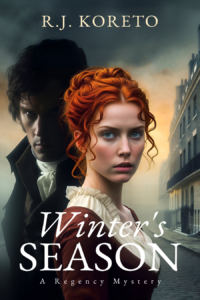
Mystery author R.J. Koreto joins me today to chat about his new historical mystery, Winter’s Season.
Bio:
R.J. Koreto has been a merchant seaman, book editor, journalist and novelist. He was born and raised in New York City and decided to be a writer after reading The Naked and the Dead. He and his wife have two grown daughters and divide their time between Rockland County, N.Y., and Martha’s Vineyard, Mass.
Welcome, R.J. Please tell us about your current release.
Winter’s Season takes place in the Regency-era, the time of Jane Austen. England had no police force yet; Scotland Yard was still in the future. So I imagined a mysterious agent, a battle-hardened veteran of the Napoleonic Wars, investigating crimes for a shadowy government bureau. Captain Edmund Winter is a gentleman by accident, moving among all levels of Regency society, but not truly at home anywhere. And as he investigates the seemingly inexplicable murder of a young society lady in a grim slum, he is sidetracked by personal matters: A stunningly beautiful adventuress helps him. But Winter knows well just how dangerous she is. And a lovely debutante, ward of his closest friend, desires him desperately, even though their class differences make marriage impossible. Winter travels London’s worst slums and most glittering drawing rooms, finding that some powerful people will stop at nothing to keep him from finding a cunning killer.
What inspired you to write this book?
I’ve always loved the Regency era, and am a big Jane Austen fan. So I thought I’d merge it with my love for mystery stories, showing the aspects of the Regency that Austen didn’t cover. I tell people I designed this book to look like a collaboration between Jane Austen and Dashiell Hammett! And I’ve long been interested in the subtle but important class distinctions in English society. We have everyone from low farmworkers to the commercial class to the aristocracy, and I like showing how they relate to each other–or fail to do so! And it’s also fun seeing if love affairs can survive class differences. Jane Austen would certainly like that.
Excerpt from Winter’s Season:
The Captain entered—a few were eating off dirty plates, and almost everyone was drinking beer, or something stronger. Slatternly women laughed and tried to slip away from the half-drunk men who loudly pursued them. Some allowed themselves to be caught, and there was more laughter and then a talk of money. The whole room smelled of smoke and grease, and the floor was sticky from weeks of spilled ale.
Few paid attention to the captain, but a fat man walked up to him surprisingly quickly for someone of his bulk.
“Oh captain, I am so pleased, do you think—”
“Shut up. Where’s Sally? She was suitable for my investigations last night, and she’ll be suitable tonight.”
“Sally—oh there she is.” He pointed to a tallish girl wearing more makeup than an actress. A large man in worker’s clothes, probably a stevedore, thought the captain, had grabbed her and placed her on his lap. She didn’t seem to mind.
The captain strode over, grabbed the woman by her wrist, and pulled her off the man’s lap.
“Come, my girl, we have an appointment as you well know.”
She yelped with surprise, then gave a shrug and followed. The large man stood up.
“See here—I saw her first,” he said. His accent wasn’t London, which explained everything.
“Good for you,” said the Captain, and pulled the girl across the room. The big man started to follow, but two of his friends grabbed him.
“Now Jake, no need to cause trouble,” said the first, who was clearly local.
“Cause trouble? I’ll flatten him—”
“No, you won’t. You don’t know, you’re new here. For God’s sake, that’s the Captain, a soldier, they say he was, and you don’t want to start something with him—I’ve seen what happens to those who do—”
“That’s right,” chimed in the other friend, also a Londoner. “Remember Big Nick—used to be here, no one stood up to him, but he challenged the Captain…” he shuddered.
“And what happened?” asked a skeptical Jake. Both men shook their heads.
“We never saw him again. He wasn’t arrested. They didn’t find his body–he was just…gone. So just stop thinking about it. There are plenty of other girls.”
But Jake still felt he had to make a show of standing up for himself.
“So, you’re telling me it would be a mistake to call him out?”
“Your last mistake,” said the first man. Then very softly, as if he was afraid of his words, he said, “He’s called Winter. If you’re thinking of staying in this part of London, you would do well to remember that name.”
What exciting project are you working on next?
I’ve got several things going! I have three books in my Historic Homes series, featuring architect Wren Fontaine, who solves mysteries centered on the historic residences she renovates. The most recent, “The Cadieux Murders,” was a Foreword Indies 2024 Gold Winner for LGBTQ+. I plan to continue her story. I also have something of an epic in my drawer: A newly minted constable in the 1880s cannot solve a murder thanks to a coverup. But he vows to find out someday, and spends years revisiting the case. Finally, as a Scotland Yard detective superintendent on the eve of retirement, he puts the last piece together. He knows it is too late for justice…but not for redemption.
When did you first consider yourself a writer?
Oh, I like this one! It made me think. Creative writing time was my favorite activity even in grade school. I took a writing course in college with an amazing instructor who made me think I was actually good at this. I guess the biggest milestone, though, was when I had a story published in Ellery Queen’s Mystery Magazine. Getting paid for fiction—that was HUGE.

Do you write full-time? If so, what’s your workday like? If not, what do you do other than write and how do you find time to write?
I write full-time, but not necessarily fiction. I have a journalism background and now write and edit a series of financial e-newsletters. Evenings and weekends are for fiction writing. It’s a balancing act. The wonderful thing about working in journalism is that you’re trained to focus and write quickly. And at the end of the day, writing is writing, with one key distinction: “The difference between fiction and nonfiction is that fiction has to make sense.”
What would you say is your interesting writing quirk?
I need noise. I grew up in Manhattan over a busy two-way street and I think I became “addicted” to sound. I can’t do work in quiet. Background TV, a Spotify playlist. It almost doesn’t matter. But there has to be something going on.
As a child, what did you want to be when you grew up?
A professional basketball player. But at 5-foot-7 with bad eyesight, that wasn’t going to happen. After reading Norman Mailer’s “Naked and the Dead” there was no going back from writing.
Anything additional you want to share with the readers?
At the end of the day, the novelist whose work I most admire is John le Carre.