
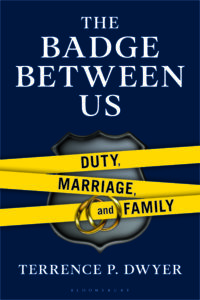
Writer Terrence P. Dwyer chats with me about his new true crime memoir, The Badge Between Us: Duty, Marriage, and Family.
Welcome, Terrence. Please tell us a little bit about yourself.
I retired from a 24½ year law enforcement career that included 22 years with the New York State Police. For 17½ years, I served as an investigator in the State Police Bureau of Criminal Investigation. I am now retired from a second career as an attorney, in my 19th year as a professor teaching legal studies at Western Connecticut State University. I have written three textbooks, the most recent being Homeland Security Law: Issues and Analysis, a Public Safety Writers Association Gold Medallion award winner for nonfiction. Since 2008, I’ve been a featured columnist for Police1.com. I reside in New York with my wife, Joan, and in my spare time enjoy boating, exploring hiking trails around the Northeast, traveling, running, and spending time with family. Joan and I have three children and seven grandchildren.
Please tell us about your current release.
The Badge Between Us peels back the curtain of what life is like for a police family and for police officers who balance work and home life. It is a narrative of my final year as a New York State Police investigator, with a retrospective view from a 22-year career spent responding to and investigating violent crime and organized criminal groups, while exploring the impact upon me and my family. Through the lens of a gang investigation and a subsequent quintuple murder that took place later in my career the book delves into the workaday world of a homicide investigator. However, compounding the narrative is a promise to my wife to leave policing after graduating law school five years into my career and reneging on that promise by postponing it to the point that when I had 20 years of service, I still could not let go of the allure of policing.
What inspired you to write this book?
I set out to write a very different book that focused on the stresses of police work and the impact of moral injury on that stress along with secondary trauma. My intent was never to write something that could be classified as a memoir. But in doing my initial research I contacted a former colleague who counseled law enforcement officers. She has quite a resume of dealing with police officers and correction officers who encountered trauma. During a 45-minute discussion she candidly asked me if I’d ever been through counseling and I questioned why she asked me that. Her response was that just from our conversation and knowing a bit of my background, I should talk with someone. After some more discussion with her and giving it some thought I decided to go to counseling more as a participatory writing or journalistic event. It’d be good for the book was how I envisioned it. Well, after a year of doing so, it was good for me. Joan and I talked more about my police career than we ever had in the 15-16 years I’d been retired at the time. We each learned things from that period of our lives that neither knew.
What exciting project are you working on next?
A true crime narrative based on a 50-year-old missing person case and murder that takes place in the northeast and the south. The victim is a young black man whose disappearance is vigorously pursued by an aging detective who initially was assigned the case when on the police department and who stubbornly refused to let go despite push back from his former agency. He worked on the case well into his 80s. There are many layers and twists to this story and aside from an interesting narrative, I am using it to continue the discussion into how the police treat missing persons and unidentified bodies cases when the victims are people of color or considered to be on the margins of society.
When did you first consider yourself a writer?
Probably as far back as third grade. I loved writing stories for class assignments. My love for writing continued into high school and I majored in English Literature in college.
Do you write full-time? If so, what’s your workday like? If not, what do you do other than write and how do you find time to write?
No, I do not write full-time. I am a university professor teaching legal studies courses to undergraduate and graduate students. However, the schedule in academia does provide plenty of opportunities to write. Prior to this general market release, I wrote three textbooks, several academic related articles, and since 2008 I have been a columnist for Police1.com. Since 2017, I’ve also been writing plays, some of which I’ve had regionally produced.
When I am working on a writing project, that is my singular focus. I often wake up and either workout and then after breakfast sit down to write or just dive in after waking and write for several hours. I tend to write in big chunks. When I do that, I put in 8 hours and work on my project. This may involve writing part of a chapter, revising another one, or sifting through my plotting and research notes.

What would you say is your interesting writing quirk?
Two things. First, as I indicated before, I tend to write in chunks, meaning that I can sit down and write for several hours a day for several days. Second, I jump around when writing different chapters, I don’t always write sequentially. I think this works well if I am stuck on a chapter. I can park it for a while and move onto another and then come back. Often that helps me free up whatever was blocking me in another chapter.
Wait, there is a third one, and this may be more of a quirk. When I sit down to write for the day, I go to my home office, put on classical music (usually Beethoven) from Spotify, light two candles that I pilfer from my wife’s collection, and shut off the main room lights and work under floor lamp to the side of the couch. That is my mood setting for when I am hunkering down for a long day of writing.
As a child, what did you want to be when you grew up?
A writer, a lawyer, and a soldier. Two out of three isn’t bad, I guess. For a short time, I wanted to play in the NBA for the Celtics, but since I couldn’t jump that high and had marginal ball handling skills that ambition did not come to pass.
Anything additional you want to share with the readers?
Nothing other than I am excited to get this first book out there and look forward to reader feedback, and that I’m fully involved in writing my next book project which I hope to have out in late 2027.