
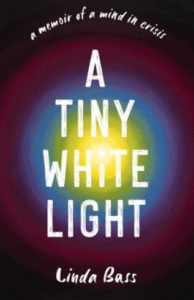
Writer Linda Bass chats with me today about her memoir, A Tiny White Light: A Memoir of a Mind in Crisis.
Bio:
Linda Bass grew up in Wisconsin before moving to California, where she earned a BA in psychology from UCLA and an MA in psychology from UC Berkeley. She worked in the workforce development field for thirty years, most recently as the executive director of a regional workforce board in Cambridge, Massachusetts. After retiring, she moved to Western Massachusetts, where she spends her time writing and painting (portraits primarily), solving puzzles, reading, singing (to herself), enjoying friends and family, and feeling grateful for all of it. She is currently working on a second book.
Welcome, Linda. Please tell us about your current release.
Here’s a summary of A Tiny White Light: A Memoir of a Mind in Crisis:
“From an author with a psychology background, a candid memoir about the interior of her own psychotic episode.
After the culture shock of moving from a small Wisconsin town to the tumult of Los Angeles in 1967, Linda’s family disintegrates: her parents decide to divorce, and she and her younger brother, Brian, suddenly must fend for themselves. While she finds a foothold in academic pursuits, Brian spirals downward into schizophrenia and, finally, commits an irrevocable act. Plagued with guilt, Linda loses her sense of purpose, abandons a promising career in psychology, and finds herself in a life she never envisioned—poor, alcoholic, an accidental parent in an unhappy marriage, feeling invisible and alone.
When Linda sees a psychologist, Sam, he helps her recover what she has lost: her sense of self. Feeling truly seen, she falls in love with him and suspects her feelings might be reciprocated, but can’t be certain. The ambiguity, mingled with other overwhelming stresses, triggers her descent into a psychotic episode—one that echoes her dreams, Brian’s experience, and Sam’s own phobia. Will Linda follow in her brother’s footsteps, or will this episode prove to be the wake-up call she needs to change course?”
What inspired you to write this book?
My goal was to accurately depict my lived experience of what started as a peak/transcendent experience, but which weeks later morphed into a psychotic episode. It was probably the most fascinating experience of my life (so far!). I didn’t intend to write a memoir at first—my goal wasn’t to share my life or reveal all. In fact, I originally wrote it in third person, changed names, and considered using a pen name and publishing it as fiction. I was still working and concerned about the impact the on my career. In the end, I decided I wanted readers to understand it was a true story and so it evolved into a memoir written in first person and using my actual name as author.
The content of my psychosis could be traced back to elements of my family’s dysfunction, my brother’s experience while schizophrenic, my dreams, and my therapist’s own phobia, which he had inadvertently disclosed to me. Although A Tiny White Light is written as a story, I conceived of the book as a case history of sorts that would show how these threads converged with stressful life circumstances to contribute to my psychotic break. In other words, the content of the experience was meaningful, and if clinicians explored clients’ psychotic content, it might provide a wealth of information about underlying issues that could be used to help clients find their way back to themselves.
I also hoped the book might be of value to anyone whose life has been touched by mental illness, either their own or that of friends, family, or colleagues, at a minimum to show that they are not alone and that it is possible to recover and lead a productive, contented life. I also think the more we can talk openly about mental crises, the more likely we are to reduce the shame and stigma attached to it.
Finally, over the years, I’ve read many accounts of psychosis/mental crises, and have often felt that much was left hidden, glossed over, or treated as simple misfiring of synapses in the brain—gobbledygook, which was not my experience at all. Instead there was an inner logic to it all, even though it was at a sort of precognitive level.
Excerpt from A Tiny White Light: A Memoir of a Mind in Crisis:
“Prologue: Family Portrait, 1982”
“. . . I’m more than a little worried that my leaving the hospital depends on figuring out proverbs. When my therapist, Sam, visits, he asks me to explain the meaning of ‘A rolling stone gathers no moss.’ But is it desirable for stones to be covered with moss or not? The beauty of moss—should I say that if one just rolls through life, always on the move, one is deprived of the beauty derived from sitting still and letting lovely things come to you? But maybe he wants me to think of moss as a kind of fungus, so I picture green furry moss lining my skull. Then I should say that an active life precludes some sort of decay, but I hate that notion, the idea that one should be like a stone, unthinking, unfeeling, busy, busy, going, going, gone. And then what is worth saying about one’s life? The difference between being and doing, it seems to me. A value judgment.”
More excerpts can be found on my website: https://lindabass.com.
What exciting project are you working on next?
My intention is to fine-tune and publish a compilation of short stories I’ve written over the years, and then I’ll write another longer form work, a novel or another memoir. The short stories are lighter or at least more humorous than A Tiny White Light, but, alas, I am still me, so there’s some darkness floating around in them, too!
When did you first consider yourself a writer?
I suppose technically I’ve always been a writer—I’ve kept a journal since I was nineteen, have participated in writing groups, and written multiple versions of the current book, along with numerous stories (that I’ve never submitted for publication), but I didn’t feel comfortable calling myself a writer until I had a publishing contract, so only about a year ago.
Do you write full-time? If so, what’s your workday like? If not, what do you do other than write and how do you find time to write?
The greatest pleasure of retirement is being able to write and paint, and I’m usually engaged in one or the other. I do have a bad habit of spending hours solving NYT puzzles and playing other online games each morning before I settle in to write, but it’s a ritual I enjoy.
What would you say is your interesting writing quirk?
I’m fortunate—I don’t have trouble writing a first draft on my Mac—words just flow freely from my brain to my fingertips, and sometimes my writing ends up as a riff, not unlike my excerpt above. But it’s also my misfortune—I write too much and then painfully have to cut, cut, cut. I also often string together anecdotes in what might appear like lists, but I find that sometimes effective.
As a child, what did you want to be when you grew up?
I wished I could be an artist. I didn’t think about writing until later, but even then neither art nor writing seemed like feasible careers since they were unlikely to generate reliable income.
Anything additional you want to share with the readers?
Thank you for reading!
Links:
Author Website | Art Website