
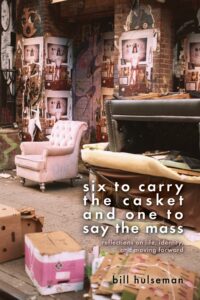
Writer Bill Hulseman joins me today to talk about his memoir, six to carry the casket and one to say the mass: reflections on life, identity, and moving forward.
Bio:
Bill Hulseman is a writer, ritual designer, and former educator whose work explores identity, belonging, and personal agency. His debut book, six to carry the casket and one to say the mass, is a collection of deeply personal essays examining the identities we inherit, the traditions we navigate, and the power we have to shape our own narratives. Through reflections on family, Catholicism, and queer identity, Hulseman offers a nuanced exploration of what it means to carve out space for oneself in a world that often seeks to define us.
A former middle school principal, teacher, and campus minister, Hulseman holds degrees in religious studies, the comparative study of religion, and education leadership. His time in Catholic schools gave him both a profound appreciation for faith and a firsthand understanding of the tensions between personal identity and institutional tradition. His writing is informed by this background, as well as his deep love for pop culture—where figures like Madonna and The Golden Girls helped him see himself long before the world was ready to.
Hulseman now lives in Seattle with his husband, Jonathon, where he continues to write, design rituals, and lead meaningful conversations about identity, faith, and belonging. Learn more at BillHulseman.com.
Please tell us about your current release.
Six to carry the casket is a collection of essays about identity. In the first part, “origins,” I explore the ways my relationships and formative experiences impacted me, and in the second, “tradition,” I think about the ways I took the reins to shape my own identity. The essays in the third part, “pride,” grew out of my own practice of reflecting on the people, places, and experiences that helped me to understand myself and shape my queer identity. Along the way, I tell a lot of stories–some delightful, some painful–about my family, about my life as an educator, and about pop culture.
What inspired you to write this book?
Well, the short answer is: burnout. Just as I began the most difficult job I’d ever had, my mom died after a long illness. My sister died very suddenly a year later, and my dad, also after a long illness, died a few months after her. Personally, I was swimming in grief, and, professionally, I just couldn’t get my feet on the ground. Physically, emotionally, spiritually, I was completely drained and broken. Soon after my dad died, though, I met my husband, and as we made plans to merge our lives, I took a year off from working to heal, to focus on the life Jon and I were building together, and to figure out what I wanted to do next.
I never intended to write a book–instead, I leaned back on various forms of reflection to figure out how I landed in that place. I returned to formative experiences and relationships to identify both the ways they directed me to burnout and the seeds of resilience and conviction they planted. I expected that the process of writing these essays would help me process my grief, but it came with a delightful surprise, too: writing helped me figure out the things I needed to let go, the things I wanted to carry forward, and the person I wanted to be. I shared these essays through my newsletter, and after a while a few friends suggested that I should collate them as a book.
One of my favorite aspects of writing the book was unpacking particular moments and seeing how the most ordinary experiences inspired the most profound insights. For example, in “how to put up a Christmas tree,” I returned to the time my husband and I bought a new tree for the holidays. Sure, the process of putting up the tree seems pretty mundane, but for me it was a nearly-mystical experience– “mystical” in the sense that the normal boundaries of space and time seem to collapse. As we shifted furniture and unwrapped and hung ornaments, happy and difficult memories, family stories, habits and aggravations, traditions and innovations–everything came to the surface. When we finished and sat to just admire the tree, we were able to contemplate the ways our lives were reflected on that tree and the home and future we were building together. I understood in that moment that these traditions weren’t just about celebrating a date or a season on the calendar–they gave us time and space to just be, to pause and consider the journey that delivered us to that moment and the paths we wanted to explore.
The essay is a mix of stream of consciousness–trying to capture everything that returned to me with the tree–and my effort as a Virgo to impose order over chaos. The first four steps: Identify and prepare the ideal spot, Pick a theme to inspire your tree, Deliver the tree and its decorations, and Decorate the tree. And finally, Bask in the glow.
It’s best to decorate your tree in late afternoon so that you can immediately enjoy its warm lights in a darkened room. Accompany your basking with playlists of holiday music, but avoid artists like Wham!, Mariah Carey, and José Feliciano. You will hear them plenty in the coming weeks. Instead, focus on playlists that include music from A Charlie Brown Christmas and Ella Fitzgerald. If a recording of “Ave Maria” comes up, especially if it’s by Harry Connick, Jr., or Beyoncé, immediately switch to a different playlist or throw the speaker out of the closest window, whichever is more dramatic.
Instrumental holiday jazz will enhance your emotional engagement with the tree and make you think about your featured solos in your college choir’s holiday concerts, or about one particular song that was part of the show each year that always made you weep. It will also trigger memories of past Christmases with your parents, though they’ve been dead for many years, like the time your mother requested a roving quartet to sing “Silent Night” in the original German. And they did. Or the time you volunteered to bring a bûche de Noël for your eighth-grade French class holiday party, but you came down with chicken pox and your mom made the whole thing by herself (though you never said it had to be homemade) and delivered it to the school on the day of the party you were missing, and later that day, your French teacher stopped by with a piece of cake for you—the moment that sealed her spot as the favorite among your teachers, and how your mom told the story for the next thirty years about how she was so put out because you volunteered her to make a bûche de Noël. Or the Christmas Eve when your cousins didn’t show up and nobody understood why, but for the next ten years your mom and aunt didn’t talk to each other until suddenly they did again, the Christmas Eve where you saw your mom cry for the first time and inhaled Chardonnay with her breath when you kissed her on the cheek to say good night. Or about the time you were fourteen and so depressed and no one knew why or even that you were depressed and you burst into tears and went outside and sat behind a statue, and your older siblings eventually came outside to have a drink and didn’t know you were there, and you heard them talking about you and mocking you and calling you a scaredy cat, and you feeling so hurt even though it was a comically vapid insult. Or that Christmas watching It’s a Wonderful Life when your mom repeatedly informed everyone around, in varying form but in consistent detail, that Lionel Barrymore was in a wheelchair because he was “full of syphilis.” Or the Christmas Eve two days after your dad died when you looked out on a room full of siblings and niblings and offered a toast and then started giving away your dad’s neckties so everyone could wear one to his funeral a few days later. Or your first Christmas Eve as a married couple in the audience of an irreverent drag show and your sudden desire to make it a tradition, and your delight that now you have someone you want to make traditions with. Or the next year, nine months into quarantine and when you found yourself warm and safe and happy in the glow of a beautiful, if bougie and overpriced, tree, husband on one side and rat terrier on the other.
Pro tip: If you do it right, even if a bûche de Noel and a rat terrier are not part of your story, all of your memories will come to the surface. Some are happy, some are not, but it’s all good. Just let its branches shelter and hide the rough patches, and let the lights shine on the rest.
What exciting project are you working on next?
I’m working on a book about weddings! As a ritual designer, most of my work is in wedding ceremonies, but I’m at odds with the Wedding Industrial Complex. See, I take tradition seriously, but I also believe that rituals like weddings should reflect the experiences, identities, and values of the people at the center. Most of the practices we associate with modern American weddings, though, are neither modern nor American. Instead, they’re a mix of 19th century Protestant theology, European royal court customs, and radically misogynistic and heteronormative customs, vestiges of a time when weddings were elaborate transactions that sold women from their first owners (their fathers) to their new owners (their husbands). Most of the resources available for planning weddings are little more than event planning guides that stick to these traditional norms, and even the most progressive and inclusive approaches offer nothing more than cosmetic alternatives without asking the bigger questions. My goal is to offer a guide to designing weddings that begins not with booking a banquet hall and a DJ but with reflection on what’s important to the people at the center, the vows they will declare, and the world they want to live in.
When did you first consider yourself a writer?
I’m not sure I ever have. I have written…does that make me a “writer”? I’ve always loved writing, but for me it’s a tool for reflection and making meaning. In all of the professional roles I’ve had–as a teacher, a campus minister, an administrator, a principal, a ritual designer–I think of myself as a facilitator, and writing six to carry the casket is my way of inviting others into that process of reflection and meaning making.

Do you write full-time? If so, what’s your workday like? If not, what do you do other than write and how do you find time to write?
Nope–most of my work is ritual design, collaborating with clients to create experiences that mark important moments for them and the communities that surround them. Weddings constitute the majority of my work, and I work with couples who don’t have a tradition to draw on or who want to do something creative, original, non-patriarchal, non-heteronormative…people who want a meaningful process and to create an authentic experience.
What would you say is your interesting writing quirk?
I write best in a crowded and noisy coffee shop. The hustle and bustle forces me to focus on my work, to block out the noise and distraction, and when I need a break or inspiration, all I have to do is look around at the people around me.
As a child, what did you want to be when you grew up?
Once upon a time, I was sure that I would be an architect–a visit to Taliesn West when I was 9 inspired a life-long obsession with design. Then, in high school, I thought I’d be an actor or professional singer, but then in college I saw a path in academia. When I started teaching, I didn’t see it as a disappointing detour from those paths–instead, I could tap into my passion for design, my love of music, and my hunger for intellectual exploration to inform my work.
Anything additional you want to share with the readers?
When it comes to my book, it’s not about me. Ok, it’s literally all about me, but my goal in publishing six to carry the casket wasn’t to share the details of my life. Instead, I wanted to offer a model for reflection, for making sense of our experiences, and for creating the world we want to live in. I hope readers will see it as an invitation to reflect on their own experiences and to figure out what they want to hold on to, what they want to let go of, and who they want to be.
Links:
Website | Instagram | Facebook | LinkedIn | YouTube | Substack