
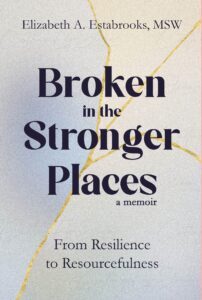
Writer Elizabeth Estabrooks, MSW, is chatting with me about her memoir, Broken in the Stronger Places: From Resilience to Resourcefulness.
Bio:
Elizabeth Estabrooks, MSW, is a speaker, writer and author with subject matter expertise on interpersonal violence, gained during a nearly 30-year career. In 2022 she retired and now spends her time writing, speaking and finding fun.
Ms. Estabrooks began her social justice work as an advocate in the field of domestic violence and sexual assault in 1993 and began consulting in 1998, working with government, tribal, and non-profit clients in the U.S. and Canada, conducting advocacy and developing policy, strategic plans, and curriculum on the topics of violence against women, diversity, peer support services, recovery, and gender- and culturally- responsive services. In 2011 she shifted her focus to women veterans and in 2016 became the first Oregon Women Veterans Coordinator, where she remained until being recruited in 2020 to serve as the Deputy Director at the Department of Veterans Affairs, Center for Women Veterans in Washington D.C.
She graduated Summa Cum Laude with a Bachelor of Science degree in Gender Studies and Political Science from Eastern Oregon University and holds a Master of Science in Social Work, Policy, from Columbia University School of Social Work in New York.
In March 2025, her book, Broken in the Stronger Places: From Resilience to Resourcefulness, was published.
Welcome, Elizabath. Please tell us about your current release.
Broken in the Stronger Places is a memoir that spans my life from joining the military through my exit from the VA and the one-year solo healing road trip that followed. The book, informed by my career focusing domestic violence and sexual assault as a subject matter expert, examines post-traumatic stress and retraumatization among women survivors. In addition to being a memoir, the book serves as a validation for survivors, with many having reported that it is as though I am telling their story. Additionally, the book offers social commentary on the topic of interpersonal violence and provides education and information on how one can best advocate for and support to victims and survivors, whether the reader is a loved ones, employer, medical provider, or part of the law enforcement or judicial system.
What inspired you to write this book?
I had always known that I wanted to write after retiring. The idea on the topic had been with me for a number of years, although not as a memoir. However, when I walked off my job at VA and then left for my solo van journey, egan writing, and it just flowed out as a memoir. As I wrote, I came to understand how it could be more than a memoir, but also provide validation for victims and survivors and education/information for literally anyone else.
Readers can find an excerpt on my website.
What exciting project are you working on next?
Broken in the Stronger Places is currently being translated into Spanish and should hit the market in November (in time for holiday gift buying). This is an important step, given that there are 477,000,000 native Spanish speakers in the world, and that violence against women in the Hispanic/Latina cultures continues unabated. I’m very excited about this step.
I am also working on my next book, which will be an anthology of women’s stories related to chronic plain. It’s a book I actually started in 2015 but put aside when I began working 60+ hours a week.
When did you first consider yourself a writer?
I understood years ago that I have a talent for writing, but that writing was primarily technical in nature: strategic plans, grants, and other documents related to work. However, I jumped into writing blogs in the late 90s and discovered that it was something I enjoyed. Weirdly enough, I still did not really consider myself a writer until I was in the process of writing this book. Now I proudly say to people “I’m a writer.”
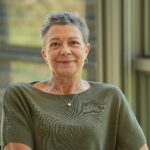
Do you write full-time? If so, what’s your workday like? If not, what do you do other than write and how do you find time to write?
I do write full-time, but what comes with that is marketing of the book, which has been a learning curve. I have been working on finding a balance between marketing my book, working with the translator, writing blogs, speaking, and prepping for my next book. Because I’m always thinking, I also come up with ideas for future books and just had a conversation with a friend who is a researcher and an expert on military sexual assault, harassment, and rape about a future book. Mixed in with all of this, I try to remember I’m retired and spend some time relaxing, kayaking, and rock-hunting with family and friends.
What would you say is your interesting writing quirk?
I’ve never been one to write an outline. I just don’t get it. When I was in my undergraduate program, my advisor instructed me to go ahead and write a paper and then write the outline. On those occasions during in my master’s program that I had to write an outline first, I struggled. My work comes from just sitting down and typing. My words flow through my fingertips and onto the paper, whether I’m writing a strategic plan, a blog, or a book. My writing is emotionally connected, and I think that’s what helps. When I was on the road, I would use my smart watch to record thoughts that became pages and chapters – a technique I would recommend that anyone try.
As a child, what did you want to be when you grew up?
An Executive. I was unclear about the specifics, but I knew I wanted an important job in a nice office making good money. Since I spent so many years working with non-profits and government offices, that “good money” part was no longer as important as the work I did, which also made nice office was less important. When I was asked to join the Center for Women Veterans, I realized that job was my opus and I had met the goal of my youth.
Anything additional you want to share with the readers?
Take care of you, always. We – especially women – tend to put our own needs on the back burner. We work to make the world, the family, and everyone better, sometimes at our own expense, which can and often does lead to not only a decline in our mental health, but also letting go of or delaying our personal and professional dreams. I’m not saying you cannot do the things I mentioned, but I am saying do not let go of who you are and what you want, because you matter.