
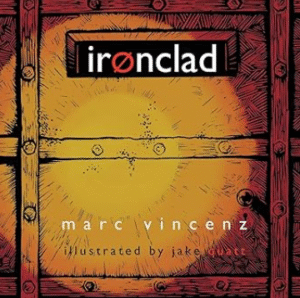
Poet Marc Vincenz is chatting with me about his new collection, IRØNCLAD.
Bio:
Marc Vincenz is a poet, fiction writer, translator, editor, musician, and artist. He has published over 50 books of poetry, fiction, and translation. His recent poetry collections include The Pearl Diver of Irunmani, A Splash of Cave Paint, The King of Prussia is Drunk on Stars, Spells for the Wicked, All the Tricks of Language, and, just out, IRØNCLAD. An album of post-classical music and spoken word, No More Animal Songs, is also forthcoming. His translation of award-winning Swiss poet and novelist Klaus Merz’ selected poems, An Audible Blue, won the 2023 Massachusetts Book Prize for Translated Literature. His most recent translation is In the House, Still Light, also by Klaus Merz. Marc’s own work has also been translated into many languages. His work has appeared in The Nation, Ploughshares, Raritan, Colorado Review, Evergreen Review, Washington Square Review, interim, Plume, Fourteen Hills, Willow Springs, Solstice, World Literature Today, The Notre Dame Review, The Golden Handcuffs Review, The Los Angeles Review of Books and many other journals, periodicals, and anthologies. Marc is publisher and editor of MadHat Press, and with Paul Hoover, co-publisher of the essential New American Writing. Vincenz lives on a farm in Western Massachusetts where there are more spiny-nosed voles, tufted grey-buckle hares and Amoeba scintilla than bipedal hominids.
Welcome, Marc. What do you enjoy most about writing poems?
The exploration of the human psyche, plumbing the depths of linguistic expression.
Can you give us a little insight into a few of your poems – perhaps a couple of your favorites?
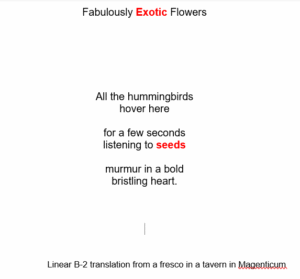
Here is a poem from IRØNCLAD.
For a little context, IRØNCLAD, an illustrated hybrid collection, is coming out mid October with Spuyten Duyvil. I always try and approach a new work from a fresh angle, and IRØNCLAD is my first book that was not written on a typewriter or in word-processing software, but directly into the layout program, InDesign. The reasoning was to try and take advantage of the actual typography of the poem or prose piece. The book is set in the fictional world of The Iron Plier Society, who themselves are trying to make sense of their own archeological record. Fragments uncovered in the geological strata inform the book and the narrative. As you move deeper into the book, you discover, fragment by fragment, artifact by artifact, what appears to be the evolution of a civilization—yet, you can never quite be sure that what you have discovered in the damp earth faithfully represents your progenitors intentions (every interpretation comes with its own set of biases also). And, it is easy to misinterpret those too!
What form are you inspired to write in the most? Why?
I have no fixed form these days. Whatever appears, appears. It might be poetry, it might be fiction, it might be something hybrid.
What type of project are you working on next?
Currently I am working on the 3rd part of my novel-in-progress, The Age of Occasions.
When did you first consider yourself a writer / poet?
From about the age of 20. (I’m now 59.)
How do you research markets for your work, perhaps as some advice for not-yet-published poets?
I take advantage of all the information that is available online, read, read, read. And, eventually decide if the journal / magazine is a good fit.
What would you say is your interesting writing quirk?
The color of my pens: black for the initial draft, green for revisions, red for corrections.
As a child, what did you want to be when you grew up?
An artist: probably a painter or a musician, still, I ended up as a writer.
Anything additional you want to share with the readers?
Release your artist upon the world in any form you can!