
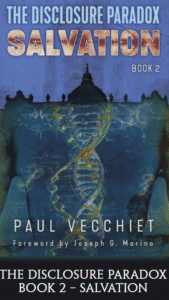
Thriller author Paul G. Vecchiet is back with a new interview. Today we’re chatting about his newest spiritual sci-fi thriller, The Disclosure Paradox Book 2, Salvation.
This is the interview for the first novel in The Disclosure Paradox series.
Bio:
Born in Trieste, Italy, Paul arrived in the United States with his parents at the age of three. He lived most of his life in the Chicago area. He earned a Bachelor of Architecture degree in 1981. Afterwards, he applied and was accepted to United States Air Force Officer Training School where graduation resulted in a commission as a second lieutenant. He was granted an honorable discharge in 1995. He and his family returned to Illinois in 1995 where they lived until 2012. He applied to the United States Army Corps of Engineers in 2012. He and his wife moved to Capon Bridge, West Virginia in 2013 where their house and property are on the south slope of mountain. Paul continues to be a design manager. His first novel, The Disclosure Paradox: Book 1 was released in February 2025.
Welcome back to Reviews and Interviews, Paul. Please tell us about your newest release.
Salvation is a sequel to The Disclosure Paradox: Book 1. An insider in the Vatican makes a deal with malevolent interdimensionals (some would call them demons) to steal the Shroud of Turin. It begins with the murder of a Vatican Interpol agent who happens to be a war buddy to Robert Ladd, Security Consultant and former US Army Ranger. Ladd discovers that his war buddy is missing and decides to go to Rome to investigate. In the course of the investigation, he requests assistance from Interpol Rome and the US Embassy to the Vatican.
The Shroud is coveted for the Blood which is different from human blood, where the DNA is also different. Robert also get help from heroines in book 1: Katrina, his partner, and Mary Ellen Velarde, Katrina’s spiritual psychic Apache friend.
The premise driving the plot is based on facts that authenticate the Shroud combined with interpretations of key verses in the Bible.
What inspired you to write this book?
I had no intention of writing a third book after I self-published two books that were not well received. The first step towards fate was a former Benedictine monk searching for a book about ETs and spirituality and finding The Disclosure Paradox. He enjoyed it so much, he sought me out and ‘friended’ me then told me that the only thing he would have liked to have seen in the book is a mention of the Shroud of Turin. His name is Joe Marino and he has been researching the Shroud for over 40 years.
I gained interest after he began sending me research papers by scientists authenticating the Shroud through multiple disciplines. Eventually, the collection of papers passed one hundred. As I took the time to read the contents in the papers, I grew increasingly interested and amazed at all the facts many people do not know. A thought occurred to me about Jesus’ Blood and with that thought, I pieced together an outline for a sequel. Joe liked it. Then in only six months, I finished the first draft and sent the manuscript to him. He loved it – especially one particular chapter where I reveal all the facts I learned about the Shroud using dialogue between scientists and investigators. In fact, Joseph G. Marino has written the foreword. You can read it on my website.
Excerpt from Salvation:
“Mr. Ladd, I feel the blood has always been special. It is not incidental that the New Testament has over 375 verses that mention the blood of Jesus. I knew there was something more than what was written. It is also written that his blood will wash away the sins of the world. I have concluded that the quote should be taken more literally. You mention DNA. What if the solution to our problems as flawed humans was always with us? What if, someday, we would be able to study Jesus’s DNA, isolate the differences from human DNA, and repair the human DNA?”
What’s the next writing project?
What Doesn’t Kill Her, a prequel to Book 1 will be released Spring 2026.
What is your biggest challenge when writing a new book? (or the biggest challenge with this book)
I honestly did not feel I had difficulty in writing the story. Perhaps the most time-consuming part was getting the Prologue right – not too long, not too brief to orient the reader.
If your novels require research – please talk about the process. Do you do the research first and then write, while you’re writing, after the novel is complete and you need to fill in the gaps?
I research as I write. For this book, I set up the plot with a detailed outline. As I worked on filling in the paragraphs following the outline, I took the time to research. There were many topics I read about, or discussed with experts: The chapter about the Shroud is like a readers’ digest of all the papers Joe Marino sent me. But there are other details I needed to confirm factually: Fulvio’s unit in Iraq, My memory of visiting the Vatican in 2006, Interpol Rome and Interpol Vatican, The US Embassies, what happened to the victims of the nerve agent attack in London in 2018, How is a nerve agent attack victim treated, and what is the physiology, Turin and the Cathedral of Saint John Baptist, How do the Italians handle a military funeral, what units would handle Robert’s military funeral. Those are the main subjects I spent time learning about.
What’s your writing space like? Do you have a particular spot to write where the muse is more active? Please tell us about it.
I write in my loft in my house. There is nothing special there.
What authors do you enjoy reading within or outside of your genre?
I try to support authors who support me. I have enjoyed reading Ursula K. Le Guin, Octavia Butler, Asimov, Herbert, Orwell. Outside of the genre, Tony Horwitz, Stephen Ambrose, and David McCollough.
Anything additional you want to share with the readers today?
People ask why I write science fiction. My reply is that I write science fiction about topics that people who would otherwise not read nonfiction about. I feel that the way I write, prompts the reader to do their own research about things that people tend to be skeptical about: UFOs, ETs, spirituality, and now, the Shroud and the Vatican. There are a couple concepts I carry through my books. Humanity, generally, is spiritually corrupt. It can lead to our own demise because a hypothetical equation I present in my book is spirituality and technology. When the two are approaching equality, there is a greater chance of survival. When a race has low spirituality and high technology, like humans have, there is a greater chance of self-destruction. When a race has a high spirituality and a low level of technology, there is a greater chance of the race being conquered. In addition, other people have a greater impact on one’s life than the individual. This is important to understand how each one of us are interconnected even though it is not evident.
Links:
Website | Bluesky | Facebook | Threads | Instagram
Thank you for coming back to Reviews and Interviews!