
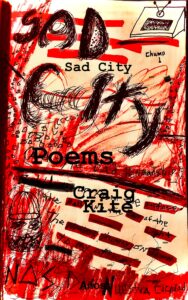
Poet Craig Kite chats with me about his new collection, Sad City.
Bio:
Craig Kite is a poet, musician and actor from New York City with a background in journalism and human rights activism. He led field teams in Iraq 2008-2009 working to expose war crimes against the Iraqi people, and earlier in Canada to protect Algonquin territory from uranium mining. He has also worked in Chiapas, Mexico with the Zapatistas, as well as projects in New Orleans post-hurricane Katrina, and the Rocky Mountains on wildfire prevention. He was a co-founder and editor of Mad Gleam Press (2015-2020) and ran a book shop / event space in Brooklyn during that time. After surviving multiple surgeries for injuries from construction work, he currently teaches guitar and works as a doorman at a speakeasy in New York, and records music as a solo singer-songwriter, and with his band Pinko, for which he is the lead guitarist and songwriter. His darkly comedic and philosophical poems and songs are social commentaries inspired by these experiences, his struggle to navigate the bureaucracy of social services, and surviving in the city.
What do you enjoy most about writing poems?
Honestly, writing poems is something I’ve always done compulsively since I was young. It’s like a safe place, or a portable sanctuary that goes with me everywhere I walk. I literally can’t help but write them. Although it sometimes feels like some strange sort of mental illness, poems are a place where I work out my philosophical quandaries, process my emotions, and distill my observations, all at the same time. In this way, it’s a means of critically thinking about social issues, plus exploring and expressing the questions I have about the world. Often, as much as they may be an emotional outlet, my poems are actually arguments. It’s my way of making a point, especially ones that may otherwise be ineffable.
I would love to one day be able to write more prose, especially memoir, to tell my stories. But I find it difficult to find an entry point, or a perspective from which to begin. It often feels contrived, like I’m trying to make the rough edges fit together perfectly. Life is chaotic and there are no clean lines, often no reasons to be found for tragedies. Perhaps, I still need to live longer. But poetry, for me, feels like an appropriate way to invent meaning. I can stich together these disjointed vignettes, these disparate bits of imagination, and create a world that is, nevertheless, as real as it gets.
Can you give us a little insight into a few of your poems – perhaps a couple of your favorites?
Yes! Some of the poems are more self-explanatory than others, so I’ll take this opportunity to explain a couple of the more abstract, lyrical ones, which also speak to a theme throughout Sad City.
In the poems “Brutalism” and “A Main Street of Only Chain Stores”, as in many of the poems in Sad City, I am playing with the tension that exists between urban, suburban, and rural communities in America. These areas are not only divided spatially, but by class divisions. We’re all aware of the ubiquitous tropes of the “coastal elite” from New York and the “basket of deplorables” from out in the red states, tropes hurled back and forth between the “flyover states” and “the crossroads of the world”. In a country where 70% of the population is priced out of higher education, what can we expect other than a situation where the vast majority resents the educated, while the privileged marvel from inside their bubble at the masses voting against their own economic best interests?
The book is organized into four sections: Blue State, Red State, Purple Suburb, and American Dystopic. Each section roughly attempts to speak from the vantage point of each type of community. I personally grew up, and have lived, in each environment. As a kid, I came up in rural Maryland. After my dad left us, we moved in with grandparents in suburbia, and I’d also spend time with grandparents in Washington, DC.
From a very young age, I felt an incredible amount of disquiet living in suburbia. I wouldn’t be able to understand why until much later. But something about the environment always felt so fraught. As my political consciousness grew, and I began to understand class dynamics, such as the phenomenons of “white flight” and gentrification, and as the lack of social and economic opportunities became increasingly clear to me, I knew I did not fit well into my family’s culture, and I yearned to eventually live in a walkable, urban community. I longed to be in a place where the energy, history, and beauty of the architecture and built environment fed my soul. These two poems both deal with the question as to why that is… why I feel more at home in a city far from “home”.
I had read about how the architectural style of brutalism was originally born out of the idea that people are taught what they like, and that standards of beauty can be culturally engineered. It was thought that if we just make the built environment as cost-effective as possible, and trade frills for efficiency, or marble for concrete, that people will eventually learn to love it and find it beautiful. What is hilarious is that this experiment failed. People ultimately rejected it. This proved that what is most profitable is not what is most beautiful, and that there is something innate about beauty.
(*Eventually brutalism developed as an aesthetic, and many inspiring structures were built, indeed. But the idea at its roots posed an important question.)
And so, I wonder if there is a comparison to be drawn between these experimental, concrete behemoths of brutalism and an Applebees, between the cookie-cutter model-home McMansions of suburbia and the cold temples of bureaucracy, where efficiency is feigned in our capitols. Because both of these styles of architecture symbolize and embody a streamlined process aimed at maximizing profit at the expense of beauty. And that’s partially what I was trying to get at in these poems.
What form are you inspired to write in the most? Why?
I’m a big fan of haiku! I actually used to be part of a little performing troop called the Haiku Hitmen (or Haiku d’etat).
But really, while I sometimes play with various forms, and I find that very fun, most of my poems are a sort of free verse with a mix of both narrative and lyrical approaches. However, I do utilize rhyme and meter, rhythm, and as many devices as I can to add literary value, as I sort of invent my own forms and patterns.
As a musician and songwriter, what is most important to me, in terms of style, is the sonic nature of the poem, the musicality, the rhythm and the cadence. As I write them, I am hearing the vocal delivery in my head.
When I owned my own literary press, called Mad Gleam Press, and I was producing many live readings, I was obsessed with collecting and curating other poets whose vocal cadences I found interesting, so that I could showcase them together. I just believe that everyone has their own unique voice, found largely in their cadence and delivery. A writer’s rhythm is like their fingerprint.
For example, although I’ve participated in, and even won, slam poetry competitions, and I truly admire and respect the culture, I can’t help but find it slightly distracting that many who engage in the slam poetry form adopt the same, very particular, cadence and style of delivery. Like.. is the that really your voice,though? I hope that doesn’t come off as pedantic or disrespectful, but I just LOVE to see a poet really tune deeply into their own unique rhythm. And I find free verse helps me to do that best.
What type of project are you working on next?
I’m currently partially through writing my next poetry collection, which is a collection of shorter, pithier poems each with a “turn” at the end, where the last word or phrase reveals a different or unexpected meaning for the poem. I’m hoping it will be even funnier than Sad City, and perhaps be even more accessible of a read.
I’d also like to finish a haiku collection!
Eventually, I have in mind to write a memoir in more straightforward prose, sort of in the sardonic style of Bukowski’s Post Office, in which I’d mainly like to illustrate my struggles navigating the bureaucracy of the social services system while being homeless in New York City. Sad City does this too, but it’d be interesting to approach it with prose. I’d also like to use said period of my life as an entry point to begin telling more back-stories from other times in my life and career.
I am also a singer-songwriter, both in a solo capacity and in a couple indie rock bands. And I am working on recording and performing music for those projects professionally. My band is called Pinko.
When did you first consider yourself a writer / poet?
I always wrote poems and songs since I was a teenager. But it wasn’t until my mid-twenties that I began sharing them, or thinking of myself as a poet.
At that time I had been a war reporter, working in a series of war zones internationally. I had come back from over a year in Iraq in 2008-2009. I was having a very hard time readjusting to American life and dealing with a lot of psychological trauma. One night, I was not doing well at all, and having thoughts of self-harm. But I had been writing a lot of poetry. And in that moment, instead of staying in by myself, I decided to google open mics in Washington, DC. It happened to be a Thursday, the night of DC’s longest running weekly open mic, called Spit Dat. I attended and it changed my life forever. I went up, feeling very vulnerable but reckless, and bore my soul to strangers through poetry. Since then I was hooked. It became my community and saving grace.
How do you research markets for your work, perhaps as some advice for not-yet-published poets?
The AWP conference (Association of Writers and Writing programs) is a great resource if you can manage to attend. The most active publishers and editors will be there in one place and you can get facetime with them.
The Writers Market is a great resource, but apparently has been sold to Penguin Random House and isn’t currently accepting new subscriptions. The books can still be bought, though. It’s a directory of publishers and editors and their contact information.
Ask Chat GPT: Here are 3 writers similar to me. Where are they published? Where are they reading? Who are their agents and publicists?
Most of your connections and sales will happen at readings. Attend regularly if you can, ask for featured slots, and ask other writers about their markets. Follow your favorite professional writers and research their markets.
If you can, it’s worth hiring an agent and publicist, in my experience. No one does this alone. And I would advocate for finding a publisher instead of self-publishing because then you’ll be working with a team. It’s always best to work with a team.
Also, submit to many literary magazines and find editors who like your work and will publish your poems repeatedly. You want relationships with editors. You want to show publishers that professional editors select your work.
Go to independent bookstores and write down the publishers they carry and submit to them. You may see better results submitting your work to them than the ones at Barnes & Noble for a start.
What would you say is your interesting writing quirk?
My thing is sarcasm and dark comedy. As one reviewer, Cole Swenson, put it: “smart pain”. I love to find the grittiest and darkest, most painful thing in my life, something no one would normally find funny, and just laugh in its face. How else do we cope at the end of the day?
As a child, what did you want to be when you grew up?
Haha! As a child, I honestly had no idea. I didn’t want to grow up. I was terrified of it. But I definitely always wanted to be a rock star. I still do. So, I guess that.
Anything additional you want to share with the readers?
Be sweet. Give money to homeless people. Xo
Links:
Instagram | Facebook | Mad Gleam Press | Twitter/X | LinkedIn | IMDb
Sad City will be available for purchase after publication at: https://www.blazevox.org