
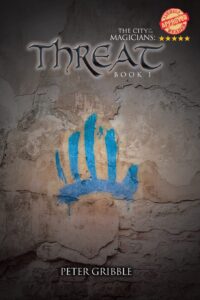
Fantasy author Peter Gribble joins me today to chat about his new novel, The City of the Magicians: Threat.
Bio:
Peter Gribble is a writer and a lifelong student of history whose work explores the intersections of knowledge, power, and the human condition. His fantasy series, “The City of the Magicians,” is set in a civilization that rejects traditional warfare. The series examines how intellect, psychological strategy, and telepathic abilities can be both a society’s greatest strength and its most dangerous vulnerability. Influenced by his childhood in postwar France—where silence about the war was as pervasive as its lingering shadows—Gribble crafts stories that explore the dangers of complacency and the consequences of pacifism and brutality colliding.
Gribble studied art at Sheridan College School of Design, experimental psychology at the University of Toronto, and education at the Ontario Institute for Studies in Education. He has written for NUVO and various British Columbia publications, including gardening columns for two journals over a decade. His time working in bookstores reinforced his belief in the power of books to inspire, challenge and transform.
Welcome, Peter. Please tell us about your current release.
The following is from Threat’s back cover:
“A Journey Without Departure” is the traditional term for a telepathic sending. It is a talent few can perform, yet this is the strategy the City of the Magicians—non-violent pacifists without an army or weapons—hopes will mitigate the barbarian invasion coming in six months. The plan could work, but then, maybe not. Sas, the young man chosen to “educate the barbarian,” can only think, Me? Sendings? They’ve made a mistake!
Lalya, a City librarian searching for her dead lover’s vanished manuscript, is ensnared by a secret society planning to collaborate with the same barbarians. Attempts to extricate herself from the blackmail, seduction and betrayal force her to realize her final treachery could very well destroy her.
Shoan, the Council strategist, is fully aware a shadowy opposition lurks behind the scenes but is stymied as to how to lure it into the open. He should remember one of the basic axioms of tactics is, “Methodology is seldom prepared for surprises.”
Both Sas and Lalya are pawns in the strategies of others . . . yet it only takes a pawn to change the game.
Threat, the first book in The City of the Magicians series, reveals all the preparations for a barbarian arrival, but when strategies collide, will anyone be ready? Will anyone be safe?
What inspired you to write this book?
The seed for it was planted when I was a nine-year-old boy standing in the middle of the Normandy War Memorial Site surrounded by thousands of little white crosses stretching to the horizon. The enormity of all that commemorated death was a profound shock. Something in me woke that day. I knew what I was seeing was deeply and horribly wrong. Back in Canada, during high school, I studied Mahatma Gandhi’s pacifist, non-violent, non-cooperative movement that successfully booted the British out of India and read Martin Luther King’s speeches, lectures and essays about his pacifist approach to ensure a peaceful transition to racial equality occurs. However, critics of pacifism pointed out that it was rarely effective against the likes of Stalin, Hitler and Mao: monsters impervious to noble stances. Pacifism also delayed Britain’s preparations for WWII. So while having a provisional sympathy with pacifism, I felt the conundrum needed exploring and it eventually became a central premise to the series.
Excerpt from The City of the Magicians: Threat:
[The opening:]
A pale blue 5—the obsolete form—was painted on a cryer pillar.
“Looks like a boney hand, don’t it?” the man remarked. D’you know its meaning, Letter sir?”
“It’s the number 5, glyphed the old way,” said Sas. “Not used in generations.”
A young girl volunteered, “Seen it other places, too.”
“Other places?”
“The Upper Ridge so far . . . on house walls, no paper.”
“Barbarians,” seethed someone.
“Indeed.”
The girl asked, “Lettered sir, what does it signify?”
“Afraid I don’t know, but thank you for showing me. Unusual, isn’t it? I’ll let others know. Sorry, you’ll have to excuse me, I’m going to be late for the Temple service.“
“You’re late now,” smirked he girl.
Sas grinned, “You’re right. Be well.” With a nod he resumed his walk.
He was slowed by a second 5 splashed on the east wall of Nethua House, then further on by another more rushed by the last. In the distance another blue 5, large and illegible, lured him toward the Temple.
He shivered.
What exciting project are you working on next?
That there were more books in the series was a complete surprise to me. When the final chapter in Quickening (book 3) wrote itself, it opened a literary portal to the next trilogy in the series. I’m working on books 4, 5 and 6.
When did you first consider yourself a writer?
I was writing (along with drawings) as early as nine or ten years old aware of writing’s intriguing pleasure but I never “called” myself a writer until decades later when I published my first piece on orchids for NUVO magazine. I was given a press pass to the International Orchid Convention held in Vancouver (2008) plus my own photographer and instructed to write a 12 to 15 hundred word article. I had been writing for years prior to this assignment but only after it was published, did I feel I could legitimately call myself a writer. Evolving into an author came when Threat(book 1) was published in 2020.

Do you write full-time? If so, what’s your workday like? If not, what do you do other than write and how do you find time to write?
With a detailed, complex series such as The City of the Magicians, writing full time is essential and requires a fairly strict daily regimen. By ten a.m. all online obligations are ended (finished or not) and the writing day begins. Journaling is NOT writing and it, too, ends at 10 a.m. but may resume after the five to eight hours are done. Lunch is invariably quick and simple (usually a salad), If the writing is inspired and continues beyond the eight hours I do not bank the additional time over into the next day but start fresh at zero next morning. With several exceptions I was able to maintain this for about thirteen years resulting in the first three books.
The foundation for this stability was my partner of many years was homebound enduring a long physical decline (quintuple heart bypass, stroke and diabetes). I was writing for him and gave him each chapter as it was finished. It was part of my role as principle caregiver and we both knew the books helped keep him going. When he read the last chapter of Quickening he exclaimed, “Don’t change a word!” Nor did I. With uncanny timing, Robert passed the Saturday before the world shut down due to the Covid pandemic. Threat is dedicated to him.
When not writing, I garden and also wrote monthly gardening columns for two different magazines in the Vancouver area over eleven years.
What would you say is your interesting writing quirk?
I probably have several but they’ve become so subservient to the writing process that I’m scarcely aware of them. One comes to mind; a habit more than a quirk: I always carry a reporter’s notepad and a pen that I slip into my back pocket and carry with me whenever I go out. At night, pen and pad are beside my pillow in case a word, an idea or a line of dialogue comes. I’m up to notepad number 35 now for The City of the Magicians and it’s written in a shorthand I developed for taking verbatim notes during class. One person who saw the shorthand said it looked like squashed Persian.
As a child, what did you want to be when you grew up?
Inspired by my high school art teacher, I wanted to be a highly qualified high school art teacher. She told me about a comprehensive program (the first of its kind) offered by University of Toronto and Sheridan School of Design that I subsequently enrolled in. It was intensive and I learned a lot but the workload was unrealistic and exhausting. I kept at it completing the first year then segued into Psychology in second year to determine why I thought myself so capable.
Anything additional you want to share with the readers?
Writing is a wondrous, dynamic shape-shifting experience. It’s a lively endeavor, elusively conscious, bestowing upon the writer the pleasure, the awareness, that they are, somehow, a sentient creative agent of Reality itself. As is the reader in the act and agency of reading.