

Writer Steven P. Unger is chatting with me about his new coffee table book, BLACK AS HELL, STRONG AS DEATH, SWEET AS LOVE: A Coffee Travel Guide.
Bio:
Steven P. Unger has traveled extensively in North, South, and Central America; Western Europe; the Middle East; Africa; Istanbul; and Romania. He has been published in numerous travel and bicycling magazines. His book, In the Footsteps of Dracula: A Personal Journey and Travel Guide, 3rd Ed., traces the voyages and eventual flight of Bram Stoker’s Count Dracula from Transylvania to London and back in text and photographs, and pairs this journey with the life and times of Dracula’s real-life counterpart, Prince Vlad Dracula, or Vlad the Impaler.
Mr. Unger was an exchange student at a historically black college, Tuskegee Institute in Alabama, and later a member of the Bear Tribe, a California commune that tried sharecropping, goat herding, and living in teepees—and failed spectacularly at everything. These adventures and many more are described in his novel Dancing in the Streets.
He also wrote the accompanying text and Preface for Before the Paparazzi: Fifty Years of Extraordinary Photographs, which includes over 250 pictures taken by Arty Pomerantz, staff photographer and assignment editor for the New York Post from the 1960s through the early 1990s.
Appearances by the author for Before the Paparazzi, 50 Years of Extraordinary Photographs included a video of his co-author’s life and work. In October 2014 at the City University of New York Graduate School of Journalism, the author’s presentation was followed by a roundtable on contemporary photojournalism with members of the New York Press Club and the New York Press Photographers’ Association. This presentation was given at the New York City Fire Museum and the Bronx Documentary Center, and was one of four lectures for the 2015-2016 California State University, Sacramento, Friends of the Library Author Lecture Series.
He lives with Ruthie St. Steven and their terrier mix Bailey in Elk Grove, California.
Welcome, Steven. Please tell us about your current release.
Our book, BLACK AS HELL, STRONG AS DEATH, SWEET AS LOVE: A Coffee Travel Guide, has just been published by Robert D. Reed Publishers.
BLACK AS HELL, STRONG AS DEATH, SWEET AS LOVE: A Coffee Travel Guideisa history of coffee and a travel guide to Coffee Experiences on almost every continent. Plus, there are fourteen recipes, most with coffee. Among the Coffee Experience destinations are places that almost no one goes to, like Ethiopia’s South Omo, and places masses of tourists go to, like Paris. Other Coffee Experiences are closer to home for Americans, as simple as sharing a colada at a ventanilla in Miami’s Little Havana; or taking the Canal streetcar to the end of the line, where Morning Call in New Orleans’ Spanish moss-shrouded City Park offers chicory coffee, beignets, crawfish bread, gumbo, alligator sausage, and jambalaya just a short walk away from the last remaining section of Bayou Metairie.
The Coffee Experiences roughly follow the journey of coffee itself, beginning by joining with tribal villagers in Ethiopia’s South Omo and a coffee ceremony at a local jebena buna bet in Addis Ababa. Coffee’s transplantation to the Arabian Peninsula is represented by partaking in the jaha, a coffee ceremony in a Bedouin tent in the Jordanian Desert near Petra. Readers are invited to have their fortunes read with coffee grounds in Istanbul; sip café crème in the storied cafés of Paris; and taste bicerin, the perfect fusion of espresso, gianduia chocolate, and fresh cream in Turin. Readers can walk among the centuries-old, jungle-surrounded ruins of a cafetal (coffee plantation) in Cuba; indulge in coffee fresh from the fields of the Kona Living History Coffee Farm in Kailua-Kona, Hawaii; sample chicory coffee, beignets, affogato, and Café Brȗlot Diabolique in New Orleans; hike in high-mountain Costa Rican coffee fields; drink cortado a la crema and Café Calipso in Havana, or cafécitos like Anthony Bourdain had at Miami’s Islas Canarias Restaurant; or treat themselves to “upside-down coffee” and pastries at a Viennese café on Jerusalem’s Via Dolorosa.
In San Francisco, they can sample a Doppio con Panna at the coffeehouse of choice for Jack Kerouac, Allen Ginsberg, and Francis Ford Coppola, or an Irish Coffee where the drink was born. The Coffee Experiences offer readers adventure, culture shock, the consumption of coffee in ways they never thought possible, and a more intimate approach to the people and the history of their chosen destination, from New Orleans to Istanbul and beyond.
BLACK AS HELL, STRONG AS DEATH, SWEET AS LOVE: A Coffee Travel Guide is a multi-genre travel book with unique historical insights that immerse the reader in the culture of a country or city through the lens of the destination’s deep relationship with coffee. No other travel book has ever provided the kind of total immersion into a country or city—through histories, travel directions, fifty one-of-a-kind photos, and local recipes—that BLACK AS HELL, STRONG AS DEATH, SWEET AS LOVE: A Coffee Travel Guide delivers in every chapter.
What inspired you to write this book?
An article I read years ago listed the best cities in the world to have coffee in. As a travel writer and coffee aficionado, I was intrigued, but I wanted to explore the world of coffee much further. I learned the history of coffee and how it was used and enjoyed over centuries and among so many different cultures. It all began in Ethiopia . . .
Excerpt from BLACK AS HELL, STRONG AS DEATH, SWEET AS LOVE: A Coffee Travel Guide:
THE MURSI
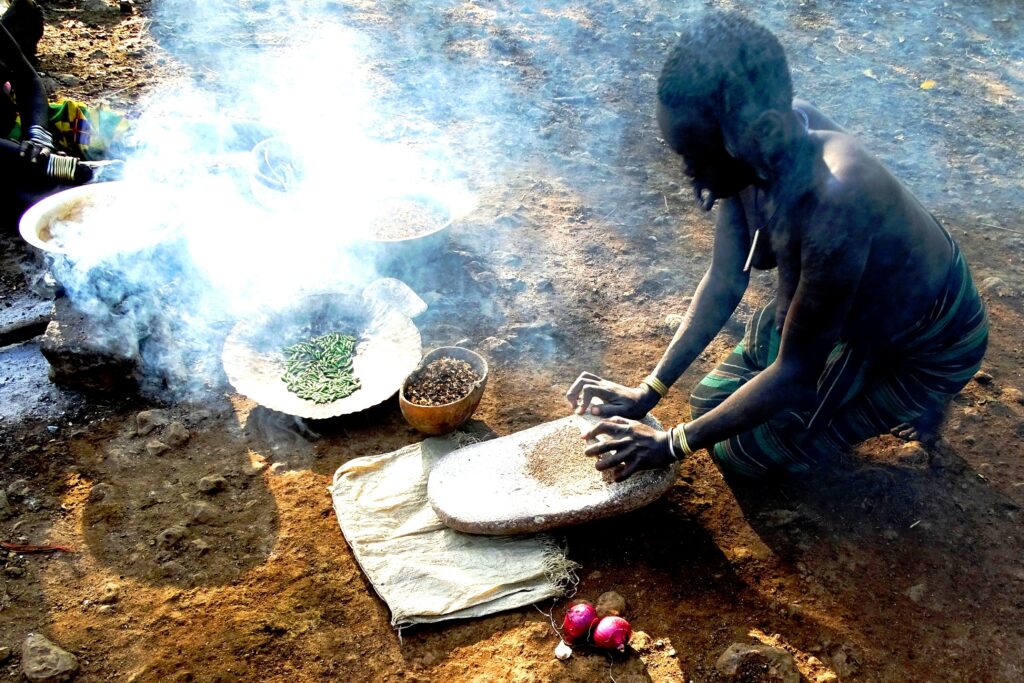
Spending a few late-morning hours in a tiny Mursi village in South Omo, Ethiopia, countless unmarked dirt roads from our predawn start in Jinka, was enough to change our lives forever. In that nameless Mursi village, we had truly gone back in time, yet nothing essential to what makes us human—babies, drinking a coffee drink, adornments, work, family, conversation, laughter—was missing.
Our guide Lalo made it possible for us to simply hang out with a dozen or so mothers, grandmothers, toddlers, and infants as the adults drank their version of morning coffee, which they called Tee Lahkeenoy. The day before, Lalo had collected discards from the buna washer at an outdoor Ari coffee processing center we’d visited—coffee cherry husks and skins that the Mursi women were now mixing with inch-long green chilies and red and green onions, the way the Mursi women always made their coffee. No one performed for us, wore their lip plates, or painted their bodies for us.
(Almost all of the older mothers and grandmothers had bottom lips that could easily stretch to accommodate the largest lip plates, as big as dessert plates, but the village women were home now, and talking and drinking coffee without the lip plates was far easier.)
Around the irregular circle, one young woman knelt to grind the mix of dried coffee cherry husks and skins with inch-long green chilies, grinding with one stone that had been ground against another for centuries, until the bottom stone was concave and dyed dark in places like a betel nut-stained tongue. Rarely stopping, she was never winded; and the sun-browned pile of coffee flour flecked with green grew ever higher, until the fine-ground flour was dumped unceremoniously with a handful of wild onion stems into the big boiling pot for the village ladies’ coffee. Other women roasted the coffee cherry husks or heated the chili peppers.
We weren’t invisible, of course. When a dog fight started in the middle of the irregular circle of Mursi women and charged right toward me, I was completely unnerved while the rest of the village had a big laugh. I imagine it was one of the big stories of the day when the men came home: “You should have seen that faranji when the dogs started fighting. He jumped up from his seat like a chicken flying off her perch!” (Or something like that.) When Lalo brought us some hot coffee from a thermos, Ruthie said “Ahh” and licked her lips, much to the amusement of the old woman painting lip plates in front of her.
As we watched a beautiful young woman with intricate scarification patterns up and down her arms—raised bumps that decorate dark skin better than any tattoo—grind the coffee cherry husks and skins and the little green chilies by stone and pour the mash into the big communal pot; an old woman setting freshly painted lip plates one after another on the ground; a group of older women talking and laughing and dipping their stitched leather cups and hollowed half-gourds into the pot, the babies being babies and their mothers and grandmothers being mothers and grandmothers, time slowed down and kept running backward.
In their youth the older women had worn their lip plates mainly during tribal ceremonies to attract the boys. Now, young women lined up mutely in the larger villages wearing their lip plates to attract tourists’ camera clicks instead of eligible men—five birr, one quarter U.S. dollar for every click—from the faranjis (foreigners) who spilled out of the white vans to line up with their cameras clicking like quarter-producing slot machines, and then spilled right back into their vans and drove away.
That was exactly what we had wanted to avoid.
There were just a few of us instead, sitting around, the women talking and drinking their coffee. This was the one and only time in our coffee travels that we didn’t partake in the coffee-related drink at hand.
The women didn’t care. Lalo had arranged everything with their Chief.
The sun warmed and the ground coffee cherry husks and chilies boiled over an open fire. Except for the presence of a few metal cooking pots, the small group of Mursi women could have been dipping their stitched cowhide cups into their usual communal coffee bowl on another warm November morning thousands of years ago.
My search for the origins of humans’ relationship with Coffea arabica had brought us here to this Mursi village. This culmination of our Ethiopian journey had brought us to the beginning, as far back as we could go in time and place and culture.
Ethiopia’s incomparable gift is burned into my brain in the best way, with the ever-vivid memory of that Mursi village, a memory that I can conjure up at any time in my alternate reality of twenty-first century California. As I drive down the freeway sipping Ethiopian Yirgacheffe and cursing the Humvee tailgating me, the Mursi women are enjoying their morning Tee Lahkeenoy as they have always done—and probably having a better time.
What exciting project are you working on next?
I’ve been fine-tuning a book of short stories with characters based on the coffee experiences in our book.
When did you first consider yourself a writer?
Ever since childhood I wrote down stories, often expanded from bits of dream material.
Do you write full-time? If so, what’s your workday like? If not, what do you do other than write and how do you find time to write?
I mostly write about travel, so we travel part of the year, and Ruthie does the photography. We have a regular retirement income—I’ve never been able to live off my writing.
What would you say is your interesting writing quirk?
I’ve always written prose as if I was writing a screenplay without a shooting script—the shots are all in my head as I describe the actions.
As a child, what did you want to be when you grew up?
I remember I wanted to impress people by saying I wanted to be a nuclear physicist, but all I’ve ever dreamed about is being a writer.
Anything additional you want to share with the readers?
Being a writer is just about writing, knowing that you’re creating something that never existed before. It’s about being compelled to write, whether anyone else ever reads it or not.