
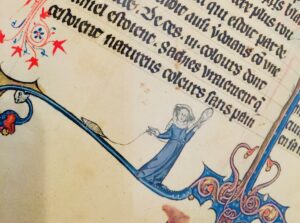
 Poet Mary Leader joins me today to chat about her new collection, The Distaff Side.
Welcome, Mary. Please tell us a little bit about yourself.
I began writing poems amid a career as a lawyer, first as an Oklahoma Assistant Attorney General and later as a Referee for the Oklahoma Supreme Court. The Distaff Side is my fifth collection of poems, my third in the United Kingdom with Shearsman Books. I am also the recipient of two major book awards in the United States, the National Poetry Series for my collection Red Signature and the Iowa Poetry Prize for my collection The Penultimate Suitor.
What do you enjoy most about writing poems?
Losing track of time. Taking a long view while finding absorption in detail. Gratitude for the rich amalgamation that is the English language, especially when pressured by the techniques of poetry, over the centuries. Ever used. Ever new.
Can you give us a little insight into a few of your poems – perhaps a couple of your favorites?
My favorite poems among my own are the ones I call “homespun.” These encompass the vernacular English I heard from birth through high school in Pawnee, Oklahoma, and elsewhere in the state thereafter. Examples are a list poem, “Probate,” in my first book, and a dramatic monologue, “Myrtle,” in this new book.
What form are you inspired to write in the most? Why?
I never met a form I didn’t like, whether historically traditional, or the different free-verse patterns, or a one-off for the nonce: the unique poem in hand at the moment. The very variety of form is my inspiration rather than any single form. One reason is this: dealings and even shenanigans with formal choices busy my mind so that ideas, and feelings, can sneak in while I’m not trying for them directly.
What type of project are you working on next?
I am putting the finishing touches on my sixth book, Earthshine, and getting the poems in it out to magazines. I’ve tried to follow a theme of transformation, which is not natural for me, but I am 73 and curious about it. Next, I am going to put together a Selected Poems by my late Mother, Katharine H. Privett, and write an introduction for it. Working for 25 years on The Distaff Side — the phrase refers specifically to the female branch of a family — I came to appreciate my mom’s real lyric talent and professionalism, usually unacknowledged by publishers, but not entirely — once in a blue moon, magazines and chapbooks — and blue moons added up over many decades of unfailing practice in the genre.
When did you first consider yourself a writer / poet?
I started late, in the throes of a midlife crisis. I thought I was merely expressing myself while crying. One sadness (as well as joy!) involved the growing up of my oldest child, my daughter Sara. I wrote a villanelle while crying about that. As the tears waned, the fascination of the form waxed. She was 16 at the time, but for the sake of the iambic pentameter line, I said she was !7:
hear it?: “She’s SEVenTEEN; her DOOR is ONE i KNOCK.” Art outweighs factoids.
How do you research markets for your work, perhaps as some advice for not-yet-published poets?
I use Poets & Writers. Reluctantly. Because I hate the subliminal guarantee, which is that if you work hard enough, to write, given lip service as the main thing, but really, implicitly just as important, work hard enough to send out your poems, then publication will happen sooner or later. Bogus promise! It infuriates me when a comfortably published poet tells an audience of wishing unpublished poets, “Don’t worry. If your work is good, it will be accepted. Cream rises to the top.”
There are good reasons to send out, chiefly because it helps you see the piece through other eyes, plus poems like it. It is also possible to use it as capital for buying stock in yourself. But the belief that only good poems are accepted and only bad poems are rejected is outrageously untrue. Moreover, in the categories of lies, it’s a cruel one and often a debilitating one. Fashion is the main driver of publication.
I was immensely lucky to start late because earlier I’d have cared way too much what other people thought. My advice is, whatever age you are, give no proprietor of slings or arrows the power of fatality. Poetry rises, not like cream, but when as such it is honored by a poet who feels free and takes care.
What would you say is your interesting writing quirk?
I use wingdings and other pictography and shapes, especially in The Distaff Side, which equates needlework with writing, textile with text. In a poem called “Argument,” I mount a legal defense of the seriousness and utility of these visual gestures.
As a child, what did you want to be when you grew up?
I don’t think I thought about it. I did once make an offhand remark at supper that I wanted to be a nun, but the horror-stricken look on the faces of both my Catholic mother and my Methodist father put the kibosh on that. Was I too easily swayed? Can I put swaying to use in writing?
Anything additional you want to share with the readers?
I pretty much gave my sermon in discussing marketing above. Fear not.
Thanks for being here today, Mary.