
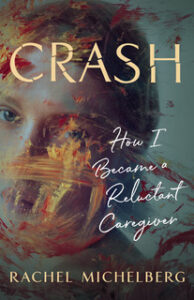
 Writer Rachel Michelberg joins me today to chat about her memoir, Crash – How I Became a Reluctant Caregiver.
Bio:
Rachel Michelberg grew up in the San Francisco Bay Area and still enjoys living there with her husband Richard and their two dogs, Nala and Beenie. She earned her Bachelor of Music degree in vocal performance from San José State University, and has performed leading roles in musicals and opera from Carmen to My Fair Lady and the Mother Abbess (three times!) in The Sound of Music. When Rachel isn’t working with one of her twenty voice and piano students, she loves gardening, hiking and making her own bone broth. Crash – How I Became a Reluctant Caregiver is her first book.
Welcome, Rachel. Please tell us about your current release.
Crash is the story of my dilemma regarding being thrust into a caregiving role for my husband David, after he suffered a severe brain injury in a plane crash. Our marriage had been in trouble before the crash – still, I wanted to do what was expected, what was “honorable.” But I knew I couldn’t be a caregiver long term. I faced pressure from David’s family and friends, struggled with a recurring eating disorder, and was stalked by the wife of a man with whom I’d started an affair.
Kirkus Reviews called the book, “…an engaging exploration of duty, guilt, and self-preservation. Michelberg is a frank writer…. continually willing to unpack her guilt while also exploring options for her own emotional survival. A cleareyed consideration of difficult ethical and familial choices.”
What inspired you to write this book?
At some point in their lives, most adults will be confronted with the challenge of caregiving – usually for an aging parent. I would contend that most don’t want the role. I’ve read heroic stories of those who rose to the occasion – but none about those who chose not to, nor the repercussions of that decision.
Excerpt from Crash:
The next day, Lois saves my life.
It could be argued that I save my own life. I make the decision. But Lois opens the door, and I go through it. Her permission is my get-out-of-jail-free card.
I turn down Lois’s offer of a soda from the vending machine. We’re having a where-are-we-now-and-what’s-next meeting on an outdoor terrace at Valley Med. The fog’s lifted— it’s a lovely California early summer morning.
She pulls two metal chairs under the shade of an umbrella, leans back to study me, shakes her head, and sighs. “My God, Rachel, you’ve had a rough time. How are you feeling now?”
Her genuine concern for me is surprising. Disconcerting. Until now we’d only discussed David’s condition, David’s needs. I don’t answer right away, shifting uncomfortably as the bones of my ass dig into the unforgiving metal chair. Lois’s eyes reflect the gaunt, skeletal creature in front of her. “Still pretty weak,” I admit.
“The doctors say that for every day you spend in the hospital, it takes about ten days to fully recover.” Where she is going with this? “You were there for nine days? Figure two to three months to get back to normal.” I see her steal a glance at my bony arms, IV bruises, dull hair. “You need to take care of yourself.”
I look at my left arm, clutch it protectively. Take care of myself ? How exactly? With my copious free time and excess millions of dollars? How the hell am I supposed to do that while caring for two kids and an impulsive, incontinent, seizure-prone grown man? “Yeah.” That is so not going to happen. My sad little life is over. I’ll even have to sneak drinks.
Lois’s focus is laser, blatant.
I shift again. Damn, this chair is hard. Can she hear me whining about the lack of chardonnay in my future? Does she have any idea how selfish I really am? How cowardly? Can she guess that afternoons without my lover are more terrifying than my children losing a father or me a husband?
“There is another option.”
“I have options?” My creative imagination was stolen from the bag I put my clothes in at the ER.
“David doesn’t have to come home.”
I almost laugh out loud. Seriously? No fucking way. I couldn’t do that. What kind of a monster would refuse to care for her disabled husband? Not me, not a nice Jewish girl like me. I do the right thing. I fill the postman’s bag with groceries. Buy unneeded gift-wrap from the neighbor’s kid. Recycle. I will take care of my brain-injured husband, no matter how unhappy I’ve been in our marriage.
“There’s a facility in Gilroy called Learning Services. It’s out in the country, kind of like a ranch. It’s run by a lovely person— Dr. Jill Winegardner. She’s Jewish, I think.” Lois studies me. “She looks like you. I think you’d really like her.”
It shouldn’t have been reassuring that the director is Jewish. But it is. Lois is throwing me a lifeline—but all I can think about is Dr. Winegardner and I comparing matzah ball soup recipes.
Lois opens a folder, a brochure slides across the table. She’s been preparing for this conversation. She’s been tracking my reality. I haven’t been alone!
“They have a day program as well as live-in, but I’d recommend that David start with few months in residence.” So gentle. But so firm.
“But . . . ”
She holds up her hand. “Just so you can regain your strength.” I allow myself to glance at the brochure, but quickly avert my eyes from that gateway to moral depravity. Yet, something shifts. In an instant I know I’m dangerously capable of considering her suggestion. Barely suspecting that my role as the heroine, the ingénue, the victim, is about to be usurped—just like Bette Davis in All About Eve.
This can work. No it can’t. David can’t go into an institution. Crazy people go into institutions, put there by selfish relatives who can’t handle a little extra work. I can see the evil twin peeking from behind the curtain, stage left. The twin who would protest, “What about me? What about my life? My needs, my happiness? Don’t I matter?”
Lois watches me wavering. She seizes her chance. “Your kids are so young. They are traumatized, too. They need a lot of support. The demands on you are going to be enormous. It would be insanely difficult in the best of circumstances—but you’re weak, you’re drained. You have no idea how often I’ve seen perfectly healthy caretakers implode from the stress.” She moves in for the kill. “If you can’t do it for yourself or David, do it for Hannah and Joshie.”
My sore ass is forgotten. I lean forward. “Tell me more about Learning Services.”
What exciting story are you working on next?
I’m considering a historical novel based on my grandmother and mother’s lives, both women who lived unfulfilled lives as wives and mothers. It would move from Russia to the tenements of the lower east side and Los Angeles during WW2, to Japan and then Northern California during the tumultuous 60s.
When did you first consider yourself a writer?
Not sure I do yet! Perhaps when my book is published?
Do you write full-time? If so, what’s your work day like? If not, what do you do other than write and how do you find time to write?
I don’t write full time. I teach voice and piano in the afternoon. I stopped writing after I finished my book, thinking I didn’t have another story in me. But there are more stories to be told. So I joined a writing practices class to exercise those muscles and get the ideas flowing. My plan is to scale back my music studio and focus on writing.
What would you say is your interesting writing quirk?
I listen to NPR all day (when I’m not teaching) but when I’m writing I have classical music on, mostly my favorites Mozart and Vaughan Williams. I like to take my dogs for a walk after an hour or so to clear my head.
As a child, what did you want to be when you grew up?
I wanted to be Julie Andrews. Seriously.
Anything additional you want to share with the readers?
My story is raw, and honest. I consider myself an anti-hero. Very flawed, very human. I wanted to expose the genuine reluctance to – on occasion – reject conventional expectations. Not to promote the rejection of caregiving responsibilities, just to open the discussion.
Links:
Website | Facebook | Instagram
Thanks for being here today, Rachel.