
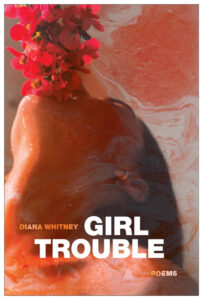
Poet Diana Whitney chats with me about her new poetry book, Girl Trouble.
Bio:
Diana Whitney is a queer writer and educator embracing a fierce belief in the power of poetry as a means of connection to self and others. She is the editor of the bestselling anthology You Don’t Have to Be Everything: Poems for Girls Becoming Themselves, winner of the Claudia Lewis Award, and the author of three full-length poetry books, Wanting It, Dark Beds, and Girl Trouble. Her writing has appeared in the New York Times, the Kenyon Review, the San Francisco Chronicle, and many other outlets. An advocate for survivors of sexual violence in her Vermont hometown and beyond, Diana works as a developmental editor and a community organizer for a rural LGBTQ+ nonprofit.
What do you enjoy most about writing poems?
I love the surprise and strangeness of poetry, how you can follow language and image into another realm and not know where it will take you. Writing poems is an emotional conduit for me and a path of self-discovery.
Can you give us a little insight into a few of your poems – perhaps a couple of your favorites?
In my new book Girl Trouble—about raising girls, surviving rape culture, and excavating female adolescence—I have a series of poems reimagining high school and reclaiming my own queerness. They were fun and empowering to write, and the project enacted a kind of healing I didn’t know I needed. Both “Prom After-Party Revisited” and “My 16-Year-Old Self Makes Out with Jaimie Rossi” are joyful retellings of some of the unhappiest moments of my life, vivid fantasies about girls I had crushes on but could never acknowledge at the time. I love how poetry allows us to move backwards and forwards in time and create new worlds in the process. In doubling back and re-visioning the past in these poems, I’ve been inspired by Stephanie Burt’s idea of queer time. In the introduction to her marvelous anthology, Super Gay Poems, she writes: “We rainbow people may (not must, but may) experience the passage of time in a way that’s shaped by our gender and sexuality. We seem to be more likely to double back, to live in the moment (or try), to inhabit a not-yet, a future still unbuilt, to do what looks (to the straight world) like not growing up, or otherwise reject the pace, the markers, and the milestones that define, for straight, cisgender people, the passage of time.”
What form are you inspired to write in the most? Why?
For many years I only wrote free verse poems, which had their own musicality and rhythm (and often slant rhyme) but were not in any traditional form. I feared my voice would be muted by formal constraints and resisted when one of my mentors (Major Jackson) recommended I try writing in form. But when I finally tried sonnets, I found them thrilling and liberating, and they became a gateway to other forms. I went on to experiment with sestinas, villanelles, pantoums, and mirror poems; I discovered they worked as containers for challenging subjects (sexual violence, family estrangement), a way to write through trauma, to work with it in a measured way on the page. I’ve been surprised by the discoveries I can make when writing in form and want to keep stretching myself, trying unfamiliar ones.
What type of project are you working on next?
To be honest, I’m in between projects at the moment and have had to give myself permission to rest, read, and not be “productive” in my writing. My mother died two years ago, at a time of other major losses, and tending to my grief has required most of my creative energy. I’ve accepted that I’m a slow writer in general and have learned not to force a project, to trust the process (as my mom used to tell me) and believe that eventually something new will bubble up.
When did you first consider yourself a writer / poet?
I loved writing fantasy stories as a child and started writing poems in the crucible of middle school. In high school, I had two wonderful English teachers who encouraged my creative writing, and I started to consider myself a poet.
How do you research markets for your work, perhaps as some advice for not-yet-published poets?
I notice where the poets I most love are publishing and then try submitting to those markets. But I haven’t been rigorous about submitting the past few years and believe it’s healthy for poets to have periods where we immerse ourselves in reading and our own writing projects without the pressure to publish (see: tending to grief, above).
What would you say is your interesting writing quirk?
That is a tough question! I aspire to be quirkier, to strange up my writing. Maybe one interesting thing is that I write across genres—back in the Baby Cave, when my daughters were little, I wrote an irreverent parenting column called Spilt Milk for four years. Now I write everything from lyric poems to conversational personal essays to scathing feminist op-eds.
As a child, what did you want to be when you grew up?
I wanted to be an astronaut as a young child, which is odd because I’m a bit claustrophobic now and have a fear of heights. I like to think of that childhood dream as a kind of metaphor—the vastness of imagination, the infinite possibilities of Space.
Anything additional you want to share with the readers?
The cover of Girl Trouble uses a photograph taken by my (now) 18-year-old daughter Carmen, as part of her high school art project. It feels fitting to have the artwork of a teen girl guiding this book into the world. Thank you for being there for the journey!
Links:
Website | Cavan Kerry Press | Instagram | Facebook