
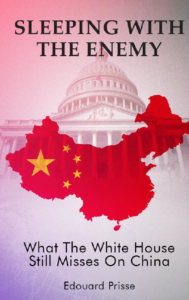
Writer Edouard Prisse is chatting with me about his new economics book, Sleeping with the Enemy: What The White House Still Misses On China.
Bio:
Edouard Prisse is a strictly independent thinker and author, who refuses any affiliation anywhere. He has an MA Dutch Law, an MBA from INSEAD and has deeply studied Keynesian theory. He founded his own company, set up a daughter company in China, and has two children by his Chinese wife. He publishes about the damage that the perceived general absence of macro-economic knowledge almost everywhere in the West does to our economy, and, crucially, what the White House can and—in his opinion, should—do about the worst result of this absence: the erroneously created, damaging free trade with China that has now existed for 25 years.
Welcome, Edouard. Please tell us about your current release.
This book is the best version of my extensively researched writing about what we—the US—still do wrong in our trade relations with China.
What inspired you to write this book?
I saw around 2003 that China’s growth was coming and would harm us. Everybody told me I did not know what I was talking about. Seeing it happen as I had predicted gave me the task to write about it.
Excerpt from Sleeping with the Enemy: What The White House Still Misses On China:
(Taken from Chapter 1)
Anyone unhappy with the growing power of China and the impossibility for our industry to compete with the low Chinese prices needs to know the origin of the present global trade disequilibrium.
It started in the year 2000, when President Clinton argued that we needed free trade with China. He made the US take that initiative, and the whole world outside China followed the US’s lead.
Speaking at the Paul Nitze School of Advanced International Studies in New York, a part of John Hopkins University, on March 8 of that year, President Clinton gave his arguments. The sheer absurdity of what he said there leaves no doubt that a single leader—and an entire nation with him—can be totally mistaken on a critical issue, which in this case has put the entire West at risk. Below, you will find the central portion of his speech, with the six key errors the President made, numbered.
President Clinton said:
“The (coming) WTO agreement will move China in the right direction. It will advance the goals America has worked for in China for the past three decades. And of course, it will advance our own economic interests (1). Economically, this agreement is the equivalent of a one-way street (2). It requires China to open its markets—with a fifth of the world’s population, potentially the biggest markets in the world—to both our products and services in unprecedented new ways. All we do is to agree to maintain the present access which China enjoys.
Chinese tariffs, from telecommunications products to automobiles to agriculture, will fall by half or more in just five years. For the first time, our companies will be able to sell and distribute products in China made by workers here in America, without being forced to relocate manufacturing to China (3), sell through the Chinese Government, or transfer valuable technology (4). For the first time, we’ll be able to export products without exporting jobs (5). Meanwhile, we’ll get valuable new safeguards against any surges of imports from China (6 ).”
I am not quoting this incredible nonsense here to criticize President Clinton. Statesmen hardly ever have a macroeconomic education or understanding—with the famous exception of China’s Deng Xiaoping, of course—and President Clinton was simply articulating what his economic and trade advisers had told him and what everyone seemed to have easily agreed upon at the time.
What exciting project are you working on next?
I wish to publish an article on one of the cornerstones of the book. It is about the perceived absence of macro-economic knowledge in the whole West, including in the many universities. This article shows how this absence came about. It is now ready for publication.
When did you first consider yourself a writer?
I started small time, by sending my opinions to newspapers. I got published and so my wish to give clear information about controversial subjects grew.
Do you write full-time? If so, what’s your workday like? If not, what do you do other than write and how do you find time to write?
Almost full time. I also organize house concerts here with young talented pianists.
Being retired, I have the time to write.
What would you say is your interesting writing quirk?
It is my ability to present a complicated situation in simple, fun-to-read language. The negative side of this ability is of course that some people cannot take seriously what I write, because it seems too easy to them.
As a child, what did you want to be when you grew up?
Conductor and composer.
Anything additional you want to share with the readers?
My advice: take a little time to read this. It is so very interesting.