
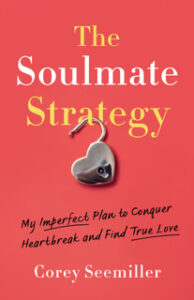
Memoirist Corey Seemiller chats about her book, The Soulmate Strategy: My Imperfect Plan to Conquer Heartbreak and Find True Love.
Bio:
Corey Seemiller is an award-winning professor of leadership and global generational expert. She has authored several books and articles and speaks at events around the world. Her work has been featured in major news publications and media outlets such as NPR, The New York Times, Time Magazine, and Newsweek, and her highly popular TED Talk has garnered hundreds of thousands of views. An accredited life coach with specialties in Law of Attraction and intuitive development, Corey also co-hosts the Rock That Relationship! podcast, discussing debacles and successes with breakups, healing processes, dating, and relationships. Corey resides in Tucson, Arizona.
Welcome, Corey. What inspired you to write this book?
This book was wholly inspired by my devastating breakup that left me curled up on the floor sobbing for days. When nothing seemed to be making me feel better, I took control and decided I would embark on a quest to heal and move on. But, this journey was anything but predictable, no matter how much control I attempted to assert. While I faced setbacks and more heartbreak, I also experienced epic adventures, made new connections, and discovered so much about myself (like my propensity to eat jelly beans while under stress or how the infamous rapper, Eminem, always seemed to offer sagely wisdom to me through his music).
Once I entered the dating scene, the absurdity took over, and I could barely keep the ridiculous tales to myself. After sharing many of them with friends and loved ones, I decided to chronicle my journey in writing, both as a way to reflect on my experience as well as to help others who might be struggling moving through their own heartbreak. Perhaps if they saw the lengths I went to in order to try to heal and find love, they would feel validated in their own efforts.
Excerpt from The Soulmate Strategy:
I waited by security, pacing and looking at every exiting passenger. I was hoping that once we met, my anxiety would melt away and I would have pow, boom, bang.
I finally saw her walking toward me. She was taller and stockier than I had imagined. Her sandy blond hair fell to the shoulders of her gray cardigan sweater, which she was wearing over a collared dress shirt, not quite the fashion I was attracted to.
She flashed a glowing, wide grin. As she came closer, I felt nothing . . . literally nothing. No pow. No boom. And certainly, no bang. The heavy rock sitting in my stomach smothered any butterflies that might have been there weeks earlier. Shit. What did I do? This lady just flew across the country for some romantic rendezvous with me, and I was so uncomfortable with my own guilt for feeling uncomfortable that all I wanted was for her to get back on the plane.
What exciting project are you working on next?
I’m in the final stages of editing a heartbreak to healing interactive self-help book that follows along with many of the efforts I engaged in during my journey…from going to a breakup coach to writing a love manifest.
When did you first consider yourself a writer?
When I was in elementary school, a local theater troupe selected my play about a king and his missing bag of gold to perform for the school. Then, in sixth grade, I wrote a poem for the yearbook, and in high school, I authored a short story published in a compilation book called Every Woman Has a Story by Warner Books. While all of these were examples of being validated as a writer by the external world even at an early age, I have probably considered myself a writer since I learned how to write.
Do you write full-time? If so, what’s your workday like? If not, what do you do other than write and how do you find time to write?
I am a full-time professor, which does involve writing, particularly academic articles and books. However, I have always written outside of work whenever I can – everything from poems to songs to my memoir.
My two favorite times/places to write include my Shut Up and Write Meetup group, where we gather online for an hour a week and write uninterrupted. I also enjoy writing on the plane (as I travel a lot for speaking engagements) because it provides the perfect place to write distraction-free.
What would you say is your interesting writing quirk?
It isn’t necessarily a quirk that appears during my writing but instead one that inspires me beforehand. I go on a 4-mile walk every day. During that time, ideas about a current writing project will often bombard me. So, I keep an open email on my phone and type in each idea as it comes. Once I get home, I send myself that email, and voila, I have a whole list of ideas! Whether it’s titling a book or solving that tricky puzzle of wording that kept me from finishing a section, I can always count on my walks to make me a better writer!

As a child, what did you want to be when you grew up?
I actually wanted to be a teacher. I would line up my stuffed animals, stand in front of a chalk board, and teach them subjects like math and language arts. I also had a fascination with writing and considered being a journalist during high school when I wrote for the school paper.
Anything additional you want to share with the readers?
I have written and published many pieces throughout my life. And, I have been inspired by, proud of, and excited about each of them. But, there was something very special about the process of writing this memoir. Because the book is about my story rather than a compilation of concrete ideas or data-driven research like my typical academic publications, I feel a much stronger and more meaningful connection to the content. That comes with more fulfillment, but also more vulnerability. I had to capture dialogue and scenes as they unfolded, even if at some points, I wanted the story to take a different path. Staying true to what happened in real life forced me to describe my own character in a not-so-positive light at times. Having to write about and then re-read about my questionable choices and missteps over and over through the editing process was a learning experience for me that actually helped with my own self-growth.
Links:
Website (book) | Website | LinkedIn | Facebook (author page) | Facebook (personal page) | Amazon