
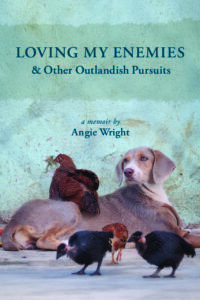
Writer Angie Wright is chatting with me about her memoir, Loving My Enemies & Other Outlandish Pursuits today.
Bio:
Angie Wright has always liked starting trouble—good trouble, as civil rights hero Rep. John Lewis called it. She was the founding pastor of Beloved Community United Church of Christ in downtown Birmingham, Alabama, where she served for sixteen years. She was a founder of Alabama Arise and a leader in Alabama’s immigrant rights movement. She served on the staff and boards of numerous local, regional, and national non-profit organizations. Now retired, Angie lives in Hillsborough, North Carolina with her red dog, Rio. She has two splendid sons and a precocious 8-year-old grandson.
Welcome, Angie. Please tell us about your current release.
This memoir of faith, family, and power follows Angie Wright’s commitment as an activist and pastor to stand against hate without hating the haters. In her story, spirituality meets social justice and personal betrayals push against her ethic of forgiveness.
In Loving My Enemies & Other Outlandish Pursuits, Wright probes questions most of us have to face at times in our lives: How do we reconsider our relationship with people we’ve been taught to fear, disrespect, and maybe even hate? And when others wreak harm on us or our communities, can we respond in ways that summon their humanity while protecting our own?
What inspired you to write this book?
I was taught to disrespect and even hate people who were different than my family of origin. Even as a young child, I knew that was wrong. I promised myself that one day, I would speak out and stand up against hate. And I did, as a community organizer and later, as a progressive Christian pastor. I was deeply influenced by the teachings of civil rights heroes and heroines who rooted their courageous and costly fights against injustice in the power of redemptive love. As much as I hoped to emulate them, I often found myself hating the haters and tempted to retaliate when loved ones betrayed me. This memoir is my story of seeking a better way.
Excerpt from Loving My Enemies & Other Outlandish Pursuits:
After the funeral my five siblings and I went back to our father’s McMansion. I had never seen the house before. I had never been invited. A crack in the driveway caught the heel of my dress shoe and I nearly tripped. The utter disrepair of this lavish home shook me. Rotten eaves, holes in the roof, an awning hanging loose. Kudzu—that quintessential Southern sign of decay—climbing the walls, wrapping around the gutters, creeping onto the roof, on its way to creating a ruin. It was as if despair had grown from the inside out.
In the garage an antique, maroon Bentley lay disemboweled and propped up on blocks, covered with dust an inch thick, piled high with crumpled boxes, torn dog beds, decades-old baby seats, and moldy life jackets. There was so much rubbish piled around the car, I couldn’t get close enough to peer into its filthy windows.
From there I wandered into the basement, where I discovered a trophy room of sorts, a graveyard of stuffed wild game my father had killed on hunting trips. The animals tumbled all over each other as if they had suddenly collapsed, unable to go on. Their horns were cracked, limbs broken, eyes weeping. A green-gray mold grew on their balding hides. Clumps of hair piled up like abandoned bird nests on threadbare animal hides that rotted on the floor. So this is how his story ended, I thought. Everything he cared about, left to decay.
What exciting project are you working on next?
My project now is to invite deep conversations about what love requires of us in these times of profound discord and division.
When did you first consider yourself a writer?
I imagined myself as a poet in high school. Instead I became a community organizer and pastor. I did a lot of writing: grant proposals, reports and weekly sermons. Only after retiring and devoting myself to the practice of writing did I come to think of myself as a writer.
Do you write full-time? If so, what’s your workday like? If not, what do you do other than write and how do you find time to write?
I write in bursts. I’ve never been good at maintaining routines. Deadlines have held a mystical power to bring forth my best writing.

What would you say is your interesting writing quirk?
I love writing in noisy places.
As a child, what did you want to be when you grew up?
A flight attendant. A poet. A doctor.
Anything additional you want to share with the readers?
Never doubt the power of stories to change hearts and minds.