
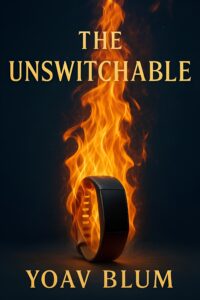
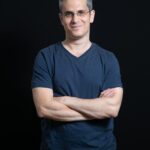
Thriller author Yoav Blum chats with me about his new technothriller, The Unswitchable.
Bio:
Yoav Blum is an author who masterfully blends high-concept speculative and science fiction with gripping mystery, thriller, and philosophical depth. His novels delve into the extraordinary – from the overwhelming experience of hearing the thoughts of everyone around you, to the mind-bending possibilities of time travel, the intricate mechanics of body switching, and the hidden art of orchestrating coincidences.
But beneath the thrilling concepts lie profound questions about what it truly means to be human. Blum explores the complexities of identity, the struggle to define the self amidst external influences, the nature of consciousness and perception, and the delicate dance between fate and free will. His narratives often feature compelling mysteries, secret knowledge, and unique characters grappling with the extraordinary challenges their abilities or circumstances present.
With a tone that is at once introspective, suspenseful, and sometimes playfully self-aware, Blum invites readers to question everything they think they know about reality, human connection, and the stories we tell ourselves.
Winner of three Geffen Awards,
Welcome, Yoav. Please tell us about your current release.
My current release is The Unswitchable. It’s set in a world where a single, deceptively simple invention allows people to switch bodies with one another. The technology works a bit like a smartwatch: you “call” someone, they accept, and the two of you instantly trade bodies.
Everyone can do it, except one man.
For reasons no one fully understands, he’s immune to switching. That exception pulls him into a dangerous web of conspiracy, violence, and murder, turning his very normality into a liability. At its core, The Unswitchable is a fast-paced thriller, but it also asks deeper questions about identity, the self, and the fragile connection between mind and body.
What inspired you to write this book?
The inspiration came from my ongoing fascination with the idea of the self – what defines it, where it resides, and how much of it is tied to the body. Questions of authenticity, identity, and selfhood run through most of my work, and this time I approached them through the lens of the mind-body connection.
I also like to challenge myself structurally from time to time, so I experimented with how the story is told and how information unfolds. That said, first and foremost, I wanted this book to be fun to write and exciting to read. It’s a thriller, an adventure, and a philosophical playground – all trying to coexist without getting in each other’s way.
What exciting project are you working on next?
I’m currently working on my seventh book, which is, in many ways, about writing itself. It explores how meaningful (or possibly meaningless) writing can be, both personally and in relation to the world.
It’s very different from my previous books: more introspective, more confrontational, and somewhere between self-reflection and shouting into the void.
When did you first consider yourself a writer?
Honestly, not after my first book, and probably not even after my second.
For me, being a writer isn’t about publication. It’s about the ability and willingness to sustain a coherent thought over time, to return again and again to the core of being human and echo something meaningful forward, each time in a slightly different way.
I think you can only call yourself a writer in retrospect, after years of looking back and asking whether you managed to say something that lasted. The same probably applies to being an artist.
Do you write full-time? If so, what’s your workday like?
I do write full-time now, though I didn’t start that way. I used to be a software programmer and wrote one or two days a week. A few years ago, I made the leap to writing full-time.
That said, it would be dishonest to claim I write all day, every day. Writing is always a struggle – sometimes to find the time, sometimes the will, sometimes the passion. I’ve come to believe that “writing” also happens when you’re not physically writing: when you’re observing the world, thinking about it, absorbing it, and letting experiences settle into something that might later turn into words.
This tension – between letting writing take over your life and letting life feed the writing – is something I’m actively exploring in my current novel. These days, I suspect that integrating writing into life, rather than letting it consume you , might be the healthier path.
What would you say is your interesting writing quirk?
I’m not sure how interesting it is, but I create playlists for different scenes or chapters. Each type of moment – action, reflection, tension – gets its own soundtrack. When I write a specific scene, I can listen to the playlist created for it. It helps me slip back into the emotional rhythm of that part of the story.
As a child, what did you want to be when you grew up?
I don’t remember a single clear answer, but I do remember wanting to create things. Not necessarily as a writer or an artist, creation itself was the point.
I still see software, writing, and storytelling as variations of the same impulse: bringing something new into the world. Almost any human act that genuinely creates feels meaningful to me.
Anything additional you want to share with the readers?
I believe a book is only fully written during the reading process. Every reader brings their own interpretation, giving the story new meaning each time it’s read.
My hope is that my books linger – not just as entertainment, but as something that opens new thoughts, questions, or inner conversations. If a story stays with a reader after the last page, quietly reshaping the way they see something, that feels like the real reward.