
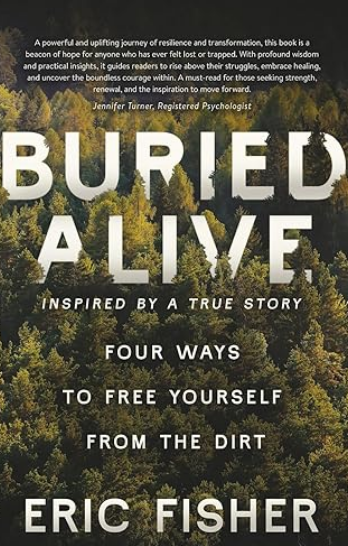
Writer Eric Fisher chats with me about his new non-fiction, Buried Alive: Four Ways to Free Yourself from the Dirt.
Bio:
Canadian transplant. Southern US born. Eric Fisher is a Canadian Certified Counsellor residing in Calgary, Alberta, Canada. Originally from Tennessee, he has over 15 years of experience working outpatient and inpatient treatment settings in the US and Canada. He has two books published at this time: The Martial Art of Recovery: Self-Mastery Practices to Subdue Addiction and Achieve Mental Wellness, and Buried Alive: Four Ways to Free Yourself from the Dirt.
Eric is a master practitioner of Accelerated Resolution Therapy (ART) and is also trained in Eye Movement Desensitization and Reprocessing (EMDR), both of which are evidence-based treatments for trauma. Eric’s private practice, Recovery Arts Counselling, serves individuals, couples, and families both locally and remotely. He also serves as an associate for local clinics in the surrounding area. In the past, Eric has supervised master’s-level graduate students and counsellors early in their careers.
He has won multiple awards for screenwriting: The Departure – official finalist in biographical/historical genre – 2014 Beverly Hills Screenplay Contest; Only 16 Miles – Finalist – 2014 Horror Screenplay Contest. Universal Escapade (Finalist – Top 25) – We Screenplay International Screenplay Competition. Hipster Z (co-written) – best feature screenplay – 2017 Action On Film International Film Festival. Hipster Z – Best horror/comedy Screenplay – 2017 International Horror Hotel Film Fest.
Additionally, Eric has a black belt in two martial arts styles: American Kenpo and Wadō-ryū. One interesting thing about Eric is that he had the opportunity to be an intern with the FBI — twice. Eric enjoys hiking and riding his bike outdoors, music concerts, tasting new food dishes, travelling near and far, and meeting people.
Welcome, Eric. Please tell us about your current release.
Buried Alive: Four Ways to Free Yourself from the Dirt is part true story in documentary fashion and part self-help. I incorporate strategies for helping readers unearth themselves from what keeps them buried alive in a metaphorical sense – shame, guilt, regret, depression, etc. I bring in the true story of a harrowing incident my father went through and tell what happened through real life interviews with the three men involved. I apply the strategies to what happened on that fateful day in February 2020 and also give practical suggestions for how to apply the strategies. The parts of the book include finding the balance with certain topics such as emotions, comparisons, planning, and many more, the CIA acronym (curiosity, introspection, and agency) and its importance with mental wellness, the importance of social connection, and a mysterious word that begins with a “W” that is important for how to approach daily life. I move back and forth between the true story interviews and the self-help strategies and at the end of the book give examples of how to incorporate all the strategies with real-life examples.
What inspired you to write this book?
I wanted to give inspiration from an incident that was scary for those involved. I wanted to highlight the importance of resilience in our lives, which I find to be very important. The true story of what my dad went through was a good example of resilience.
Excerpt from Buried Alive: Four Ways to Free Yourself from the Dirt:
“If I had to summarize this book, I’d say it’s about rediscovering our self-identity. Far too many of us are buried alive beneath our regrets, shame, guilt, trauma, addiction, pain, suffering, grief, and general disconnection from ourselves. This book aims to decipher the messages and our inner wisdom on how to arise from the dirt. Through this process, we can find ourselves again in an authentic, unrefined, and realistic way. We may not even know we have buried ourselves. Denial, minimizing, rationalizing, or outright avoidance may create obstacles in our path that hide the true extent of our submersion. We are crawling in the dark, attempting to flip on the light switch. The lighthouse in our soul seems distant. There is a way back to the light. We can chart a course to reach the lighthouse, illuminating the truth from its vantage point close to shore. What we may lack are the details.”
What exciting project are you working on next?
I’m at the point of finishing my rough draft on my upcoming non-fiction manuscript. The book is about my journey as a mental health counsellor – my learnings, experiences, mistakes, and successes. The content will be exploitative on account that I don’t hold much back with the material and I’m quite vulnerable with the true stories from my time as a professional in the mental health field.
When did you first consider yourself a writer?
I would say when I wrote a short story in history class in 8th grade that received recognition from the teacher for its attention to detail and creativity. The story was about a runaway slave (the topic that we were asked to write a story about).
Do you write full-time? If so, what’s your workday like? If not, what do you do other than write and how do you find time to write?
I don’t write full time. I am a professional therapist, which takes up a lot of my time. I do my best to stay active with a podcast I’ve started that’s called Recovery Arts. I also like to stay active in different ways, whether that’s walking outside, riding my bicycle, and working out indoors. I seek out the pockets of time where I feel I am the most creative and prepared to delve into the writing realm. Spontaneity plays a big part in the writing process, and that can be for minutes at a time or longer than an hour depending on the circumstances. I often will not write in a public space and find that I’ll write mostly at home.
What would you say is your interesting writing quirk?
I sometimes like to listen to music when writing that’s tranquil and ethereal.
As a child, what did you want to be when you grew up?
I’m not sure – definitely not a writer or a therapist! I honestly cannot remember.
Anything additional you want to share with the readers?
I hope that you are able to find content, from my book and otherwise, regardless of the genre, that inspires you and that you find insightful.
Links:
Website | Linktree | Instagram | LinkedIn | Facebook | Hiro FM