
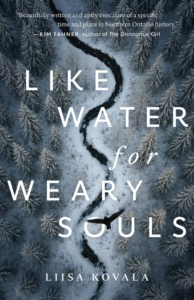
Mystery author Liisa Kovala is chatting with me about her new historical novel, Like Water for Weary Souls.
Bio:
Liisa Kovala is a Finnish Canadian author, certified fiction and memoir book coach, and podcast host. Like Water for Weary Souls (House of Karhu, 2025) is her second historical novel. Her debut historical novel, Sisu’s Winter War, was released by Latitude 46 Publishing in 2022. Surviving Stutthof: My Father’s Memories Behind the Death Gate (Latitude 46, 2017) was translated and published by Docendo in Finland and short-listed for a Northern Lit award. As a certified Author Accelerator fiction and memoir book coach, Liisa works with writers both in small group settings and individually to plan, write, and revise their manuscripts. Liisa features fellow writers in her Women Writing newsletter, hosts the Women Writing Podcast and co-hosts Rekindle Creativity Women’s Writing Retreats. Learn more about Liisa at liisakovalabookcoach.com and visit liisakovalawomenwriting.substack.com.
Welcome, Liisa. Please tell us about your current release.
Like Water for Weary Souls is set in the harsh landscape of a Depression-era Northern Ontario mining town. Finnish immigrant sisters Hanna and Essi Kivi scrape together a living as domestic workers, sharing a room in a disreputable boarding house owned by a protective madame.
When Hanna’s body is discovered in the icy waters of Nolin Creek, the police call it a tragic accident. But Essi knows better. Her sister would never have risked crossing unstable ice—not after they lost their youngest sister Martta to drowning years before.
Haunted by guilt and driven by loyalty, Essi begins to unravel the secrets Hanna kept hidden. As Essi digs deeper into her sister’s final days, she discovers that in a town built on desperation and dreams for a better future, everyone has something to hide.
What inspired you to write this book?
As a Finnish Canadian, I’m interested in historical events involving Finnish immigrants. I was inspired by Varpu Lindstrom’s book Defiant Sisters. She wrote about women in 1930s in my hometown of Sudbury, Ontario, including domestic workers, boarding house owners, bootleggers, and madams who ran brothels. I was also fascinated by the North American Finns who moved to Soviet Karelia in the 1930s in search of a better future. They created a socialist utopian society or workers’ paradise.
Excerpt from Like Water for Weary Souls:
Prologue
My dreams of Karelia are buried with me, beneath a thin sheet of ice in a shallow creek. From where my body lies, frost paints the steel girders of the bridge above me, blending its footings with the snow-covered embankment. Dark clouds will soon obscure the slate sky, dotted with stars, and the snow will fall.
It is the kind of Northern Ontario night that envelops one in its complete stillness. The kind of air that transforms one’s breath as it balloons and stretches, spirals, and dissipates. My breath is still, stopped by an unjust hand. No one will see my body, nearly covered in water so cold I would be numb if I could feel it. My partially exposed face reveals one eye, wide open, and so blue it’s almost translucent. It sees nothing, yet I see all.
With little will, I rise from the creek, from my heavy body, from the water tugging at my clothes. No signs of life within my empty shell and yet everything is awake to me now. A cacophony surrounds me: creeping growth of frost, cracking of shifting snow, colliding of water and ice, sighing of cold air, shifting of stars, scraping of snowflakes against sky. I am apart from it and yet a part of it all.
A low rumble follows a tremor in the air in the distance growing steadily louder. The night train’s light, a pinprick in the distance, expands towards me until it illuminates the scene below in blinding clarity. The clack and whine of wheels against steel tracks are enough to wake the dead, or so I’ve heard.
A gust awakens the trees, their branches crunching along the shore, and passes through me, threatening to drag me in every direction. I will myself to stay. For how long, I cannot tell. I only know I am tethered to this place, to this one lifeless body, to this one space in time, despite the powerful pull from some force wishing me away. Not yet. Not until.
What exciting project are you working on next?
I’m currently working on the second book in the Hygge House Cozy Mystery series called Midsummer, Marriage, and Murder. The first book, Hygge and Homicide, will be released in March of 2026, followed by book two, and book three in the fall. It’s been delightful to dip back into this Nordic inspired story and revisit the quaint small town, quirky characters, and hygge coziness.
When did you first consider yourself a writer?
I was a writer from the time I was very young, but I didn’t call myself a writer until I was working on my first full-length project, Surviving Stutthof: My Father’s Memories Behind the Death Gate (Latitude 46 2017) around the time I turned forty. That’s when I became very serious about writing and studying craft. While interviewing my father about his experiences as a Finnish merchant marine sailor in a Nazi concentration camp in Poland at the age of sixteen, I started studying at the University of Toronto’s Creative Writing Certificate program, and later studied at the Humber School for Writers.
Do you write full-time? If so, what’s your workday like? If not, what do you do other than write and how do you find time to write?
I am fortunate to have a second career as a creative. Previously, I was a secondary school teacher and taught English, Creative Writing, and AP Research. I left teaching in 2022 and am now a full-time writer and book coach. My current schedule might feel chaotic to other people, but I love it. My workday starts a little later than my previous career. I’m usually working by 10:00 am, and sometimes later, but I usually stop working at around 8:00 pm. The day might include client work, recording podcasts, writing for Substack, writing time, hosting online writing groups, instructing small group book coaching classes, posting on social media, and a variety of other tasks depending on the day and upcoming deadlines. I’m also organizing Book Coaches Canada’s first online event for spring of 2026, am a Board member for Wordstock Literary Festival, and will president of Sisters in Crime, Toronto Chapter starting in 2026. As you can see, I like to have a lot of interesting projects happening at any given time.
What would you say is your interesting writing quirk?
I can write anywhere! I love to write in a coffee shop, but I’ve been known to write in my car, at the dance studio, during theatre rehearsals, and at sporting events. I can tune out the background noise and get into the groove, even if it’s only for ten- or twenty-minute sprints. Also, I usually have three projects on the go: one that is nearing the end stage, one that I’m drafting, and one that is at its idea stage. That way, I never get writers’ block. I just switch to a different project.
As a child, what did you want to be when you grew up?
As a child I wanted to be three things: a teacher, a writer, and a dancer. It turns out that I was a teacher for 28 years, I’m a writer, and I’ve been a rhythmic gymnast and coach, a sport that incorporates dance and led me to try other forms like ballet, hip-hop, and tap.

Anything additional you want to share with the readers?
My mission is to empower writers to find their sisu to finish their projects. Subscribe to Women Writing on Substack and download a free copy of my workbook “The Sisu Method for Writing: Ancient Wisdom for Modern Writers.”