
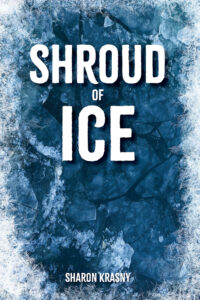
Historical fiction author Sharon Krasny chats with me about her new novel, Shroud of Ice.
Bio:
Sharon Krasny has worked as an educator for twenty-two years in Virginia and taught abroad in both Hungary and Czechia. Through teaching English as a second language, she discovered a love for oral history. Sharon listened as her students explained central European history and culture to her, and she saw how inextricably bound their past is with part of their identity. This understanding began her fascination with people’s need to be known and heard. Retired from teaching English and research in Virginia, she currently writes, grows lavender, and finds adventures for her and her husband to experience.
Welcome, Sharon. Please tell us about your current release.
Shroud of Ice is based on the life of Ötzi the Iceman. He was murdered over 5000 years ago and frozen in a glacier until 1991. In Shroud of Ice, Gaspare, in the role of Ötzi, must find the courage to escape from the slavery of the copper mine that his village banished him to work. Using the stars to guide him, he walks over 350 miles home for justice and love. On his way, he battles being hunted by two guards over rapids and dangerous mountains, to find the family who betrayed him. His journey is more than just survival. He needs to learn the truth of becoming a man and claiming his right as a holy man, if he is to stand against the darkness of his past.
Looking to the stars and the memory of Mara’s eyes, Gaspare hopes to find forgiveness and a sense of home. Shroud of Ice has themes of dignity, loyalty, and resilience in the search for freedom, redemption, and true brotherhood. It seeks an answer to the question will we ever be enough?
What inspired you to write this book?
I actually tried to write a book about a ring that my father wore through his time in World War II. It is a coral cameo set in gold that he kept on his pinky to remember he was not alone. This story morphed into a story about women, which then warped into the “well I’m writing a story…” kind of excuse because I didn’t know what to do with it. I was too close to the text. In the news I learned about Ötzi the Iceman. He was discovered about the same time as a Peruvian princess mummy. The difference was he was murdered and years before I had a dream or a vision about writing a story in the Italian alps about a man who was murdered. I guess he is my dream date so to speak.
I started writing his story and fumbled around with what would an ancient language look like that is now extinct. It came out a bit like Yoda, so I gave that one up. I put the story aside for a bit until I learned that my friend’s 11-year-old daughter was fascinated by Ötzi. While doing research on his tattoos, I found that Brad Pitt has a tattoo of Ötzi on his forearm with a Nitsche quote about the futility of man. That fired me into giving Ötzi a voice. He had dreams and goals just like the rest of us. He loved and was hated just like the rest of us. He did have purpose and now he only lays naked exposed to millions with no idea of a name or who he was. My goal became to cloth him in a story, to restore dignity to him, and in so doing remind readers that people are people. When we look down on someone as less than ourselves, we are the ones who lose. In our advanced age, we have forgotten the voices of the ancients that remind us of who we really are. That’s why I wrote Shroud of Ice.
Excerpt from Shroud of Ice:
The silence of the lake pulled our gaze out across the waters to the far edge. The wave’s lapping sounds blended with the frogs’ mating calls. Fear buzzed behind my eardrums.
“Don’t you want to go home?” Haliam asked.
Displaced anger threw down my reply. “Why? What’s there? There’s nothing left for me. Do you understand? Nothing . . . nuk is what you say, right? Nuk.” My sharp reply tasted like acid.
No one missed me because no one had come. When my legs had felt like breaking on the mountain’s rocks, the only thing to pick me up had been the pull of the rope tied to another slave. No one came to help me. Why should I want to go home? They were better off. The old village cries of “cursed one” from my memory joined the fear buzzing—death had marked me.
The flutter of a bat’s wings scuttled overhead. Smacking the mosquitos one last time, I shifted to leave.
Haliam stopped me. “An old tale from my village tells of a great man who died and stood before the greatest god. The man thought his greatness enough to have earned passage to the god’s presence. The deity looked him over and commanded the dead man to show him his wounds. There were no scars, of course, because he hadn’t done anything great. The god sent him back till he found something worth fighting for.” Haliam let his words linger. A frog sang louder; puffing his chest, he repeated his call, desperate for a mate in the dark.
“Where is that boy from the well who fell trying to give me food all those springs ago?” he asked. “That boy would want more than this place.”
Scoffing, I turned away from him and the moon. My head shook. “That boy fell off a cliff and died,” I said.
“I don’t believe that. I won’t. Only one with a heart of courage would have pushed through the crowd to help me. That courage cannot be gone. The heart of the eagle lies inside you, Gaspare,” Haliam said, making a fist and pounding his chest.
“I failed. You never got my food,” I said.
Haliam quickly reached for my shoulder. With the hoarsest whisper, he said, “I feasted on more than food. All those people, all that hostility and anger that surrounded me, were defeated each time I remembered your courage. I made the trek across mountains here because your kindness reminded me good still existed.” Haliam looked at me, willing that boy from the past at my village’s well to stand in my place.
What exciting project are you working on next?
I’m doing research on Jamestown’s Jane Doe. She is the 14-year-old girl who gave us evidence of cannibalism during the starving times of our nation’s beginnings. I’m writing a love story. After that, it will be back to the Vikings coming to America.
When did you first consider yourself a writer?
That’s a hard statement – “I am a writer” taps into the imposter syndrome full force. But I do write. I have written three books now, not counting the children’s book I wrote. I have ideas about future books, but I am not disciplined to write every day. Am I a writer? If you say so. Do I enjoy writing, most of the time. Writing is very creative, which means there are a lot of problem solving going on. It’s never the easy answer that shows up on the page. It’s the solution that I have to work for. That is a process that most days I find thrilling and exasperating at the same time. Writing takes a lot of research, which is also intriguing. I suppose I am a writer, yes, I do the things a writer does, so I must be a writer.
Do you write full-time? If so, what’s your workday like? If not, what do you do other than write and how do you find time to write?
Last year I retired from 22 years of teaching. I currently am working as Director of Admissions for our newly opened Chesterton Academy of St. Thomas Aquinas. I enjoy still being around students, but like a grandparent, I don’t have to grade or spend prep time creating lessons. It’s a nice in between stage from the classroom to becoming a fulltime writer.
What would you say is your interesting writing quirk?
Because I saw so many struggling readers in school, especially boys, I write so the reader can see. I have been known to go outside in the moonlight to see the colors of shadows. I have smelled rocks to find the connection through two sensory images: touch and smell. I’m not really sure that makes me unique, but it is something I do.
As a child, what did you want to be when you grew up?
I wanted to be a teacher. I would put my toys in school with worksheets and lessons. Then I thought about being a stewardess or a ballerina, but I grew to be 6’0 tall. Back then those roles were reserved for more petite women. When I was a junior in high school, my American literature teacher saw something in me that others overlooked. She helped nurture and encouraged my writing. Because of her and others, I pursued the path of teaching. It was a passion and calling that I took seriously.
Anything additional you want to share with the readers?
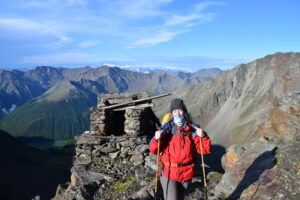
What is the length a writer will go to for the story? For my story, I climbed almost 10K feet above sea level in a severe storm. It would be good to note that I am note particularly a hiker. I struggled with the ending of Shroud of Ice. When I received an excellence in education grant from my county, I knew I needed to use the funds to go and meet Ötzi. In Austria, I met my expert advisor, Dr. Walter Leitner. He is an archeologist who has worked extensively in the region Ötzi was discovered. He took me to the Ötzal Dorf, which is a primitive village based on findings of life during the Copper Era when Ötzi lived. Then he pointed me in the direction of Ötzi’s mountain and the place of his murder. My husband and I began our climb on July 24, 2023. We experienced rain off and on all day. At the fork in the path a decision needed to be made. Do we go directly to where Ötzi was murdered, or do we go first to the hutte where we were staying the night. We chose to go to the hutte and that probably saved my life. The mountain decided to show us her fury by bringing heavy rains and strong winds down on us. What was left of the glacier became preferable to walk on than the rushing water at our feet. The wind and rain drove straight into my face stealing my breath. We could only go one blaze on the path at a time. When I looked behind me, there wasn’t anyone in sight. It was just the two of us. I didn’t have the freedom to say no. I didn’t have the luxury to say I can’t. I needed to take one step and then one more. Hyperthermia began setting in shortly before we reached the hutte. I had a very strong idea of what Ötzi faced when he climbed that mountain. As we left the next morning, we saw snow and more storms. The sun came out long enough for us to descend the other side to our hotel. When we reached the tree line, I felt the ending of the story I needed. I could see what I needed to do. I was walking where Ötzi had walked and I knew what the ending had to be.
When I met him in repose at his museum in Italy, I was affirmed in my mission as a writer. Ötzi has done so much to teach us about ourselves. He is an incredible archeological find of the twentieth century. Yet we do not even know his name. Ötzi is derived from the Ötzal region of mountains where he was found. Restoring dignity to this man who had been silenced 5000 years ago by murder felt right. When I write, I seek to find the beauty in the ugly truths. I look for ways to give voice to those silenced and dignity to those lost to time. That’s my goal as a historical fiction writer.