
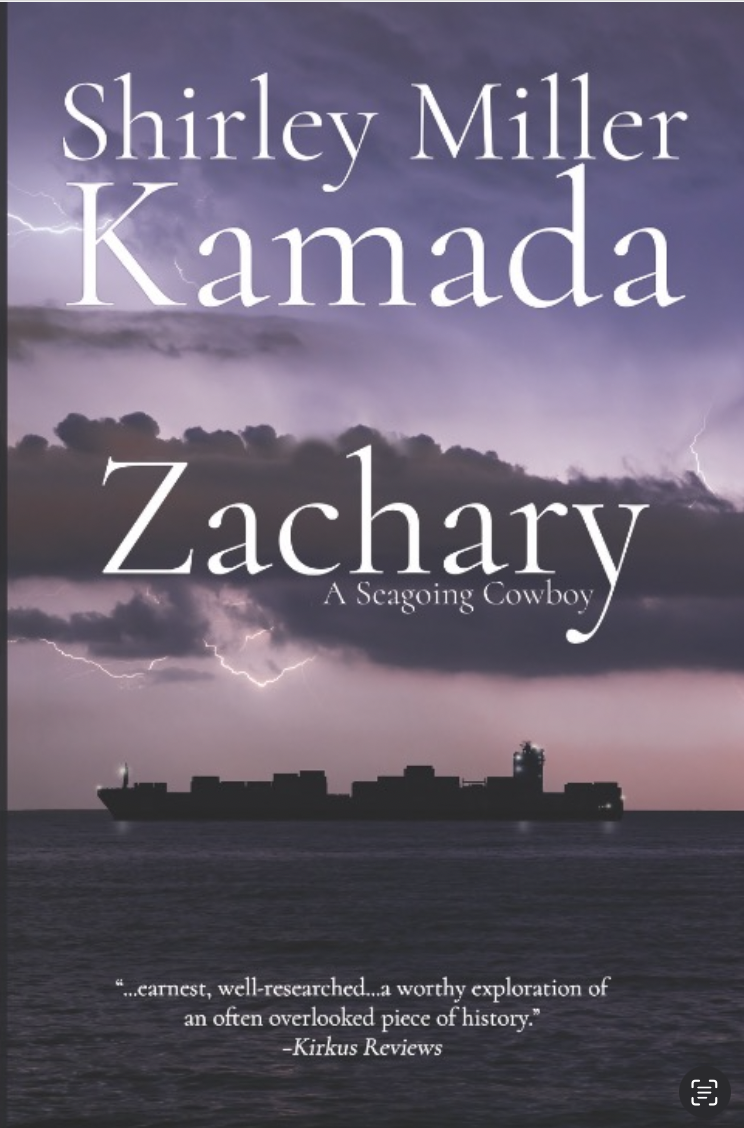
Today’s special guest is YA author Shirley Miller Kamada to chat about her new historical novel, Zachary: A Seagoing Cowboy.
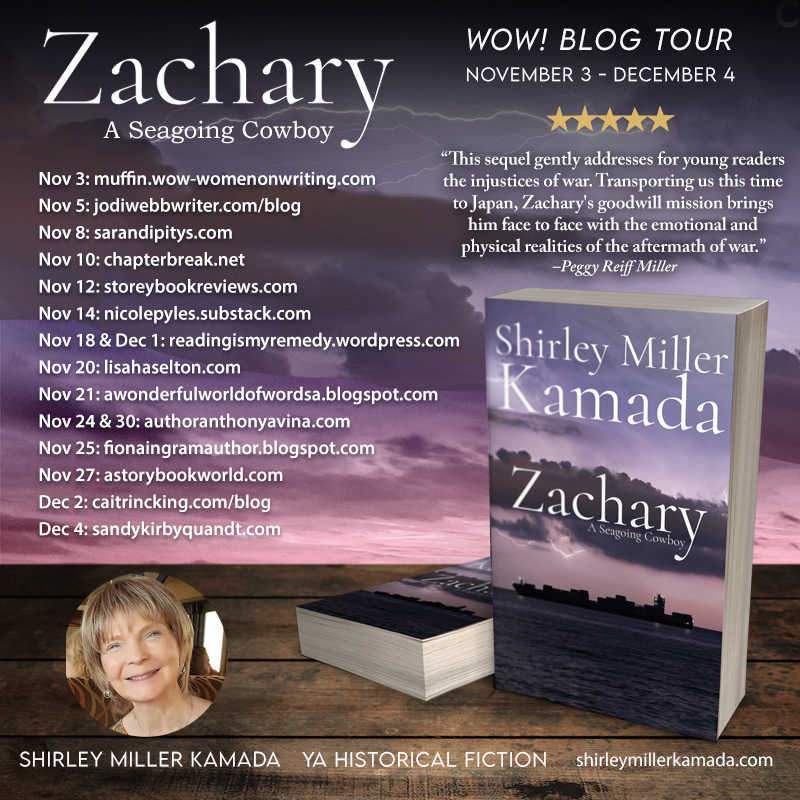
Shirley is in the midst of a tour with Wow! Women on Writing. All her tour stop details can be found here, and below. Feel free to check them out!
Bio:
Shirley Miller Kamada grew up on a farm in northeastern Colorado. She has been an educator in Oregon, Idaho, and Washington, a bookstore-espresso café owner in Centralia, Washington, and director of a learning center in Olympia, Washington. Her much-loved first novel, NO QUIET WATER, was a Kirkus recommended title and a finalist for several awards. When not writing, she enjoys casting a fly rod, particularly from the dock at her home on Moses Lake in Central Washington, which she shares with her husband and two spoiled pups.
Welcome, Shirley. Please tell us about your current release.
Zachary Whitlock knows sheep. He knows farming and knows what it’s like to have his best friend forced into an internment camp for Japanese Americans. What he does not know much about is goats and traveling by sea on cargo ships, yet he makes a decision to go with a group of volunteers to Japan to help deliver a herd of more than two hundred goats, many of which are pregnant, to survivors of the U.S. bombing of Hiroshima and Nagasaki.
What inspired you to write this book?
After publishing my first book, No Quiet Water, I was often asked, “What about Zachary? How did the events of World War II affect his life?” I was drawn to Zachary Whitlock, also, to his sense of responsibility to his family and his community, his willingness to work hard, his curiosity. Writing this novella gave me an opportunity to delve further into his interests and motivations, his intelligence, curiosity, and compassion.
I came to know of Floyd Schmoe, a man with a strong sense of justice who gave much of his time visiting internment camps, personally surveying the conditions to which wrongly imprisoned Japanese Americans were subjected. Looking further into the activities of the American Society of Religious Friends, I found that they helped connect those incarcerated with legal assistance, accomplish banking tasks, and sometimes brought needed supplies to the camps. When I learned that after the war Floyd Schmoe had taken charge of a mission to Japan with what was then known as the Heifer Project, the connection was made—in my mind and my heart. The story took on a shape, and grew, with a mission of its own.
Excerpt from Zachary: A Seagoing Cowboy:
From Ch. 1 Seagoing Cowboys
Something enormous throws a shadow over my shoulder. I turn, tilt back my head. From the ship rises a sort of elevated cabin, as on a ferry boat, but immense. Fronted by glass panels, like car windshields, except bigger. Much bigger.
“That’s the bridge,” a crew member says. He’s young, but older than me. His uniform is crisply pressed, and his shoes are so shiny I can’t help but notice.
“Sorry?”
“That.” He points. “What might be thought of as a tower, on a ship it’s called the bridge.”
“Oh. Thanks.”
The bridge. I’d never have come up with that. A bridge is longer than it is wide, sometimes iron, sometimes concrete, the ones near our house are wood. Those bridges go from someplace to someplace.
“You’re a Seagoing Cowboy, right?”
Strange nickname, but, as Mr. Schmoe told me, in the Heifer Project’s early days milk cows were donated to starving communities. The name fit better then than it does now, I guess. I force a grin.
“I’ve met a few of you Seagoing Cowboys. Most are more comfortable on land than at sea. You?”
His expression tells me that wasn’t a question.
“Those goats you’re taking to folks in Japan are real fine. Saanens! You’re going to be one busy Cowboy. My name’s Eddie Vasquez. I’ll see you around.”
With the animals settled in, and merchant marines readying the ship to get underway, the people who donated the goats approach Mr. Schmoe and the other Cowboys to shake hands. Mr. Schmoe speaks with each of them.
In many cases, these goats are replacing, if such can be said of a living being, animals that were killed in the war’s hostilities. Mr. Schmoe writes in a small notebook he carries in a pocket. Addresses, probably. I imagine he’ll send a personal note.
I hear talk of shared blessings. I see tears on the faces of some goat owners. Grown men wipe their eyes. My own eyes sting. What of our flock of sheep at home? Would I be so selfless? Could I raise them and then let strangers take them to a devastated land so far away?
The clamor, the smell, the sounds of a cargo ship readying to set sail. Sharing farm animals, a livelihood, hope. I lean into it all.
*
What exciting project are you working on next?
My next writing project is somewhat influenced by events in the lives of my husband’s parents, Isao and Yuriko, both of whom were American citizens. Both were educated in Japan, however, and as the two neared adulthood, their families in America decided they would be an appropriate match. Isao and Yuriko agreed with this plan.
Isao returned to the United States and worked on commercial fishing boats, plying the waters between Alaska and Seattle. Before Yuriko could join him, it was proper that they first be married, and so two weddings were held. At the first wedding in Japan, Isao could not be in attendance, rather a stand-in was used. As I picture it, all the formalities were the same as if he were able to be there. The second wedding took place in the home of family and friends who lived in Seattle.
In only a few months, the young couple found themselves imprisoned at Camp Minidoka, dry, dusty, inhospitable. The were to bear two children there, one of whom was my husband Jimmy. This story, and that of what occurred after WWII was over, is the next story I’m trying to tell.
When did you first consider yourself a writer?
Later in life, having left my job as director of a well-known learning center, marrying and moving to central Washington, I found I had the time and the space to pursue publication. I did not consider myself a writer until the independent publisher, Black Rose Writing, accepted my book of historical fiction, No Quiet Water, and made it a reality in early 2023.
Do you write full-time? If so, what’s your workday like? If not, what do you do other than write and how do you find time to write?
I’m fortunate to be able to dedicate eight hours a day, Monday through Thursday, and four hours each day, Friday and Saturday, to all the facets of writing. My choice to write historical fiction leads me to primary sources, such as found via the website, Densho, The Legacy Project, where many oral histories can be found, as well as a broad array of other original documents. I find inspiration in the offerings of museums focused on Asian American history and academic papers.
Photographs fascinate me. I am amazed at the resourcefulness of those confined to internment camps who often were barred from having a camera, yet found a way to record their reality in black and white. The well-known work of photojournalists Dorothea Lange and Russell Lee, who each worked under contract with the Farm Security Administration and other government entities, is informative.
The family photograph albums in the safekeeping of my husband, Jimmy, document the lives of American citizens enduring racially based hardship, while still building community, contributing to the common good, and prevailing.
As I work, I scribble reminders using index cards, stenographer’s notebooks, and sometimes in the margins of magazines and catalogs. The laptop comes later.
What would you say is your interesting writing quirk?
When developing a story, I often begin in the middle, then work both ways. Some source of information captures my attention and works in the back of my mind. I wonder how the lives of ordinary people were affected by an occurrence. I dig around in the historical events of an era, and a personality takes shape in my mind. I have never begun with an outline. I don’t know how a story is going to end until I write it.
As a child, what did you want to be when you grew up?
At age six, I wanted to be a ballerina. I must have seen a special on television, probably “The Nutcracker.” I was given a children’s book on the topic. Early on it became obvious that this was not in the cards. I wanted to be a bank teller, as was my Aunt Mary (who later became a certificated teacher of the gifted). My parents bought me a Nancy Drew book which I devoured in one afternoon. But it didn’t occur to me that somebody wrote that book. I admired my first grade teacher, Mrs. Mayor. If a student was troublesome, they were made to sit in the closet, but I don’t think any of us thought of that as out of line. In second grade, Mrs. Kendall made uncooperative students sit in the hall. Once, that was me. I guess I was unusually visit-y that day. In retrospect, I think she was validating that the rules applied to everyone. She also had me check other students’ spelling tests. None of these occurrences deterred me from becoming an educator. I taught elementary school for sixteen years (and never put anyone in a closet).
Anything additional you want to share with the readers?
Writing is a long, hard job. Many people think they want to be writers, but they don’t really understand the extent of what that means. The advice that was given to me was never to give up. I have to say that’s probably the most important advice anyone can give you.
Links:
Website | Twitter/X | Instagram | Facebook | BlueSky
Blog Tour Calendar
November 3 @ The Muffin
Join us at the Muffin as we celebrate the launch of Zachary: A Seagoing Cowboy by Shirley Miller Kamada. We interview the author and give you a chance to win a copy of the book. https://muffin.wow-womenonwriting.com
November 5 @ Words by Webb
Visit Jodi’s blog for her review of Zachary: A Seagoing Cowboy by Shirley Miller Kamada https://www.jodiwebbwriter.com/blog
November 8 @ Sarandipity
Visit Sara’s blog for a guest post by Shirley Miller Kamada about Marshall strawberries. https://sarandipitys.com
November 10 @ Chapter Break
Visit Julie’s blog for a guest post by Shirley Miller Kamada about owning a coffee shop and bookstore. https://chapterbreak.net
November 12 @ Storey Book Reviews
Visit Leslie’s blog for a guest post by Shirley Miller Kamada about the day her mother took a chainsaw to their sofa. https://www.storeybookreviews.com
November 14 @ Nicole Writes About Stuff
Visit Nicole’s Substack newsletter for a weekend contribution by Shirley Miller Kamada. https://nicolepyles.substack.com/
November 18 @ Reading is My Remedy
Stop by Chelsie’s blog for a review of Zachary: A Seagoing Cowboy by Shirley Miller Kamada. https://readingismyremedy.wordpress.com
November 20 HERE!
November 21 @ A Wonderful World of Books
Visit Joy’s blog for an excerpt from Zachary: A Seagoing Cowboy by Shirley Miller Kamada. https://awonderfulworldofwordsa.blogspot.com/
November 24 @ Author Anthony Avina’s blog
Join Anthony for an excerpt from Zachary: A Seagoing Cowboy by Shirley Miller Kamada. https://www.authoranthonyavina.com
November 25 @ Word Magic
Visit Fiona’s blog for a guest post by Shirley Miller Kamada about why so few people know about the U.S. firebombing of Tokyo. https://fionaingramauthor.blogspot.com
November 27 @ A Storybook World
Visit Deirdra’s blog for her spotlight of Zachary: A Seagoing Cowboy by Shirley Miller Kamada https://www.astorybookworld.com/
November 30 @ Author Anthony Avina’s blog
Visit Anthony’s blog for his review of Zachary: A Seagoing Cowboy by Shirley Miller Kamada. https://www.authoranthonyavina.com
December 1 @ Reading is My Remedy
Stop by Chelsie’s blog for Shirley Miller Kamada’s guest post on learning that her grandfather helped build the internment camp at Minidoka in southern Idaho. https://readingismyremedy.wordpress.com
December 2 @ CC King’s blog
Join Caitrin as she features a guest post by Shirley Miller Kamada about how the character of Zachary developed. https://www.caitrincking.com/blog
December 4 @ Sandy Kirby Quandt
Visit Sandy’s blog for her review of Zachary: A Seagoing Cowboy by Shirley Miller Kamada https://sandykirbyquandt.com/