
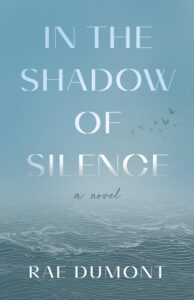
Literary author Rae Dumont chats with me today about her upcoming release (Feb 17, 2026) about family, relationships, mental health, and suicide, In the Shadow of Silence, a Novel.
Bio:
Raymonde Dumont, MD, LMFT, is both a pediatrician and a family therapist. She practiced and taught for several years at Harvard Medical School, and at the Joslin Diabetes Center. She focused on the impact of one person’s illness through their entire family, and demonstrated how mental health and family function affect the medical outcome. She is currently a family therapist in private practice. She helps families to navigate difficulties by collaborating, rather than becoming divided.
She is also a mother, a widow, and a friend to many. She now turns her years of experience into words that speak of resilience, and of the flawed road that leads us to becoming good enough. She wrote this book because the story would not let her go, and because she hopes it will bring some insight and comfort.
She has published many professional articles, but in fiction, she finds a more personal, intimate voice. Several of her short stories were published in Persimmon Tree and in The Hemlock Journal.
She lives and practices in Montclair, New Jersey, within reach of New York City.
Welcome, Rae. Please tell us about your upcoming release.
Depression not only affects the person who struggles with it, but their entire family as well. Loved ones and friends have to grapple with whether they can help, and how. Especially after a suicide, they will wonder whether they have done enough, done the right thing, or made it worse. This book is intended to offer hope. Even if love cannot solve everything, it is a source of resilience that helps people get through unforeseen tragedy.
What inspired you to write this book?
I am a mother, a widow, and a friend. Life has brought its share of pain, my own and that of loved ones, and I know its ripple effects.
As a pediatrician and as a family therapist I have borne witness to many people’s experiences, and I have tried to help. Sometimes, despite my best efforts, I could not ease their suffering. In writing fiction, I hope to bring these many lives to the page, and to share what they have taught me.
Depression and anxiety are on the rise. When tragedy touches a loved one, a family, or a friend, the effects reach far beyond those directly affected. Suicide leaves behind a storm of sorrow and confusion, guilt, and anger.
I wrote this book for those who struggle with depression. Help is at hand; there are people who love you, and people who care. There is light beyond the darkness.
This book is also for those who have loved someone, seen their suffering, and felt helpless.
I want you to know you are not alone, and it is not your fault.
Excerpt from In the Shadow of Silence, a Novel:
Prologue
Summer 2018
Old photographs with curled edges are scattered on the red kilim rug. Barefoot on her knees, in faded denim overalls, Eva sorts them into piles. She pulls a shoulder strap up over her vintage silk shirt, bright purple with tiny daisies.
She tosses the blurriest, most brittle pictures on the discard pile, sits back on her heels, and tucks a loose strand of gray hair behind her ear. Three shoeboxes sit on the floor, filled with still more images.
On the coffee table, Eva carefully fans out the largest black-and-white photos. Uncle Roger spent hours in the dark room creating these crisp prints, full of contrast and shadows, on grainy matte paper. Eva picks up a self-portrait of him with her aunt. He wears enormous furry mittens, like bear paws. Aunt Josie is trapped in his arms, and he looks at her with amusement. She smiles at the camera, coquettish, and nestles into him. How Eva misses them and the delight they took in each other.
Here is a small photograph of young Eva, perhaps two or three years old, perched on top of a huge Belgian draft horse. Uncle Roger stands beside the beast. He looks up, holding the halter. She is just a little girl with a pale full-skirted dress, her legs stretched across the broad back, a wide grin on her face. The sweet smell of the horse made her feel safe. Her love of horses was one of the many lasting gifts from Uncle Roger.
Eva’s knees hurt. Serves her right, she thinks, for getting so lost in time. She slowly gets up and makes her way to the kitchen. She fills the kettle, then returns to collect some smaller pictures from the living room floor in the lid of an open shoebox. She straightens, careful with her back, sets the lid on a tray with her tea, and heads out to the patio. She settles into her funky cypress rocking chair. She rests her foot on a stool; her feet cannot reach the ground without it. Gabe, her middle child, laughed when he first saw her sitting in it. “Hello there, Edith Ann!” he said. And it’s true, the oversized rocker dwarfs her.
She sits for a while, admiring the fields and tall grasses. A few irises sparkle an impossible blue. She tracks the swallows overhead and listens to the busy red-winged blackbirds. It is too hazy today to see the Green Mountains further away, but she knows that they stand there, steady and familiar.
The venerable northern red oak proudly towers above the white ash and hickory. Over the years, it has become a little easier to look at that tree, but still, almost every time, she relives that awful day again. And then her thoughts spiral to Lyman’s terrible note. What if she had not gone on that trip? Maybe he—maybe she could have stopped him . . .
Her mind wanders through the years that followed. Olivia, the youngest, might not have had such a turbulent adolescence with her father around. Maybe Gabriel wouldn’t have stepped into the void his father left, to support Olivia—and grown up too fast. Then again, perhaps he became more himself, finding his footing as he supported his stumbling little sister.
And Ezra? Her intense and talented firstborn? He took on challenges at full speed; when he slammed into walls, he bounced back and made it all into music. Would he have dealt with his troubles more wisely if his father had lived? A familiar, sad-angry chill prowls around her heart at the wonder and the tragedy of her marriage.
She is too old to live alone in this big house, but she cannot bear the thought of leaving. She has raised her children here. When she first bought it, it was a tiny, dilapidated cottage, but then she and Lyman improved it and made it bigger over the years. So many memories live in the house. In the fields and in the trees too.
And so here she stays, and she remembers.
What exciting project are you working on next?
I am currently revising my second novel, Grow up, Mother!
It describes what it is like, for a bright teenager, to grow up with parents who are in a codependent relationship, in a household where secrets lurk. The novel shows how the adolescent and the young adult’s angry push-back can lead everyone to more mature interactions. We often hear how trauma is passed on across generations. But this book is a story of the next generation doing better than the previous one, and it includes some very happy grandchildren.
When did you first consider yourself a writer?
I began writing short stories when I reduced the hours spent in my practice, some ten years ago. It took about five years to consider myself a writer, although some part of me always was.
Do you write full-time? If so, what’s your workday like? If not, what do you do other than write and how do you find time to write?
I write full-time. My best hours are in the morning, after a cup of tea, and once I’ve scanned the news and my e-mail to make sure the world hasn’t fallen apart overnight. In the afternoon, my two dogs take me for a hike, two or three miles on hilly wooded trails. Nature inspires me, and this is most often when the next section comes to me, for the project I am working on.
What would you say is your interesting writing quirk?
I like to write my first draft long-hand. My son urged me to borrow his reMarkable. I am not into more gadgets, so I rolled my eyes but I humored him. Once I discovered it could convert the handwriting into text, and I could paste it into Word to be edited… well, I was hooked. I carry it everywhere.

As a child, what did you want to be when you grew up?
I wanted to be a doctor, but in second grade I was told girls should be nurses. That only reinforced my determination to go to medical school. I have never regretted it. Many years later, my children were playing together with a toy doctor’s set. I heard my daughter tell her brother that No, he could not be the doctor, he had to be the nurse. She declared that Only women can be doctors.
Anything additional you want to share with the readers?
My eleven-year-old grandson wants us to write a book together. He’ll draw the pictures. The only problem is that we like different superheroes. His heroes have superpowers and they enjoy violently destroying evil. My superheroes, as he has heard many times, are Martin Luther King, and the Mahatma Ghandi, and the Dalai Lama. “I know,” he laughs, rolling his eyes.
Links:
Website | Substack | Facebook | Amazon Author | Goodreads