
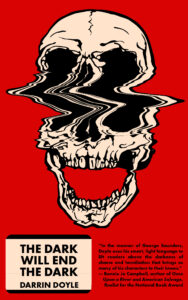
Dark fiction author Darrin Doyle chats with me about his new literary gothic horror collection, The Dark Will End the Dark.
Bio:
Darrin Doyle is the author of seven books of fiction, most recently the novella Let Gravity Seize the Dead (Regal House) and the novel The Beast in Aisle 34 (Tortoise Books). His short stories have appeared in many literary journals such as Alaska Quarterly Review, The Macguffin, Spelk, and Blackbird. He teaches at Central Michigan University.
Welcome, Darrin. What do you enjoy most about writing short stories/children’s books/novellas?
I love the short story form because It forces the writer to say as much as possible with as few words as possible. I definitely try to adhere to the dictum of Edgar Allan Poe who said that every word of a short story should be toward a singular effect. To me, this means that not a word or phrase or sentence should be spent on anything but something that’s either moving the story forward, developing character, or building tone. I also enjoy the fact that in short stories the writer can have wild premises, absurdity, satire, realism, magical realism—any tone or conceit that they want, and in the next story it can be something completely different. While the short story itself has a tighter boundary than a novel, within a series of short stories the range is much wider.
Can you give us a little insight into a few of your short stories – perhaps some of your favorites?
I’m fond of “Barney Hester,” which features a man reflecting on a childhood friend (Barney Hester) who was swallowed whole by a girl. When I say Barney was the narrator’s “friend,” this is a stretch because the relationship between narrator and Barney is definitely a borderline bullying situation. Barney is the type of guy who likes to torment the narrator and yet at the same time seems to need affection. I feel like I knew some boys like this when I was young, kids who probably didn’t know how to express kindness or love, so they showed affection by teasing and bullying. The whole story draws from my childhood in ways that many others don’t. The neighborhood that I describe in the story where the Hester family lives is very similar to a neighborhood where I had a good friend. It’s set off of a main road and it’s surrounded by a lot of woods, and it feels isolated. The story deals with issues of faith as well, and I love the fact that even though the narrator witnessed this girl literally swallowing Barney Hester, the reader simply has to take his word for it — the magical realism component is equal parts psychological and literal.
Another story that comes to mind is “Happy Turkey Day,” which is more straightforward comedic than the rest of the collection. It’s told with an omniscient 3rd person narrator, and I had a lot of fun letting this narrator, who isn’t a character in the story, inject themselves into the narrative with judgmental comments and diversions and meanderings. Basically this narrator knows everything about everybody in the world, so the story feels wildly expansive for a very small literal situation. Essentially there’s one teenage boy holding a knife to another teenage boy’s throat in an alleyway, and rain is pouring down on them: that’s the entirety of the literal situation that’s going on in front of the reader. The rest of the story takes place in wanderings and flashbacks that tell us who these people are and how they got into this situation.
What genre are you inspired to write in the most? Why?
I try not to think of my writing in terms of genre. I’m solely interested in telling a story that will interest (and entertain) myself as well as entertain a reader. Whichever form, mode, tone, or genre that takes shape as, I’m fine with it. I think a better word for me is mode or style. My primary interests are character, setting, and situation, so I start with those. However, the modes I most typically use (and the ones most present in this collection) are probably comedy, horror, realism, and fabulism. This makes it difficult to label this collection as strictly horror or strictly magical realism, but I’m fine with the work being difficult to label (although it is a disadvantage when it comes to where to put it on a store bookshelf these days).
What exciting story are you working on next?
I’ve been writing novellas lately, which as the name implies is a small novel. I love this form because it’s got the breadth of a novel which allows more development, but it’s still got some of the tightness and compression of a short story. Last year, regal house publishing put out Let Gravity Seize the Dead, which is a gothic horror novella, and in 2027 they’ll release The Boy Behind the World, which is another novella in the horror arena. It deals with a desiccated corpse that’s found in the basement of a old three-story house in Flint, MI. The corpses of an old woman, and there are signs of an occult killing. The novella itself is a manuscript that was written by the elderly woman that lived in the home, and the police hope that this will shed some light on what happened.

When did you first consider yourself a writer?
To me, if you’re going to use that label it means that you are publishing your work and entering the long-running conversation of letters (the poetry, fiction, nonfiction, and playwriting of your culture). For me, I spent years writing, working very hard, writing every night, reading constantly, but it wasn’t until I got that first short story published that I really truly felt like I was part of this conversation. I’ll never forget that first publication. I’d been sending out stories for at least three years without any luck, and I was living in Osaka, Japan. My wife and I were on a train and we had picked up our mail and were going through it, and lo and behold I got a story acceptance from a small journal named LitRag. I’m forever grateful to them because it was finally some outside validation that what I was doing had value. I was thrilled and relieved, and it felt like the first step toward calling myself a writer.
As a child, what did you want to be when you grew up?
A movie stuntman! Honestly, that’s what I wanted to be when I was a little kid. It looked incredibly fun, flying out of windows and falling into bales of hay from rooftops. I was always jumping off of things and trying to create stunts whenever possible. My parents tell me that I was taken to the doctor enough times that the doctor had to take me aside and ask me if I was being abused. No joke. Then I saw this TV movie titled “Who is Killing the Stuntmen?” And there’s a part where this guy has a rooftop jump and the killer rigs the air cushion so it doesn’t work, and he ends up permanent vegetable. That’s what I’m scared the bejesus out of me and made me rethink my career options.