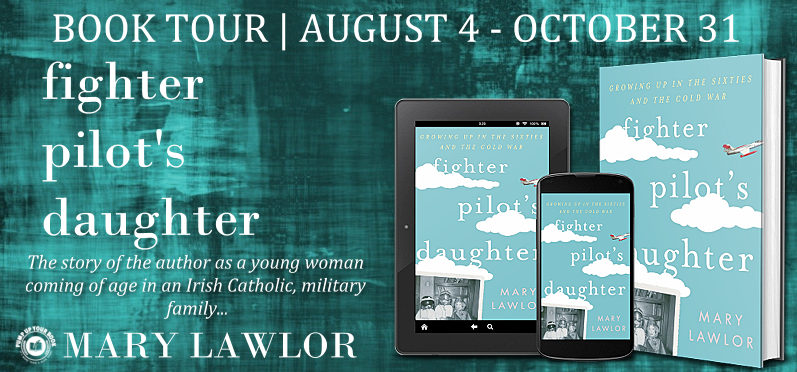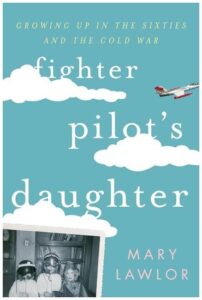
Writer Mary Lawlor chats with me about her memoir, Fighter Pilot’s Daughter: Growing Up in the Sixties & the Cold War.
Bio:
Mary Lawlor is author of a memoir, Fighter Pilot’s Daughter: Growing Up in the Sixties and the Cold War (Rowman & Littlefield 2013)and two books of cultural analysis, Recalling the Wild: Naturalism and the Closing of the American West (Rutgers UP 2000) and Public Native America (Rutgers UP 2006). She studied at the American University in Paris, the University of Maryland, and New York University. She divides her time between Easton, Pennsylvania and Gaucin, Spain. Her novel-in-progress, The Translators, is set in 12th century Spain and fictionalizes the experiences of Robert of Ketton, first translator of the Koran into Latin.
Welcome, Mary. What inspired you to write this book?
For a long time, I’d wanted to make a list of places where my family lived and link each one to the issues in the headlines of the time, especially headlines concerning foreign policy and US government military matters. We were a Marine Corps, later an Army family, and we moved every two years. I went to 14 different schools by the time I was ready for college. That was a confusing, exciting, and bewildering way to grow up. Where are you from, people would ask, and I was never sure how to respond. My answers would be way too long. Eventually I’d say my roots were in suburban New Jersey and more distantly, Ireland, but I didn’t know either of those places.
At Muhlenberg College, I taught American Studies and gave a course on literature and film of the Cold War. My students had lots of questions about those years, and though we didn’t talk about my own life in the classroom, they got me thinking about what my family went through and what effects all that moving had on me. I finally sat down and started a draft. A few years later I had a full manuscript of Fighter Pilot’s Daughter.
Excerpt from Fighter Pilot’s Daughter: Growing Up in the Sixties & the Cold War:
From “The Pilot’s House,” in the Introduction
The pilot’s house where I grew up was mostly a women’s world. There were five of us. We had the place to ourselves most of the time. My mother made the big decisions—where we went to school, which bank to keep our money in. She had to decide these things often because we moved every couple of years. The house is thus a figure of speech, a way of thinking about a long series of small, cement dwellings we occupied as one fictional home.
It was my father, however, who turned the wheel, his job that rotated us to so many different places. He was an aviator, first in the Marines, later in the Army. When he came home from his extended absences-missions, they were called-the rooms shrank around him.
There wasn’t enough air. We didn’t breathe as freely as we did when he was gone, not because he was mean or demanding but because we worshipped him. Like satellites my sisters and I orbited him at a distance, waiting for the chance to come closer, to show him things we’d made, accept gifts, hear his stories. My mother wasn’t at the center of things anymore. She hovered, maneuvered, arranged, corrected. She was first lady, the dame in waiting. He was the center point of our circle, a flier, a winged sentry who spent most of his time far up over our heads. When he was home, the house was definitely his.
These were the early years of the Cold War. It was a time of vivid fears, pictured nowadays in photos of kids hunkered under their school desks. My sisters and I did that. The phrase “air raid drill” rang hard— the double-A sound a cold, metallic twang, ending with ill. It meant rehearsal for a time when you might get burnt by the air you breathed.
…. Our fathers knew the particular threats of war, but we, the daughters, sons, and wives known collectively as “dependents,” found ourselves on the receiving end of terrifying, half told stories of what sounded like imminent catastrophe. The stories were maimed by our fathers’ commitment to a code of military secrecy, to a self-censorship we sort of knew about. That was how things were, floating, half told, partly known but mostly not. Dads were present, intermittently, but even the youngest kids could sense there were limits to what you could ask, fences around what they could say. Our fathers were divided, distracted, distant, even when they paid attention to us.
…. I remember my parents in a palimpsest of images. In their youth, they were a big, glamorous pair, well dressed and full of an almost uncontrolled energy. In their forties, they seem lined and angry, tense, even sullen. They don’t stand beside each other so easily. They’re not really a couple anymore. Then they are old, retired, living by the sea.
Frannie exchanges her long dark pageboy for a shorter cut that hides the gray better. She has a home that’s hers for good. My sisters and I don’t live with them anymore, and when we visit, it’s like a return to some ancient order of seeing and believing. It’s also great fun, not like it used to be. Frannie still embarrasses us with her exuberance and her life-long inclination to drop hints about our social status (as if it weren’t impossibly nebulous). At the grocery store, she tells the checkout clerk how much better butter was “when we lived in Europe.” She is also as funny and eccentric as ever. Visiting Hawk Mountain with us during the fall raptor migration, she walks past the park guard shack, smoking-the only one for miles, it seems, with a cigarette-and complaining in her loud, alto voice, “I don’t even like hawks. They kill small birds.” At the corn maze, hunched over a smoke, she interrogates the kids as they come out. “So how was it?” Like the maze was some sort of existential test.
Jack, in the meantime, grows dark and troubled in retirement. The trouble reaches a climax, and he has to deal with it. There is too much drinking; too much time spent looking at maps and remembering. He’s a little thicker now. He climbs out of it with the help of AA. He softens.
He becomes a grandfather in fact and figure. We get close, and I know he loves me. He has a small-scale stroke one night, and the result is the loss of vision in one eye. He begins to wear an eye patch, which make him look like a pirate to the little kids that now come with us to the house. He likes this and begins to play on his old roles as a dangerous man, exploiting them for maximum performance effect. I love him
dearly.
The feelings pile up with these images. They’re confusing and contradictory. I am utterly different from Frannie and Jack, or I want to be; I am totally identified with them and can’t help it. They are the most meaningful people in my life; the most distant and irrelevant. They were hard on us; they were affectionate, playful, attentive parents. My father’s fury and my mother’s edgy hauteur ran absolutely opposite to the silly, even foolish, behaviors they were capable of. Jack and Frannie-the syllables have an almost cute rhythm, and I am not supposed to call them that. They were anything but cute, even in clowning mode They were cultured, literary, intelligent. And they were shortsighted easily frightened ideologues. I do not know them. I know them too well.
I love them, I hate them.
What exciting project are you working on next?
I’ve just finished a historical novel called The Translators, based on the actual lives of two medieval priests who traveled from England and Croatia, respectively, to northern Spain in the 1140s. There they met and became intimate friends, learned Arabic and translated works in the libraries that once belonged to the emirs of al-Andalus (what the southern part of the Iberian Peninsula was called when it was Arab and Muslim, from 711 until 1492). I’ve fictionalized much of the priests’ lives for the novel but relied on extensive research on the history of the time. A lot of the tension in the story arises from the Church’s attitude toward the books the priests translate and make available to Christendom. The climax involves the English priest’s sister, who’s in England trying to survive the disasters of “the Anarchy” (an early English civil war) but who escapes the chaos to meet her brother in France, where she helps him and his friend overcome their personal tensions and, indirectly, resolves their struggles with the Church.
When did you first consider yourself a writer?
That’s an interesting question! I’ve been writing since I was quite young and always dreamed of “being a writer.” When I began studying literature in graduate school at NYU, my plan was to get an MA, then shift to the Creative Writing Program (if I could get in) and start writing fiction. Then I would be a writer. Once I had the MA, however, instead of shifting to CW, I decided to do a PhD in literature; and when my dissertation was published as a book (Recalling the Wild, Rutgers Univ. Press, 2000), I still didn’t think of myself as a writer! Nor did I after publishing a second book (Public Native America, Rutgers Univ. Press, 2006). I always thought writers were people who wrote creatively, so it wasn’t until I finally started to write creative non-fiction with Fighter Pilot’s Daughter that I thought of myself as a writer.
Do you write full-time? If so, what’s your workday like? If not, what do you do other than write and how do you find time to write?
I do write full-time now. I get up early in the morning, make tea, and sit down at the computer. I have breakfast while writing and keep at it until mid-day. After lunch, I give time to email, social media, and errands. In the afternoons, I try to come back to writing for at least a couple more hours.
What would you say is your interesting writing quirk?
I often write while peddling on a stationary bicycle. My husband created a ledge on it for my laptop so I can keep moving while writing. But the peddling is really, really slow unless I’m reading what I’ve written instead of actually moving my fingers across the keys. Friends think this is wildly weird or funny. Several of them have tried it, but for some reason it doesn’t seem to work for them.
As a child, what did you want to be when you grew up?
A writer, always!
Anything additional you want to share with the readers?
It’s been a while since Fighter Pilot’s Daughter came out and was reissued in paperback. I still enjoy reading it and feel it’s one of the best things I’ve done in my life—not just for the sake of having written and published the book but because it gave me a deeper understanding of my past, my family and the history of those times.