
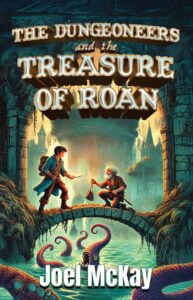
Fantasy author Joel McKay chats with me about his new novel, The Dungeoneers and the Treasure of Roan.
Bio:
Joel McKay is an award-winning author, public administrator and former journalist. When not writing, you can find him enjoying the great outdoors of Northern British Columbia. He lives in Prince George, B.C., with his wife and two daughters.
Welcome, Joel. Please tell us about your current release.
The Dungeoneers and the Treasure of Roan is a young adult action adventure fantasy that follows two thieves—father and son—as they attempt to survive one another and the countless dangers afoot in an ancient subterranean city.
What inspired you to write this book?
I wanted to write a fantastical adventure in the vein of Journey to the Center of the Earth or The Colour of Magic. Fun, humorous, quick, enjoyable characters and lots to marvel at. That feeling of magic you got as a young adult when you found that book and your life was never the same.
Excerpt from The Dungeoneers and the Treasure of Roan:
Wincott was tired of running. It didn’t help that the snow was waist-high. He had short legs to begin with. His large gut didn’t encourage swiftness or agility either. And then there was the murderous band of goblins that trailed him through the forest, their rusty blades at the ready. Yet those weren’t the worst part of his predicament. The worst part was the crusty midwinter snow that crunched over the top of his boot cuffs, slid down his ankles, and pooled coldly beneath the soles of his feet. Wincott hated having cold feet.
“Hell,” he growled.
Snow flung left and right as his stubby legs churned through the winter muck. The goblins had been chasing him for half a day. That surprised him; normally, they gave up after a mile or two. Goblins were, after all, notoriously lazy. Except for these ones. These ones were persistent, and he was tired of their tenacity. He hadn’t made matters easier for himself by stealing a purse of coins from their den and slitting two of their throats in the process. But he was a thief, and that’s what thieves do, and on occasion, the ancient and exalted profession of thieving warranted murder. Besides, it wasn’t as if he was killing real people; they were only goblins. And no one liked goblins anyway.
As he fled through the wintry forest, he wondered if it was time to retire. He had been thieving for nearly fifty years, far longer than most in his profession. And truthfully, he was a lot slower, fatter, and clumsier than he ever had been. Many years had passed since he’d been at the peak of his professional abilities.
Gone were the days of weeklong raids, palace capers, and high handed hijinks. The friends of his youth were dead, and what few thieves remained were no friends of his, and so he thieved alone. And when you throw a slower, fatter, clumsier, older thief with no friends into a den of goblins, he is bound to make a few mistakes. In this instance, the mistake had been a cast-iron frying pan placed precariously atop a pile of rubble next to a smoldering fire. Wincott clumsily knocked it over as he’d taken the coin purse. Sure enough, the closest two goblins were on their feet in seconds. His knife hand, still quick despite his thick fingers, was just as fast. But their squeals of pain woke the rest of the band, and the chase was on. It was enough to make a veteran thief think twice about his future. But not for long. Truth is, a man doesn’t live half so long as Wincott without learning a thing or two about his strengths and weaknesses. Wincott loved stealing things. After all these years, it still gave him a rush to abscond with someone or something else’s property. And so, halfway across a snow-encrusted valley with ten frozen toes, Wincott decided he would continue stealing things as long as he could. If the goblins didn’t get him first.
What exciting project are you working on next?
I’m into first draft edits of an epic cosmic horror novel, think The Shining meets The Thing.
When did you first consider yourself a writer?
When I was 12 and began writing fantasy and horror stories. I think within a matter of months I knew it was my thing and it never stopped being so.

Do you write full-time? If so, what’s your workday like? If not, what do you do other than write and how do you find time to write?
I used to as a journalist, but I left that career many years ago to get into public service, which is my main job. I’m a part-time writer – scary stories by lamplight and all that.
I find time most days, even for a sentence or two or a few notes. It’s admittedly more difficult to write when you’re working full time and editing in your spare time, which has been much of my life the last eight months. I hope to get back to the writing far more regularly this fall.
What would you say is your interesting writing quirk?
I don’t plan a damn thing. I get an idea, a sentence, a scene and just go for it. I only begin to plan in written form when I’m into the last third of a novel, then it’s really useful. Until then I work everything out in my head, mostly when I’m awake but occasionally a good dream does it too.
As a child, what did you want to be when you grew up?
First, a veterinarian. Then a fighter pilot. Then an astronomer. Then a novelist. Finally working on that last one.