
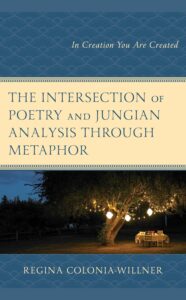
Dr. Regina Colonia-Willner, PhD chats with me today about her new book, The Intersection of Poetry and Jungian Analysis Through Metaphor.
Bio:
Regina Colonia-Willner was born in Rio de Janeiro, grew up in Paris, and lives in the United States. She has worked as a journalist and diplomat in several countries, serving in Brazil, Senegal, Portugal, and the United States. In addition, she has taught literature abroad, as in Budapest and Debrecen, Hungary. Colonia-Willner has held the position of Writer-in-Residence at the University of Georgia. Her work as a writer has been supported by residencies at the Colrain Conference in 2020 and 2021, the TWH Conference in 2021, and a Fellowship Award from Tupelo Press in 2022.
Regina Colonia-Willner is a licensed clinical psychologist. She holds a PhD in neuroscience from the Georgia Institute of Technology, and is a diplomate of the Carl Gustav Jung Institut Zurich, where she defended her thesis “In Creation, You Are Created. The Intersection of Poetry and Jungian Analysis through the Metaphor.” She is an accredited psychoanalyst at the Carl Gustav Jung Institut Zurich (CGJIZ) and a member of the International Association for Analytical Psychology (IAAP). She has received the George E. Briggs Dissertation Award and the Earl A. Alluisi Early Career Achievement Award from the American Psychological Association (APA). A fellow of APA, Regina Colonia-Willner has served as an elected member of the APA Council for six years. Her peer-reviewed scientific papers have been published by APA, Elsevier, and The International Journal of Behavioral Development (ISSBD).
In the field of literature, Regina Colonia-Willner is the author of four collections of poetry and short stories, including Cancao Para o Totem (Song for the Totem), which won the Jabuti Prize, Brazil’s Pulitzer. Her poems have appeared in Catamaran Literary Reader, The Cortland Review, and elsewhere in the United States. Her fiction appears in the anthology Urban Voices—Contemporary Short Stories From Brazil, published by the University Press of America. Colonia-Willner is working on her new collection of poems, Into the Blooming Night. She is a preliminary reader at Tupelo Press.
Colonia-Willner’s books are published in Portuguese and French and anthologized in English, French, German, Italian, and Polish. Her collection of poems Sumaimana, written in Portuguese, was recently translated and published in France in a bilingual edition.
Welcome, Regina. Please tell us about your newest release.
In my recently published book, The Intersection of Poetry and Jungian Analysis Through Metaphor, I say, “The experience of hearing a good poem or a good interpretation is of being understood and at the same time seeing something new about oneself that has been articulated by someone else from within that other person’s own experience. The change that can happen in hearing such language we call insight. Insight is not only knowledge, not only content. “It is an experience of resonance with another person’s vision of things.”
I believe in the following, written by Dr. Elizabeth Brodersen, Training Analyst at the Carl Gustav Jung Institute (CGJIZ) in Zurich, may be helpful:
“Regina Colonia-Willner has written a uniquely creative and scholarly study which focuses on the metaphor as a bridge between different experience domains. Using fairy tales, poetry, music, myth, and the developments in neuroscience with effective skill and knowledge, Dr Colonia-Willner shows how the metaphor is deeply rooted in the body because it organizes both bodily sensations and is located on the border between the mind and the brain. She also highlights how Jungian psychoanalysis can restore a diminished metaphor capacity and empower transformation. I highly commend Dr Colonia-Willner’s original contribution to Jungian psychoanalytic theory and practice.”
—Dr Phil. Elizabeth Brodersen is an Accredited Training Analyst and Supervisor at CGJIZ and author of Jungian Dimensions of the Mourning Process, Burial Rituals and Access to the Land of the Dead; Intimations of Immortality, published by Routledge, 2024.
When did you first consider yourself a writer?
When I was five years old, I made a drawing in which I was holding a microphone and a pen and said this was a picture of me as a writer.
How do you research markets for your work, perhaps as some advice for writers?
Good Writers read a lot, participate in Conferences and are supported by Residencies.