
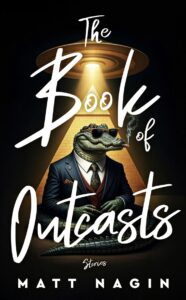
Short story writer Matt Nagin chats with me today about his new collection, The Book of Outcasts.
Bio:
Matt Nagin has been a writer for almost thirty years. He’s published three poetry books, all of which obtained very strong reviews. Kirkus Reviews, for example, referred to Matt’s first book as “powerful verse from a writer of real talent.” His poem, “If We Are Doomed,” won The Spirit First Editor’s Choice Award. A short story, “The Failure,” made The Best of Across The Margin 2021. Matt’s had satirical writing showcased in The Humor Times, The Satirist, Points In Case, The Higgs-Weldon, The New York Post, and many others. His first humor book, Do Not Feed The Clown, published in 2019 by Tenth Street Press, garnered a strong cult following. Matt’s latest work, the short story collection The Book of Outcasts, comes out in March 2025.
What do you enjoy most about writing short stories?
Writing short stories gives you a chance to immerse yourself in a whole new world. With a novel, you’re moving in. You’re decorating. You’re checking out the public schools for your kids and having five-course dinner parties. With a short story, you’re a hippie vacationing at an Airbnb in a town with an eighteen-syllable name. Basically, the best part of a short story is that it’s not as much of a commitment. Once you say what you need to, it’s onto the next world.
Can you give us a little insight into a few of your short stories – perhaps some of your favorites?
One of my favorite stories, “Nagin Vs. Nagin,” was inspired by Jorge Luis Borges and various other postmodern and meta-fiction writers such as Don DeLillo.
I think it is one of my more interesting stories because while not me exactly in the story, it is a character that is somewhat like me, or that has aspects of me, including my name.
The story involves a writer who is in direct competition with his doppelganger, who also has the same name as him, Nagin, and apparently resembles him as well. They are both writers and very similar in numerous ways and essentially get in an existential battle of sorts, that gets increasingly callous, to beat the other and to essentially become renowned and successful. They are willing to make the other Nagin suffer tremendously in order to achieve this success.
I think the story gets at an essential element about our culture and serves as a warning: we can sometimes go too far in our pursuit of accomplishment and fame. But in a world in which our competitors are taking the gloves off, are we left no choice but to take the gloves off too? And if there are other options, what are they? And why are they important?
The story is also about what constitutes identity, and questions how important it is to be original in a world in which simulacrum dominate. This has overtones of the whole A.I. conversation, of bots, of Grok, and of various other contemporary matters. Does identity even count in a world when it essentially can be mimicked and duplicated? And if so why?
What genre are you inspired to write in the most? Why?
I really enjoy dystopian fiction and transgressive fiction, sometimes with sci-fi elements. I think the reason I like these genres is they give the writer an opportunity to comment on our culture and write stories that can serve as a warning. I also like pushing boundaries and testing what is culturally accepted, and by having characters go through horrible or traumatic experiences there are great spiritual lessons that can be learned.
Some of my stories may seem graphic or dark but I never try to make it gratuitous. I am simply writing in this way because I am trying to make sure the story is honest. This way, also, when the story gets to the dramatic resolution it feels real and makes sense.
What exciting story are you working on next?
I am writing a story about a man who is dying of nut cancer, as he calls it. He has lost most of his hope and faith in humanity. A Jesuit comes to his door, to try to convert him, and he works for a bunch of satanists. The story is about what this man with nut cancer comes to understand about the world and himself.
When did you first consider yourself a writer?
I guess when I lived in Los Angeles many years ago. At that time I made a commitment in my mind that I would take writing seriously and try my best at it. I was walking around outside under the palm trees in Westwood and I just decided that I would give it a shot. I didn’t put a time limit on it. I didn’t say you have to accomplish such and such goal. I just figured I’d try and try and try.
I of course knew you had to have a practical side as well and consider finances. But I just figured that whatever I’d be doing writing would probably always be a part of it since it was what I found most fulfilling. I knew it was a tough road but I just felt compelled. When I was writing I often felt most alive, most connected, most myself. So it was as if I had no other choice.
How do you research markets for your work, perhaps as some advice for writers?
Sometimes I come across a market that seems appropriate for my work. Or you meet people along the way that suggest you submit. Researching by genre and type of writing also makes sense.
What would you say is your interesting writing quirk?
I would say an interesting writing quirk is that I find it difficult to write unless I have a great deal of alone time. I need to have time to reflect and consider matters and I am very sensitive to my surroundings. This does not mean I can’t write in a packed café. I can. But I have to feel alone, like an anonymous face in the crowd, and it helps too for no one to be looking at what I’m writing.
I also sometimes get paranoid someone is reading my writing when I’m in public! Which is crazy, because this is writing I will one day likely want to publish. But it is just a weird quirk of my writing process that I like it to feel like no one can see it or look at it till it’s done.
I also don’t generally like to talk about my stories until they are done. That can ruin the mojo. Keep you from completing it. Or someone could say something negative about an idea that blocks you and keeps you from getting the work done. So for me it is a very isolated and personal process, at least until the story is finished in draft form.
As a child, what did you want to be when you grew up?
A fireman. An NFL Quarterback. A superhero was up there as well…Superman. At no point, as a child, did I ever think about writing books, or doing standup comedy, or being an actor, or teaching writing. These were just not something I considered.
Anything additional you want to share with the readers?
Thank you for this interview. It gave me a chance to collect my thoughts on various matters and talk about my work and I hope it was helpful for readers. I did want to mention that one great thing readers might appreciate about my books is I write in vastly different genres. It’s not just a genre change though.
I write in very different styles. It’s still essentially me of course. But it’s different sides of me. So my three poetry books are a very different Matt Nagin than the Matt Nagin in my humor book, and that Matt Nagin is significantly different than the Matt Nagin in my short story collection.
I think those who check out my work might find it interesting to compare/contrast, and also wanted to mention that, as writers, this working in different genres is so important. Keep dancing. Keep moving. Keep trying new things. That’s part of what makes the whole process interesting.