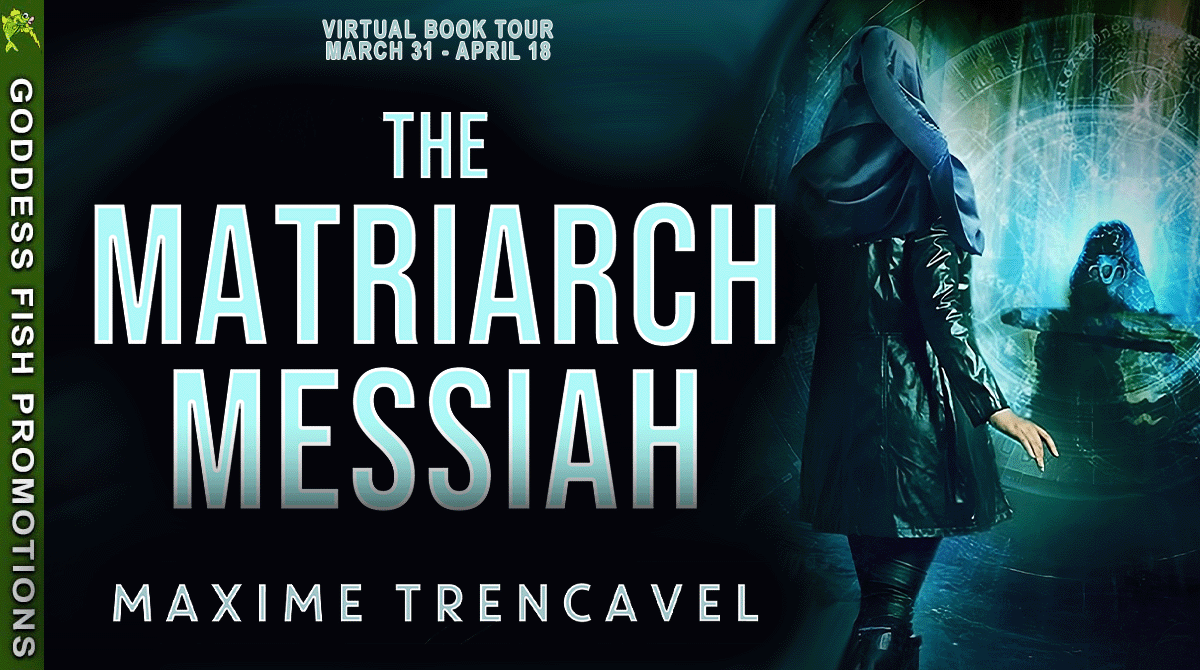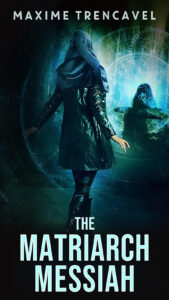
Sci-fi author Maxime Trencavel joins me today to chat about his new sci-fi suspense, The Matriarch Messiah.
During his virtual book tour, Maxime will be awarding a $20 Amazon or Barnes and Noble (winner’s choice) to a lucky randomly chosen participant. To be entered for a chance to win, use the form below. To increase your chances of winning, feel free to visit his other tour stops and enter there, too!
Bio:
Maxime has been scribbling stories since grade school, from adventure epics to morality plays. Blessed with living in multicultural pluralistic settings and having earned degrees in science and marketing, Maxime has worked in business and sports, traveling to countries across five continents and learning about cultures, traditions, and the importance of tolerance and understanding. Maxime’s second novel, The Matriarch Messiah, was conceived, outlined, written, and edited in different locations in Belgium, including the Turkish and Kurdish neighborhoods of Brussels, in various islands of the Caribbean, in Colombia, in Madrid, Malaga, Mallorca, Spain, London, UK, and on the two coasts of the United States.
Welcome, Maxime. Please tell us about your current release.
The previous book, The Matriarch Matrix, followed the story told by patriarchs to their male descendants of a legend coming from an ancient matriarch.
The Matriarch Messiah tells the story from the matriarchs who have discretely told their side of the story to their female descendants.
Zara follows her great-grandmother’s last words to find the blue light. But she is to meet her match. Rachel, an Israeli archaeologist, is also following her great-grandmother’s last words. But those words mean she will kill Peter and Alexander and stop Zara by any means.
The prophecy foretells of two women who will fight to the death. One will enter the chamber of the blue light and save humanity.
Who will be the Messiah of modern times? Zara? Rachel? Or someone else?
What inspired you to write this book?
The first book only told half the story. The patriarch version. To be fair, the matriarch part of the legend needed to be told. At the root of these books is the message for all of us to learn to learn about each other. For lack of understanding leads to intolerance. And so on, creating much of the hate and destruction of our modern world. The most recent Self-Publishing Review of this book hit the nail on the head on what the novel intended to inspire.
Excerpt from The Matriarch Messiah:
But her eyes do not gaze upon that road. They do not disrupt the deepest mutual intimacy he has shared—his beloved banana slugs in his most sacred place on Earth. In this regard, she realizes he is like her, as she has a sacred place on her mountain back at her childhood home. A flattop rock next to the twisting trail where her beloved father would take her hiking. The place where she found her greatest peace. That is, until she met Peter.
Her grandmother Roza said peace comes from tolerance. The root of tolerance is mutual understanding. His communing in these woods with his yellow mollusk friends is his source of deep mysticism. No different from her Roza’s father’s Sufi twirling dance. Both ways to understand Xwedê’s world and be closer to Her.
Hence why she made the long journey from the Anatolian Kurdish State to California many times since his pappy’s funeral—the culmination of their two-month mission together searching for the mythical black object of his family’s legends. There is more to this man than his odd demeanor would portray. His composure, his placid eyes gazing in unity with nature remind her so much of her father on her mountain back home. Perhaps he really is a man seeking the Divine. Like her. Like what her mother had with her father. We shall see, she thinks. Her serene moment is interrupted as Peter challenges, “So, I showed you mine.” He brushes a dewdrop from her nose as they make eye contact again. “Time for you to show me yours.”
Having grown up on the other side of the world, both geographically and culturally, from this man who now asks her to show him something most intimate of her inner being, Zara purses her lips, unsure what he is truly seeking in her. Their several-month relationship has already transcended the physical, the emotional, the limits of what she has had with previous boyfriends. What could he have not already seen in her given their ancient ability to spiritually bond?
She tugs on her headscarf more tightly to her head. Shelter from the cold fog? Shielding her most intimate thoughts from this man? Or simply an instinctive subconscious action?
She turns her back to him, facing the redwoods. The negative-ion-charged Pacific air passes so quietly as it flows through these monolithic beings. Ones who have seen a millennium pass. Ones whose family has seen the passage of time since the ancients. Seen the mysteries of the ancients. Like the mystery she and Peter saw because of their genetic descendancy from the ancient matriarch Nanshe’s family. Through their solving the mystery of Nanshe’s words passed from generation to generation.
The words that Peter’s pappy, Nikolas, had made him memorize. The words that her Sasha knew would lead to an ancient monolith, the black object. Known to the rest of the world as Alexander Murometz, her malevolent Sasha had built the world’s most powerful and politically invasive private enterprise so he would have access to the resources needed to find this object. The black object that spawned Zara’s prophecies; this stone could destroy the world. And this silly man in front of her outfoxed, outargued, outwitted the most politically manipulative man in the world, her Sasha, to prevent Turkey, the US, China, and Russia from starting a world war.
Another dewdrop hits her nose. But this time, she does not wipe it off as it mingles with the drops from her eyes while she searches inside for the strength to remember that which remains unresolved in her life, with her family, with her destiny. Is he really the one? Should she reveal what should only be revealed to the one man who will bring her to her destiny?
A purse of her lips and she finally says, “Sara, my great-grandmother, she was our link to the wisdom of generations of spiritually inspired women before her.”
Still facing away from Peter, she says, “Sara liked you. She saw something in you when she first met you at that first dinner at her ancestral house when we were staging for our mission to retrieve the object.”
What exciting project are you working on next?
The manuscript for The Matriarch Mission has just been completed. Set eighty years prior to the current two books, it takes place in post-civil war Russia. The story provides the background for Rachel’s pursuit of the truth behind Asherah and how her family became intimate with the legend of the cavern of the blue light, as shown in The Matriarch Messiah prologue. The protagonist is Oksana, the mother of Rachel’s great-grandmother, Ariella.
As well, we will learn why Alexander Murometz, the ominous puppet master Russian oligarch in The Matriarch Matrix and The Matriarch Messiah, is driven to find the legendary black object at all cost. His grandfather, Zoran Murometz, plays a role in Oksana’s destiny with Asherah and the mysterious Agartthans, who were in real life sought after by Russian and French occultists.
While beta readers and developmental editor opine on The Matriarch Mission in April, I will outline The Matriarch Mandate basking on the shores of Mallorca, which will follow the stories of the first two book’s characters eighteen years later. Zara finds out what is more difficult than hand to hand combat with oppressors. Raising teenagers!
When did you first consider yourself a writer?
When I was a child. I had wanted to emulate the Captain Horatio Hornblower novels in primary. That was a fail. But later in secondary school, I wrote morality plays that the theater group practiced. Actually, tacking a novel as an adult did not happened until corporate life took a liberating turn. The Matriarch Matrix was the result.
Do you write full-time? If so, what’s your workday like? If not, what do you do other than write and how do you find time to write?
I am blessed with flexibility. Of time. Of location. So, if I do not have more pressing appointments, I will start at 5am banging away on the keyboards, either de novo prose, editing, or practicing writing. When I have the chance to take a break, I will hike or bike ride and think about where the story needs to go next or where it needs to be improved. There will be days when I cannot touch the manuscript due to other pressing needs. And then days I can focus solely on cranking out chapters.
What would you say is your interesting writing quirk?
I write like the French did a hundred and fifty years ago. Out from my fingers spring this poetic, lyrical prose that a number of reviewers of the first book praised. The Self-Publishing Review posted today kindly said “Unexpected vocabulary choices, visceral turns of phrase, and the ability to summon stark and compelling landscapes in readers’ minds give the prose an electric and almost sacred quality, unburdened by frivolous detail or narrative filler.”
As a child, what did you want to be when you grew up?
I wanted to study philosophy or history. But a STEM oriented parent said math had to be in the primary studies. So, after a career where algebra played a role, I am able to return to what I wanted to do so many years ago.
Anything additional you want to share with the readers?
The life of a writer is emotionally desolate, or so I hear at major writing conferences. Tucked away in a room somewhere, there’s the tap tap on the keyboards always wondering if anyone will like what you are writing. Major NYTimes best-selling authors would cry on stage about the emotional depressions they would suffer, thinking everyone will hate their newest works. But only perseverance and the kindness of critique groups help them through. So, reviews are the life blood of authors, but as with other things in life, they can be devastating if the reviewer is not constructive. Be truthful, but be kind in your reviews.
Links:
Website | Blog | Facebook | Instagram | Amazon | Kobo | Apple | Google