
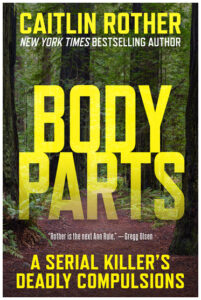
True crime author Caitlin Rother chats with me today about her new book, Body Parts.
Bio:
New York Times bestselling author Caitlin Rother has written or co-authored 15 books. Her next title, DOWN TO THE BONE, about the McStay family murders, comes out in June 2025. The author of narrative non-fiction crime, thrillers, and memoir, Rother also has the first two books in a new series of crime novels coming out in 2026, starting with DOPAMINE FIX (Thomas & Mercer). Her most recent title is DEATH ON OCEAN BOULEVARD, which was optioned by Untitled Entertainment. An award-winning investigative newspaper reporter for 19 years, Rother’s journalism has been published in Cosmopolitan, the Los Angeles Times, The Washington Post, The San Diego Union Tribune, The Boston Globe, Chicago Tribune, and The Daily Beast. Her more than 250 TV, radio and podcast appearances include 20/20, People Magazine Investigates, Crime Watch Daily, Australia’s World News, and numerous shows on Netflix, Investigation Discovery, Lifetime, HLN and REELZ. A popular public speaker, she also works as a writing-research coach-consultant. For fun, she binges on limited series, swims, and plays keyboards and sings in a trio with her partner. Rother earned a bachelor’s in psychology from UC Berkeley and a master's in journalism from Northwestern University. For more information, please visit her website: https://caitlinrother.com
Welcome, Caitlin. Please tell us about your current release.
BODY PARTS takes a deep psychological look at serial killer Wayne Adam Ford. A long-haul trucker,Ford confessed to picking up dozens of prostitutes and troubled women along California roads. Aftertorturing and repeatedly choking and reviving them with CPR during sex, only four of them didn’tsurvive, he said, claiming that was an accident. After dismembering two of his victims, he dumpedtheir bodies in the California Aqueduct and other waterways in Humboldt, Kern, San Joaquin, andSan Bernardino Counties. Ford's complex death penalty case made national news because he is oneof the only serial killers to turn himself in and help authorities identify his victims. He was recentlytransferred from death row at San Quentin to a state prison in San Luis Obispo. Originally released inMarch 2009, this new edition of BODY PARTS has been updated with 32 pages of developmentsabout the identification of Kerry Anne Cummings, Ford’s first victim, whom he dismembered and whowent unidentified for 25 years. If there is such a thing as a happy ending to a book about a serialkiller, this is it. The new material takes the reader through the investigative process involved in solvinga cold case like this one so many years after the fact. Kerry now has her name back and her family has closure after so many years of not knowing what happened to her, and being prevented from reporting her missing to police because she was using drugs. Rother is the first writer to interview theCummings family about Kerry and her troubled life before she went missing in late 1997.
What inspired you to write this book?
I was inspired to write this book because I’d never heard of a serial killer who had turned himself inbefore, and this one made national news because he had a woman’s severed breast in his jacket pocket when he did. I’ve always been intrigued by stories involving mental illness, because I believe that people who are mentally ill are not black-and-white evil, they are complicated and sick. In addition to multiple paraphilias I’d never heard of before I wrote this book, Wayne Adam Ford has many different psychiatric diagnoses. He also had a severe head injury that he suffered when he was a 19-year-old Marine. He was on the side of the freeway, trying to save a car crash victim’s life, when a drunk driver hit him and knocked him 40 feet down an embankment. His family said his personality changed after that. During his recorded interviews with detectives from four different counties up and down California where he dumped his victims’ bodies, I could hear how messed up this man’s mental state was. I didn’t write this book to excuse his behavior, but my research certainly helped me and my readers understand what makes a sexual predator and how they get that way. His brain injury is only one contributor to this man’s psychiatric make-up.
Excerpt from Body Parts:
Kathie Cummings had recently moved from the Seattle area to the small town of Addy in northeastern, Washington, after leaving a job with the University of Washington as the director of operations in finance and research.
The new number Detective Fridley tried for Kathie went to voice mail, so he left her a message, saying that he was calling from the sheriff’s department in Eureka.
Kathie immediately assumed that he was calling about her long-missing sister, Kerry, though she was expecting him to say that Kerry had overdosed, and they had finally identified her. But when they connected, she didn’t mention any preconceived notions. “I let him do the talking,” she recalled.
“I’m calling about an unusual situation,” he told her. “Can I ask if you have any family members who are missing?”
“Yes, I do, my sister.”
“How long has she been missing?”
“Since 1997 or 1996,” Kathie said, feeling a little dizzy from the stress of the call and unable to remember exactly.
“Does your sister have any identifying marks?”
“She has a ring of flowers around her left ankle, a nose piercing, and her ears are pierced.”
“Can you tell me, did your sister ever give birth?”
“Not to my awareness,” she said, but inside, she was thinking, oh, s***. She knew he was talking about Kerry, so she started to panic, jumbling the chronology of events in her mind. There’s a baby out there. No, there’s an adult now.
Just the thought of a baby she never knew about broke her heart, especially not knowing if the child had lived.
“We may have connected her DNA to a close relative,” Fridley told Kathie, clearly trying to be sensitive and careful with his words. “Jeff Cummings, do you know him?”
“Yes, he’s my cousin.”
“I would like to talk to you about what we know, but first we’ll need to get DNA confirmation that the person that we have here matches your sister.”
Hearing that said so directly, Kathie felt faint. “I’d been expecting it, but I hadn’t been expecting it that day,” she recalled.
“What do we need to do?” she asked. “We need to get a copy of your DNA and compare it to the DNA that we have.”
After determining the location of the nearest police agency, Fridley said he would arrange for her to get tested.
Over the next three days, Kathie went even further down the rabbit hole than Jeff had. Not only did she read all the news stories she could find, but she listened to podcasts and downloaded the first edition of this book, published in 2009, on her Kindle.
“When I searched on the internet and all those pages came up with him, I went into complete shock. I never imagined, honestly, that this would be the kind of information and news I would get.”
She had to read this book three times, because she couldn’t absorb all the gruesome details on the first go. “The first time I just read through it, and I could hardly remember what I read, other than a few identifying markers that convinced me that this was the right person. I went back for pieces that I missed, [thinking], what did I read? I just kept going through it.”
She kept wondering why Ford had started off “so gruesome,” by cutting up her sister so violently, but then didn’t do the same thing to his next victims, other than slicing off the woman’s breast that was in his pocket when he surrendered.
“Knowing my sister, she was willing to be intimate with him,” Kathie said. Based on her last conversation with Kerry, when she “was more wasted than any other conversation I’d had with her, I figured she was on something new, so he suggested, ‘Let’s try this,’ and she said, ‘Okay, whatever,’” until she choked, passed out, and died.
What exciting project are you working on next?
My next release (Citadel Press/June 24, 2025) is DOWN TO THE BONE: A MISSING FAMILY’SMURDER AND THE ELUSIVE QUEST FOR JUSTICE. This book is about the McStay familymurders, a family of four who mysteriously disappeared from their house in Fallbrook, California. TheSan Diego County Sheriff’s Department investigated their disappearance as a missing person’s case,despite many red flags that their abrupt absence was abnormal and unexplained, and finally gave up,declaring that they had voluntarily gone to Mexico. Eight months later, the family’s skeletal remainswere found in two shallow graves in the high desert, 100 miles away. The San Bernardino CountySheriff’s Department, which investigated the case as a homicide, quickly focused on Charles “Chase”
Merritt, a business associate of Joseph McStay, the father of the family, and arrested him a year later.
Merritt’s attorneys claimed that their client was a victim of confirmation bias, arguing at trial that a different business associate had the exact same motive but wasn’t even considered a suspect.
Merritt, who was sentenced to death, claims he was wrongly convicted. The book reveals the back story of the two flawed investigations and prosecution, based on Rother’s research and interviews as well as new and exclusive information from the two sheriff’s investigative files that has never been released to the public.
When did you first consider yourself a writer?
I have been writing stories, both real and imagined, ever since I was a teenager. But even after Ibecame a professional investigative newspaper journalist, which was my career for 19 years, I didn’t really consider myself a real “writer” until I published my first book in 2005, a narrative nonfiction book titled, POISONED LOVE, and even more so when I was finally able to publish my first crime novel, NAKED ADDICTION, in 2007. That book took me 17 years to get published, as did my upcoming thriller, DOPAMINE FIX, the first in a new series that will be released by Thomas & Mercer in 2026.
Do you write full-time? If so, what’s your workday like? If not, what do you do other than write and how do you find time to write?
Yes, I’m a full-time author and have been since I quit the newspaper business in 2006. But my workdays are really quite varied, partly because I’ve learned that too much sitting and typing will injure my body and wear out my mind, so I make sure to exercise during the day, even if it’s just several walks around the neighborhood. But practically speaking, my days vary because it really depends on whether I’m working on a fiction or nonfiction book, and whether I have a book coming out soon. Writing a nonfiction book usually takes much longer than fiction, because it requires much more research, and sometimes it can take years to obtain documents I want or need. In addition to the obvious tasks of writing and researching, planning and doing interviews, there are also many other jobs/duties that fall under the umbrella of “author.” They include public speaking, appearing (and preparing for interviews) as a TV/radio/podcast crime commentator, book/writing/research coaching, book marketing and promotions, and blogging. I also spent more than a decade teaching classes and writing workshops, which I no longer have time to do. More recently, I have been spending more time working with TV/film people, from agents to producers and lawyers, reading and negotiating contracts, and talking about ways to tell a story. But when I can spend the day just writing fiction, with nothing else I HAVE to do, it’s pretty fun.
What would you say is your interesting writing quirk?
I’m a perfectionist, which can be pretty annoying to other people, I’m sure, but as a trained newspaper journalist, we were not allowed to make mistakes. I believe that accuracy and integrity are important to my credibility and reputation as a nonfiction writer, and while my storytelling abilities are also important in my nonfiction, they are even more important to my fiction. It’s taken me almost 20 years to get the crime fiction/thriller series contract I had my heart set on at the start, but I now know I had to learn the material and meet the real-life characters before I could write about them.
As a child, what did you want to be when you grew up?
I had no idea, really, but I did want to be a teacher, maybe because my parents were college professors. I always had my head buried in a book.
Anything additional you want to share with the readers?
Authors cannot get anywhere unless they have an audience, so we all very much appreciate you reading and buying our books, and we love hearing from you!