
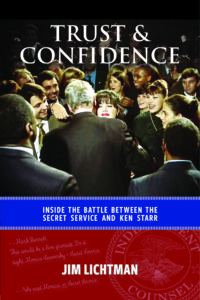
Non-fiction writer Jim Lichtman joins me today to chat about his new political book, Trust and Confidence—Inside the Battle Between the Secret Service and Ken Starr.
Bio:
Jim Lichtman has been writing and speaking on ethics since 1995. Past clients include The Federal Dispute Resolution Conference, Society of Actuaries, Blue Cross/Blue Shield of Rhode Island, Hampton University Honors College, The Penn State Forum, American Bankers Association, and the U.S. Department of State.
Jim’s Op-Eds have appeared in The Philadelphia Inquirer, Chicago Tribune, Houston Chronicle, Huffington Post, Minneapolis Star-Tribune, and The New York Times. Feature stories and appearances include USA Today, The Washington Post, Boston Herald, Weekend Today Show (local New York), National Public Radio’s Weekend Edition, NY-1, and CNN’s NewsNight with Aaron Brown.
Welcome, Jim. Please tell us about your current release.
Trust and Confidence is about an unknown aspect of independent counsel Ken Starr’s investigation of President Bill Clinton in 1998.
While pushing for testimony from Secret Service agents about Clinton’s involvement with White House intern Monica Lewinsky, Starr relied on an anonymous source inside the Secret Service who alleged that Merletti had secretly facilitated the Clinton/Lewinsky relationship in exchange for becoming director. While the allegations were false, Starr and his prosecutors believed the story.
What inspired you to write this book?
In my first interview with former Secret Service Director Lewis Merletti, I was riveted by his story, which led me to a five-to-six-year research effort through the National Archives and numerous interviews to uncover the whole story.
Excerpt from Trust and Confidence:
“An assassination has grave effects,” Merletti emphasized to Ken Starr and his deputy, Robert Bittman, during a presentation. “It’s not like any other murder. It’s a murder that has worldwide implications. Secret Service history has proven that confidentiality affords us the proximity that is critical to the success of our mission. Proximity,”Merletti stressed to Starr and Bittman,“is the difference between life and death to our protectees. If our protectees cannot trust us, if they believe that we will be called to testify before a grand jury to reveal confidences, the president will not allow us that critical proximity.
“I was fighting for two things,” he explained (in our interview). “Number one, I know that it’s trust and confidence in us that allows us proximity to our protectees. And I know that our protection is like a science. You must have proximity because it’s all about cover our protectee, the president, and evacuate him. By cover, we mean stepping in the line of fire, stepping in front of a bullet.
“I can’t outrun a bullet,” Merletti said. “None of us can. We have to have proximity. We can’t do it from across the room. We can’t do it with smoke and mirrors. And we train at it, and train at it, and train at it, so that we can immediately step in front of him.”
Despite the detailed examples in the director’s lengthy presentation, Starr remained unconvinced.
“He was on a mission,” Merletti declared, “and I firmly believe that it was driven in large part by politics.”
Starr then played his trump card.
“Someone at that meeting said, ‘We have information that you,Mr. Merletti,were involved in putting the president in the back seat of a car, covering him with a blanket, taking him out of a White House context, getting Monica Lewinsky there, and allowing them to be alone in a room.’”
Merletti was stunned. “Who told you this?”
“Oh, I can’t tell you that,” Starr said.
“He had some type of information,” Merletti said, “some ‘Deep Throat’ type of information, and he believed this information, and it could not have been further from the truth.”
What exciting project are you working on next?
I’m researching John Gilbert Winant, former U.S. Ambassador to England during World War II, an important political figure who has largely been forgotten by history.
When did you first consider yourself a writer?
As a high school senior, I wrote a book report on Ray Bradbury’s “Fahrenheit 451” and wanted to avoid the typical “I like/dislike this book” style. Instead, I modeled it after book reviews in TIME magazine. My English teacher thought it was a fresh approach for the assignment, and his encouragement likely sparked my interest in tackling self-assigned projects, including op-ed commentaries in newspapers that came much later. (see bio).
Do you write full-time? If so, what’s your workday like? If not, what do you do other than write, and how do you find time to write?
I write commentaries twice a week for my website, ItsEthicsStupid.com. While I typically write on weekdays, my schedule is flexible, allowing me to explore ideas as they come. I’m constantly reading and watching the news and often find issues worth examining from an ethical perspective.
What would you say is your interesting writing quirk?
Even when I’m at a concert, ideas float around, and I scribble some notes.
As a child, what did you want to be when you grew up?
An architect. I liked the design and structure of buildings. However, when I took drafting, I found the math infuriating. In college, I designed a couple of sets for projects, though not for shows.
Anything additional you want to share with the readers?
A few years ago, I realized I was especially drawn to films based on real stories. That’s likely where my fascination with compelling, untold stories began.
Thanks for dropping by Lisa’s blog, Jim. Otherwise, I may not have heard about your book. I like to read about the Secret Service. Good wishes, and happy writing!
Thanks for your interest, Rhonda.
This is my first visit to Lisa’s blog and I’m grateful for the chance to talk about the book to readers.
I encourage to read my twice (sometimes 3) times a week at ItsEthicsStupid.com