
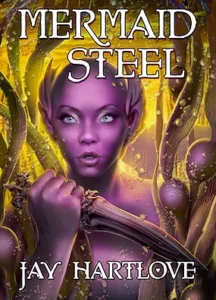
Today’s special guest is award-winning author Jay Hartlove. We’re chatting about his fantasy romance, Mermaid Steel.
Bio:
Jay Hartlove is the multiple award-winning author of the supernatural thriller Goddess Rising Trilogy, about which horror master John Shirley said, “I recommend you buy this crazy novel.”
Jay also wrote the fantasy romance Mermaid Steel, which Kirkus Reviews called, “A thoughtful erotic fantasy that asks us to see the best in each other.”
His latest novel is The Insane God, which David Brin endorsed, and Kirkus Reviews called, “Nightmare on Elm Street meets The Stand.”
Jay also wrote, produced, and directed The Mirror’s Revenge, the musical sequel to Snow White, which had its theatrical run in the San Francisco Bay area in 2018 to rave reviews.
He loves to take stories where the reader does not expect, with sympathetic villains, heroes with very dark pasts, and moral dilemmas for readers to ponder. He often turns victims into heroes. He was selected one of the 50 Authors You Should Be Reading by The Authors Show.
Welcome, Jay. Please tell us about your current release.
A human blacksmith and a mermaid weaver fall in love and must overcome the fear and hatred that divides their neighboring villages. Only by reconciling deep cultural differences can the forbidden lovers bring their peoples back from the brink of war.
What inspired you to write this book?
The book is about racism and cultural appropriation. I had been wanting to do world building for a mermaid society for a while. I was working on wrapping up my Goddess Rising thriller trilogy and I was anxious about getting everything to work for the finale. I was so nervous I took time off to get out of my head. I wrote Mermaid Steel, which is a different genre, to clear my thinking. I usually plot extensively in advance. To make this book a bigger challenge, I wrote it seat-of-the-pants, publishing each chapter online as I finished it. That way I couldn’t go back and change anything. I had to just keep moving forward. When I got to the end, I was pleasantly surprised the story worked, and I loved the characters. So, I went back and included everything I had thought of in the meantime, and made it into a complete novel. I think it is unique in that it shows as much of life underwater as above. Mermaid stories usually take place above water and I always thought you miss out not showing what life is like for them. It is also a romance that shows as much from the male point of view as the female. They have a lot going against them. Everything is different: their food, their religion, their worldview, their music, even their anatomies. Their villages are on the brink of war due to suspicions and prejudice. The only way they succeed in bringing their peoples together is by learning from each other.
Kirkus Reviews called it, “A thoughtful, erotic fantasy that asks readers to see the best in one another.”
From the front cover flap:
“Somebody’s got to stand up for what’s right. Bind him!” The men grabbed ropes and tied his arms to his body and his feet together. Sten was undeterred. “Look at me, Selric. I’m standing tall after defeating you in single combat. You’re crippled up and need to turn your sailors into lackeys to do your dirty work for you. I’m diving to the ocean floor, trying to find a peaceful solution, looking to the future. You know why I’m not afraid of you, and why you slink out here like a thief? Because I’m right. My righteousness makes me invincible. “The men all stepped back, and Boole clenched his fists and turned bright red around his bandages. “That’s right, I’m quoting scripture. I am living the Atlantean ideal. I am seizing every moment for the betterment of all. “Boole screamed and threw down his crutches. He staggered up to Sten, attempting a string of insults that just came out as furious gibberish. “Taunt me with Atlan! Go die with the damn fin where you belong! ” He threw his arms around Sten’s waist and picked him up while driving him backwards and over the edge. Sten was surprised but not disappointed. “You’re going to kill a tied-up prisoner? What a coward!” He had half hoped Boole would lose control and commit a real crime. As he went over the side, Sten saw Boole’s men were shocked as well.
What exciting project are you working on next?
I am writing a fantasy called The Dove and the Crow about a woman who falls into a parallel world and finds her experience with abuse shows her how to help heal her new broken world. A lot of my stories turn victims into heroes. This one does that more clearly than most. I’m a hundred pages into it, and I am having a ball.
When did you first consider yourself a writer?
I wrote one of the first superhero tabletop RPGs called Supergame in 1980. I ran playtest sessions for years perfecting the game, and then ran hundreds of sessions marketing it at game stores and gaming conventions. I realized I was enjoying the storytelling as much as the game itself. By 1984 I had written my first novel.

Do you write full-time? If so, what’s your workday like? If not, what do you do other than write and how do you find time to write?
I have a day job career and I only write part time. It takes me about two years to write an 80,000-word novel. I joke that my muse is named Eleven, because I usually start writing at 11 at night. There is no such thing as finding time to write. You make time to write by choosing to not do other things, like watching TV or going to bed early. It’s a job, the job you chose because you love it, and you have to show up to work.
What would you say is your interesting writing quirk?
Everyone has a method. This is mine. I write in iterative expansions. I will get an idea and jot it down. Then I’ll think about it some more and rewrite it into two or three pages of notes. I keep doing this, adding the answers to lots of what-if questions. By the time it’s ten pages I will have main characters and their background and a conflict worked out. I will then decide if it is worth prioritizing time to really work on it. Maybe it will go onto the shelf for later. Maybe it will go straight onto the “front burner.” By the time it’s twenty pages, I have started ordering a sequence of events, telling the story. I could show someone the twenty-page version and they could see what story I am trying to tell. At that point I will take a step back and decide what the story is about. I will develop a back cover blurb to use as a mission statement for the project – the target state of what I am trying to say. By the time I have started filling in secondary characters and subplots, it’s usually 30 to 40 pages, and then I will start writing the prose first draft. I will of course think of lots of things along the way. So it is not a rigid outline, but it is the accumulated decision making that I want to include.
As a child, what did you want to be when you grew up?
I was raised to believe we are here to make a difference. I was educated to be a scientist. Although I am competent at experimental design and research, my real abilities are to explain complicated things in understandable terms. So I write technically (in finance) as a career and I write science fiction on the side.
Anything additional you want to share with the readers?
Books should be about something. If I’m going to spend two years of my free time on a project, then I should make sure I have something to say to my readers. Even simple stories should be about something that makes an impact, like revenge, or redemption, or the value of loyalty. It doesn’t have to be complex to make an impression on your reader. Winnie the Pooh stories are about the value of teamwork. War and Peace is about making realistic decisions. A well-written back cover blurb should tell you what the story is about, not necessarily what happens in the story, but rather what makes this story different than its competition.